The Orthodox world has abandoned its values by abandoning Palestinians
We must correct the course for the sake of Israelis and Palestinians alike — and the sake of Judaism itself
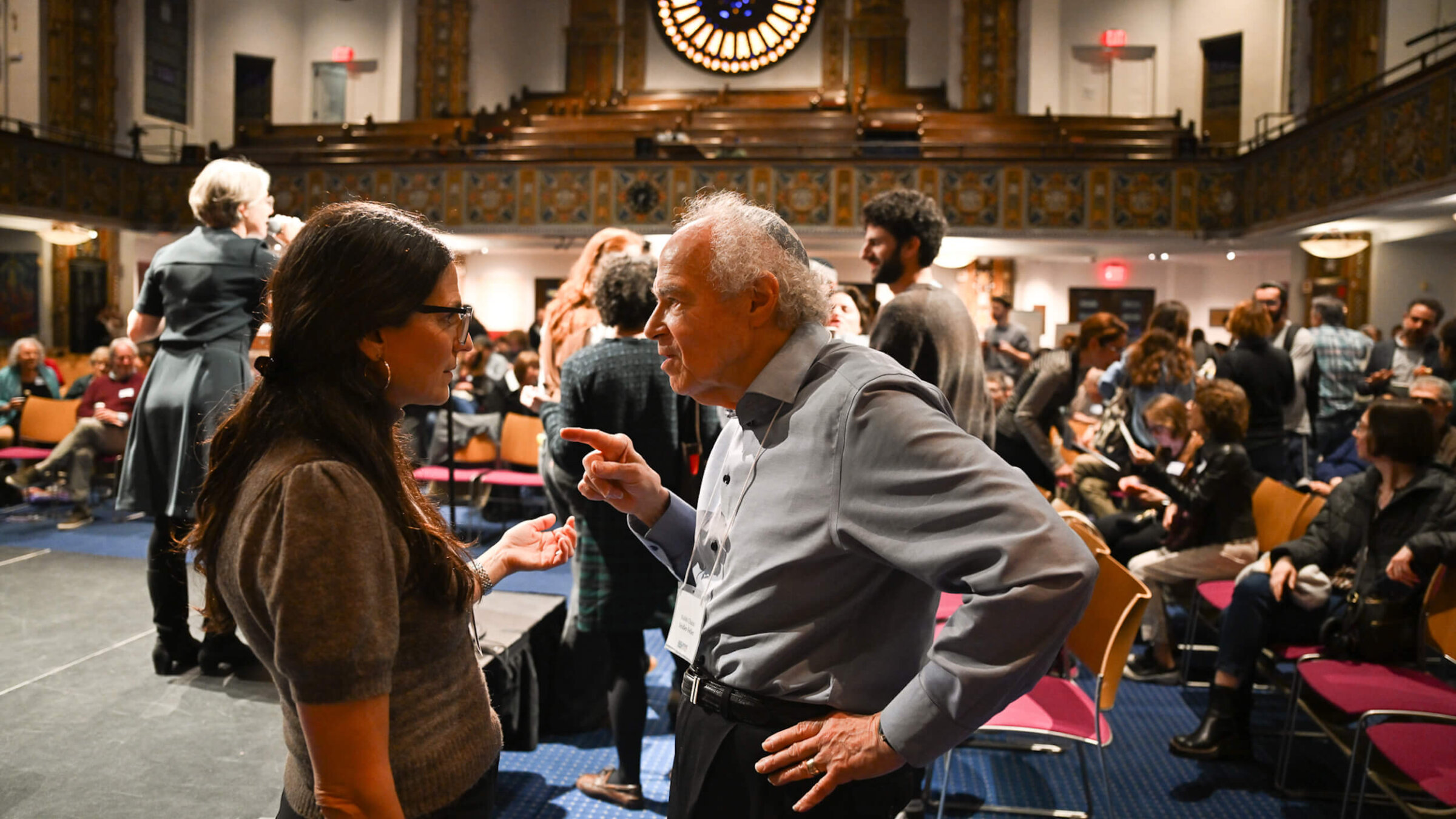
Participants in discussion at Smol Emuni’s recent conference. Photo by Gili Getz
In parts of the Orthodox world, racist rhetoric has been normalized.
Rabbis speaking from the bimah refer to Palestinians as Amalek. Calls to block humanitarian aid are incorporated into divrei torah. One might hear that “Smotrich, Ben-Gvir and their parties speak for the great majority of the religious Zionist community” — a terrifying normalization of religious extremists — or even that the Palestinian people do not exist.
We know where this kind of rhetoric leads. After undercover Israeli border police killed four members of the Bani Odeh family as they drove home from a shopping trip in Nablus in mid-March, one of the two surviving sons recounted being pulled from the car and beaten by a soldier who told a friend, “we killed the dogs.” That boy is only 11 years old; he will live the rest of his life with the memory of seeing his parents and two of his siblings killed in front of him.
The scale of Palestinian suffering in Gaza and the West Bank cannot be justified or ignored. However, in much of the American Orthodox and observant Jewish community — of which both of us are proud members — this pain is barely acknowledged, let alone condemned.
We know that these are deeply painful times for Israelis, who have endured two years of terror, fear and loss. But we believe our community has a moral imperative to empathize with Israelis and Palestinians alike — not one at the exclusion of the other.
The silence we see in our communities is neither incidental nor neutral. It is structural and communal, reinforced by political and institutional pressures.
Our tradition teaches “shetikah ke-hoda’ah” — that silence is tantamount to approval. We have seen this truth manifest in our modern world, through political upheavals like the #MeToo movement and the continuing Jeffrey Epstein scandal. These moments have proven that silence in the face of known misdeeds is not neutral.
Yet even with this clarity, too many forces in our community currently push for silence when it comes to the suffering of Palestinians. Among them are demands by funders who see supporting Israel as inconsistent with holding empathy for Palestinians, and cultural norms that suggest unquestioning support for Israel is a central principle of contemporary Orthodox life.
This communal silence allows us to ignore scathing reports of Israeli human rights and international law violations, including many issued by Israeli nonprofits such as B’Tselem, Physicians for Human Rights Israel, Yesh Din and Peace Now.
What fills that vacuum should alarm anyone committed to principles of humanity and basic decency.
As Rabbi Chaim Seidler-Feller warned at a recent conference organized by Smol Emuni, the Orthodox left group we co-founded, if we cannot speak against Israeli war crimes or settler violence “it appears as if Judaism supports the massacre of innocents, the stealing of land and sheep, the burning of homes, the uprooting of olive trees, and the murder of children.”
Our tradition has been distorted by those, like Ministers Itamar Ben-Gvir and Bezalel Smotrich, who speak the language of revenge and supremacy.
Now, more than 900 days after the Hamas attack of Oct. 7, it is time for the Orthodox community to refocus on the heart of our tradition. We must answer the biblical question: What does God demand of us right now?
How do we, as religious Jews, respond to horrific violence perpetrated by Jews? How do we face this historical moment in which Jewish people have killed more civilians than ever in modern history?
The horror inflicted on the Bani Odeh family is not an isolated incident. It is part of a sharp escalation of Israeli military and settler violence against Palestinians in the West Bank. In March to date, seven Palestinians have been killed by Jewish extremists. That’s on top of the more than 68,000 people killed in Gaza during the war, including at least 20,000 children. (The total estimated death toll in Gaza includes both combatants and civilians.)
Where are the public reckoning with Jewish-led violence, and the demand for moral accountability? The sermons, communal statements, the school assemblies? Why aren’t rabbis invoking the most basic commandments: “thou shalt not kill,” “thou shalt not steal”?
Where is the Torah that teaches that every human being is created in the image of God? The Torah that commands us to “do justice, love kindness, and walk humbly before God”?
In many Jewish spaces, we acknowledge Jewish suffering, condemning Hamas, Iran, Hezbollah and antisemitism. But a moral and religious life demands that we ask not only what has been done to us, but what wrongs we have done to others.
We must create more communal spaces for pain to be heard and questions to be raised, a reprieve from the isolation many of Orthodox Jews horrified by Israel’s abuse of Palestinians experience in our communities. We must elevate voices within our tradition that reflect a different set of values, values centered on humility and compassion and a commitment to share the land with all those living on it. For every rabbinc teaching that celebrates force, we must quote others sources that demand kindness. When we hear “He who is kind to the cruel will become cruel to the kind,” we must answer “Walk in God’s ways — just as God is merciful, so too you must be merciful.”
And we must learn to listen to the voices of people on all sides of this conflict, even those that are unsettling. Because without hearing from others we cannot learn to live with them.
We co-founded Smol Emuni U.S. as a grassroots movement for those who share a deep commitment to and love for the land and people of Israel, and who believe in the essential Jewish principle that all humans are created in the image of God. We see the pursuit of justice and equality as an essential expression of Judaism. As Rabbi Mikhael Manekin, founder of HaSmol HaEmuni in Israel, often says “we are ‘smol’” — Hebrew for “left” — “not despite our faith, but because of it.”
Decades of occupation, ongoing war, and the erosion of Israeli democracy have not only strained Israeli society but strained Judaism itself. We need, in response, to invest in an Orthodox Judaism that is brave enough to be humble, and faithful enough to be self critical. We need a Judaism for those seeking an authentic Torah vision that insists that justice, equality and human dignity are not departures from our tradition, but its very core.
We need to pursue justice and teshuva returning to God’s call to “swerve from evil, to do good, and to pursue peace.”
This is a moment of great uncertainty. Here’s what you can do about it.
We hope you appreciated this article. Before you go, we’d like to ask you to please support the Forward’s independent Jewish news this Passover.
This is a moment of great uncertainty for the news media, for the Jewish people, and for our sacred democracy. It is a time of confusion and declining trust in public institutions. An era in which we need humans to report facts, conduct investigations that hold power to account, tell stories that matter and share honest discourse on all that divides us.
With no paywall or subscriptions, the Forward is entirely supported by readers like you. Every dollar you give this Passover is invested in the future of the Forward — and telling the American Jewish story fully and fairly.
The Forward doesn’t rely on funding from institutions like governments or your local Jewish federation. There are thousands of readers like you who give us $18 or $36 or $100 each month or year.
Support our mission to tell the Jewish story fully and fairly.