My childhood echoes in newly released Shoah recordings
The New York Historical is exhibiting recordings made by Claude Lanzmann as he was researching his film, ‘Shoah’
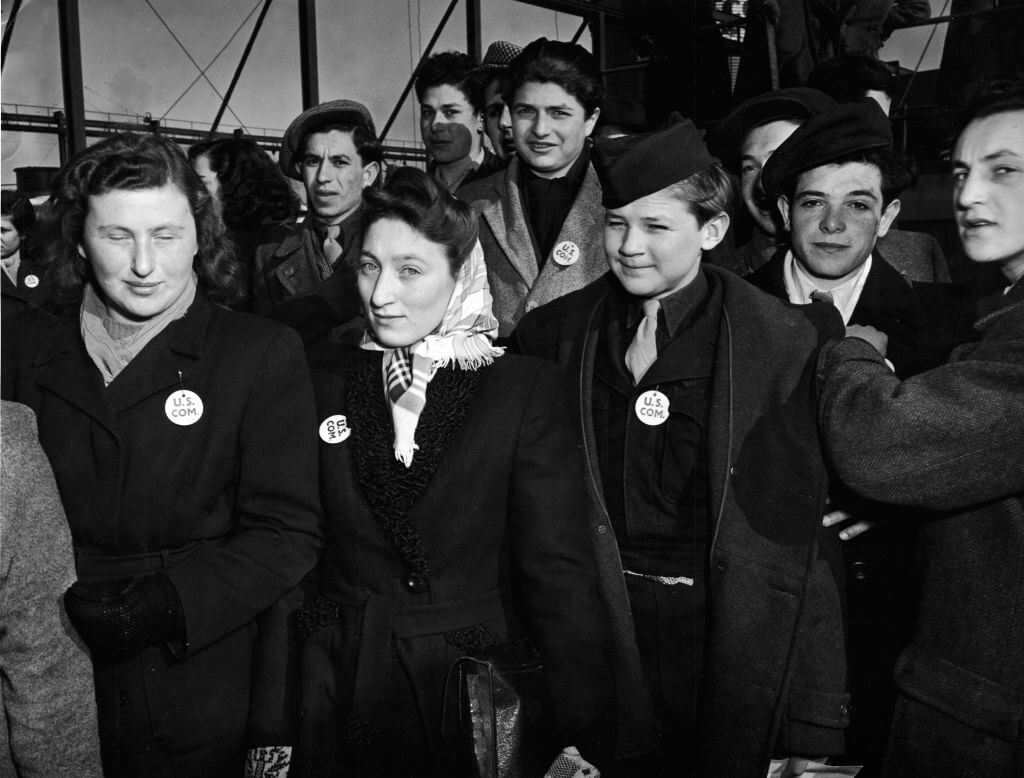
A group of unidentified children and young adults stands on the deck of the S.S. Marine Perch as it arrives in the United States bringing immigrants and World War II refugees from Europe, to New York, likely February 1947. Photo by FPG/Getty Images
In response to coverage of ‘Voices of the Shoah Tapes’.
In the New York of my childhood, each year’s change in seasons, from winter to spring, meant renewed memories of the Holocaust as the adults in my neighborhood swapped long sleeves for short, and the numbers burned into the flesh of more than a few of their arms were laid bare for all to see. Observing the awful evidence of the Nazi program to exterminate the Jews, in hushed tones, my friends and I would trade stories we’d heard about first wives, first husbands, and first sets of children that our classmates’ parents and grandparents lost in mass executions and concentration camps in Europe during World War II.
Awful as the Holocaust was to us and humbled as we were by the courage and defiance of the survivors who made no effort to cover up their arms while sunbathing at our local swimming pool, as children often do, we indulged in gallows humor about the terrible events that brought these refugees to our neighborhood.
A favorite of ours was imitating a question we’d been told many former Nazis asked after the Nazi defeat, responding to accusations of collaboration in the Holocaust. “There vas a var?” we’d ask one another, giggling, in our best reproduction of German-accented English, trying to sound the way we imagined culpable Germans might sound while screwing up our faces in exaggerated disbelief, just as we’d heard many former Nazis did to prove how they, personally, had nothing to do with the genocide.
These childhood moments came back to me as I listened to the tapes Claude Lanzmann recorded while doing research for his epic film, Shoah. The tapes have been made available to the public for the very first time, in two Shoah anniversary exhibitions, at the Jewish Museum Berlin and at The New York Historical in New York.
The tapes capture perpetrators and bystanders getting all bolloxed up in justifications, self-serving claims, deflections of guilt — including blaming the Jew victims — and efforts to extract themselves from culpability. On one of the tapes, a former SS man responds to a request for comment on the killing of Jews: “No, that’s over for me!” I thought of the jokey question of my youth – “There vas a var?” – which made pretty much the same point.
Perhaps because of my experience growing up in a New York that gave refuge to those whose scars went well beyond the numbers on their arms, branding them like cattle, it was obvious to me why Lanzmann’s tapes belonged in an exhibition in New York. It was New York’s hospitality to refugees that allowed the Holocaust survivors I knew to build new lives and new families.
But many who learned of The New York Historical’s decision to offer this unique audible Holocaust history coincidentally with the Jewish Museum Berlin, which owns the tapes, were perplexed, asking me why an institution focused on New York and American history would mount an exhibition of Lanzmann’s recordings.
In spite of the connection I felt to the history Lanzmann’s tapes told, my response was not personal. Listening to the tapes illustrates a universal point: the ease with which hatred of a people based on their religion can sink its roots in any society, and the dangers of underestimating this power.
Set against the backdrop of the rise of antisemitism today, the tapes, which record the voices of victims like the parents and grandparents I knew, provide a vital history lesson to a new generation, showing how quickly the belief that Jewish people and their faith are the problem can find its way into a nation’s political consciousness, and how that mindset can ultimately fuel violence on the world stage.
There are, as well, the moral questions raised by the rise of the Nazis in Germany, which transcend geographical boundaries and fall squarely on the permanent agenda of institutions like The New York Historical, which look to the lessons of history as a way of encouraging contemporary audiences to reflect on their own roles and responsibilities, as well as those of institutions like The New York Historical when confronted with injustice.
There is also a direct connection between the antisemitism in Europe that promoted the extermination of Jews, and the history of New York. Who could fail to recognize the enormous impact of those who fled Europe in the wake of Nazism on the city’s cultural institutions, its colleges and universities, its scientific institutions and organizations?
A whole “University in Exile” was founded in New York with some of Europe’s most notable Jewish scholars as faculty; Jewish artists and musicians formed the bedrock of our city’s modern art museums, institutes, conservatories and concert halls in the 1930s and 40s.
Finally, and above all, the tapes underscore the old adage about the importance of history: how it is impossible to understand who we are without knowing from where we came. The tapes offer an incomparable opportunity to convey, especially to young people, how a significant part of our city’s demographic came to be in New York; how this demographic, like so many others in our city right now, sought the basic right to live without fear or threat of violence because of ethnicity or religious belief.
Listening to the Lanzmann tapes in both the context of today’s debates about whether people displaced by violence around the world should be offered refuge in the United States, and as we prepare to celebrate the nation’s semiquincentennial in 2026, reminds us not only of the importance of testimony and of preserving voices from the past, but of who we are as Americans and what responsibilities our democracy gave us 250 years ago. Let this extraordinary audible history be a guide.
This is a moment of great uncertainty. Here’s what you can do about it.
We hope you appreciated this article. Before you go, we’d like to ask you to please support the Forward’s independent Jewish news this Passover. All donations are being matched by the Forward Board - up to $100,000.
This is a moment of great uncertainty for the news media, for the Jewish people, and for our sacred democracy. It is a time of confusion and declining trust in public institutions. An era in which we need humans to report facts, conduct investigations that hold power to account, tell stories that matter and share honest discourse on all that divides us.
With no paywall or subscriptions, the Forward is entirely supported by readers like you. Every dollar you give this Passover is invested in the future of the Forward — and telling the American Jewish story fully and fairly.
The Forward doesn’t rely on funding from institutions like governments or your local Jewish federation. There are thousands of readers like you who give us $18 or $36 or $100 each month or year.
Support our mission to tell the Jewish story fully and fairly.