Why the Super Bowl antisemitism ad uses a familiar slur
The Blue Square Alliance Against Hate explains the research underlying its new ad campaign focused on allyship
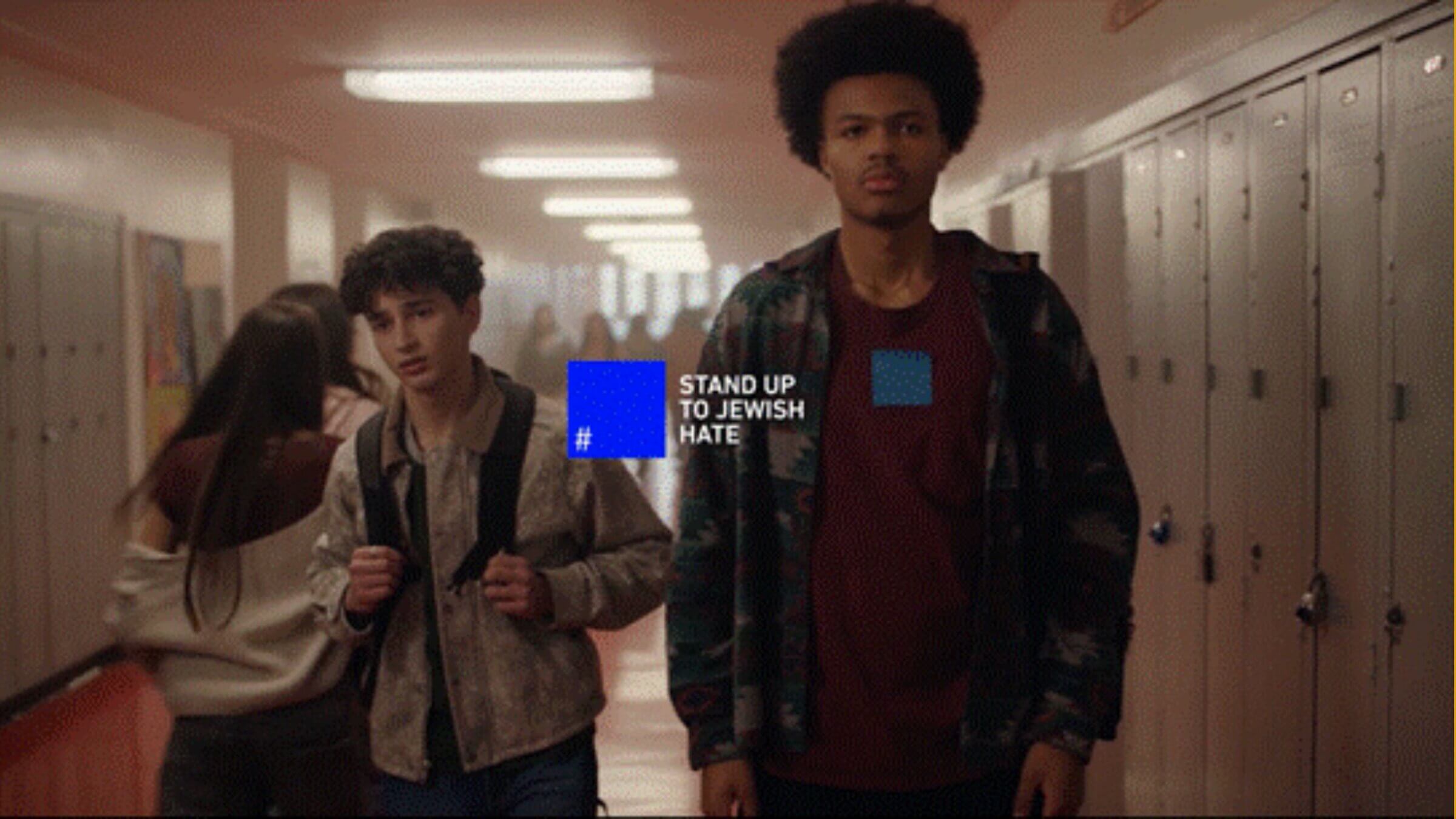
The Blue Square Alliance Against Hate’s new Super Bowl ad. Courtesy of Blue Square Alliance to End Hate
To the editors:
The sticky note cruelly slapped on a high school student’s backpack didn’t have to say “Dirty Jew.”
It could have been any one of dozens of other antisemitic slurs, and believe me, throughout my life and current line of work, I’ve seen and heard them all. At the Blue Square Alliance Against Hate, our Command Center closely tracks the spread of antisemitism online, in all its pernicious forms.
In his piece for the Forward about our new Super Bowl ad, PJ Grisar argues that the ad misses the mark by using “Dirty Jew,” characterizing it as old-fashioned and out of touch with the heavily coded, meme-driven ways students typically express antisemitism today.
We’ve seen all of those slurs gaining traction among younger people that Grisar gave as examples of how kids hate today.
But we didn’t pull “Dirty Jew” out of the history books. In creating the ad, the Blue Square Alliance made a conscious decision to follow the research. Our decisions are based on data, from the one billion social media posts we analyze daily, to our semi-annual 7,000-participant survey on American sentiment toward Jews and antisemitism, to our multi-stage audience testing that is foundational to our creative development.
Here’s the hard data: With nearly 500 million social media impressions since 2023, “Dirty Jew” is a slur that has managed to penetrate all corners of American discourse. Worse yet, its usage online has increased by 174% in the past three years, growing at a significantly higher rate than other slurs. And sadly, the last few years have seen more than a few disturbing and real incidents of the scenario in the ad play out in real life. In U.S. high schools. Right now. Not 1950.
This data-guided approach drove our selection of “Dirty Jew” among all the possible antisemitic slurs as the one to appear on the sticky note. Even though at first glance this phraseology may seem dated, it’s actually timeless and ubiquitous — scarily — and is even outpacing other slurs in frequency of use.
So, whether you’re a Boomer, Millennial or Gen Z, there’s no subtlety to what this ad is showing you: This is antisemitism, pure and simple. And, as Grisar acknowledges in his piece, the challenge of storytelling within a 30-second ad window requires a clear, unambiguous message. In that short time, clarity beats complexity.
It was also important to us to use the high school setting and focus our ad on a younger demographic because that is where we have seen the most concerning trends in antisemitism data. Our most recent survey data shows that Gen Z is three times more likely to witness antisemitism than older generations, and yet nearly twice as likely to say it is not a problem.
At the heart of this campaign is Blue Square Alliance’s dedication to addressing another data point: More than 100 million Americans say they are unengaged in the collective effort to stand up against anti-Jewish hate. We have spent the past few years closely studying this segment, and our surveys show that unengaged Americans often don’t know Jewish Americans, they aren’t familiar with antisemitism (their news feeds and social feeds don’t share the awful stories that we all know too well), and they don’t think antisemitism is a significant problem. Importantly, they don’t feel personal or societal pressure to be an ally.
That’s exactly why we’re using the Super Bowl — a cultural touchstone for the entire country — to raise awareness and model allyship. We test all of our ads, including “Sticky Note” and our earlier ads like “Tony,” specifically with this target audience. What we’re seeing is promising.
Among the unengaged, exposure to our messaging measurably shifts attitudes: Viewers become 36% more familiar with recent antisemitic incidents and 41% more likely to see antisemitism as a major problem in the United States. And the impact doesn’t stop at awareness — it moves people to act. After seeing our ads, unengaged viewers are 27% more likely to say they would speak up when they witness antisemitism.
And our work to cultivate allies extends far beyond the television screen. We complement our social media, outdoor and audio campaigns with on-the-ground bridge-building to strengthen connections with Americans across communities and reach those who have not yet been meaningfully involved in this issue. Over the past year, we’ve expanded our programs to bring more people into the conversation, like our partnership with UNCF and Hillel International, now on a 14-stop “Unity Dinner” tour, to connect Black and Jewish students on campuses nationwide. And last fall, we joined with the Appeal of Conscience Foundation to launch “Stand Up Sunday,” an interfaith effort that mobilized hundreds of thousands of congregants across the nation to reject antisemitism and all faith-based hate.
Our founder, Robert Kraft, created the Blue Square Alliance Against Hate in 2019 because he recognized that reversing the rise in antisemitism would require both awareness and empathy.
With “Sticky Note,” we’re showing what it means to be an upstander and giving Americans a clear, accessible way to step off the sidelines. We won’t simply win over the unengaged through displays of toughness and bravado alone, as some people have suggested. To reach the unengaged majority, you have to meet them where they are — not where we, as a deeply committed Jewish community, already stand.
This is a moment of great uncertainty. Here’s what you can do about it.
We hope you appreciated this article. Before you go, we’d like to ask you to please support the Forward’s independent Jewish news this Passover. All donations are being matched by the Forward Board - up to $100,000.
This is a moment of great uncertainty for the news media, for the Jewish people, and for our sacred democracy. It is a time of confusion and declining trust in public institutions. An era in which we need humans to report facts, conduct investigations that hold power to account, tell stories that matter and share honest discourse on all that divides us.
With no paywall or subscriptions, the Forward is entirely supported by readers like you. Every dollar you give this Passover is invested in the future of the Forward — and telling the American Jewish story fully and fairly.
The Forward doesn’t rely on funding from institutions like governments or your local Jewish federation. There are thousands of readers like you who give us $18 or $36 or $100 each month or year.
Support our mission to tell the Jewish story fully and fairly.