The tragic fate of a young Jewish children’s orchestra in 1933
This rare glimpse of a happy moment in prewar Jewish community life offers no hint of what lay ahead
Graphic by Angelie Zaslavsky
It’s 1933. A group of young Jewish schoolchildren in Kovno (Kaunas), Lithuania, is getting ready to perform a concert on the radio. It’s easy to imagine their excitement, knowing that their playing will be heard by listeners throughout the city and beyond.
Ordinarily, a concert by a children’s orchestra — an event which was written up in a Yiddish newspaper in Kovno that year — wouldn’t be worth singling out for comment. But this was no ordinary event. Of Kovno’s pre-Holocaust Jewish population of 35,000-40,000, only around 2,000 survived the war. These children, whose talent and enthusiasm leap vividly off the newspaper page, very likely didn’t live to become adults.
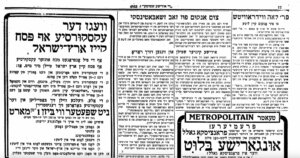
From a passing reference in the article, this seems to have been the first performance by Jewish children ever done for Kovno Radio. The 1930s were the “golden age” of radio, but 1933 was still relatively early — especially in Lithuania, where the first radio broadcast had taken place only in 1927. To these children, radio would have been thrillingly cutting-edge.
A kazoo orchestra
Most of the children were pupils at the “Harmonious Children’s World” kindergarten, and ranged from 4 to 6 years old. Several were a little older, though probably not more than 7 or 8. They performed in what the article calls a “noise orchestra” — likely made up of kazoos (or something similar), whistles, rattles and other simple percussion instruments. Among several named pieces, they played a version of a Haydn symphony. One child, presumably from the slightly older group, performed a trumpet solo. Whoever wrote the “review” said he was impressed by how well such tiny people handled their instruments, and how intuitively they seemed to understand the rhythm and structure of the music.
The kids also sang songs in Lithuanian and in Yiddish. Poignantly, the reviewer noted that they sang in Lithuanian with “a perfect accent.” One of the Lithuanian pieces was a translation of a Hebrew song for children (the title is not given). The Yiddish tunes included “Carousels,” “Yidn-Shmidn” and “The Night-Princess.” Some of the children had excellent voices.
Robert Duff, professor of the practice of music and choral conductor at Brandeis University, told the Forward that he heard about that radio concert. “I spent several days in Kovno on a performance tour of the Baltics back in 2017. Our tour guide was a musician herself and she told our group about this 1933 radio performance by the Jewish children. So it’s still being discussed among Lithuanian musicians.”
A bright future cut short
The most heart-rending observation in the article wouldn’t have seemed particularly remarkable to the author: He was pleased to see musical knowledge and skill already being developed in such small children. The implication was that this early immersion would stand them in good stead throughout their lives. But more than likely, these children never heard any music after 1941, when Kovno was occupied by German forces. By the time the city was liberated on Aug. 1, 1944, 95% of its Jews were gone. These children, between 4 and 8 in 1933, were probably all murdered as teenagers.
The world is a quieter place without the music they might have made.
This is a moment of great uncertainty. Here’s what you can do about it.
We hope you appreciated this article. Before you go, we’d like to ask you to please support the Forward’s independent Jewish news this Passover.
This is a moment of great uncertainty for the news media, for the Jewish people, and for our sacred democracy. It is a time of confusion and declining trust in public institutions. An era in which we need humans to report facts, conduct investigations that hold power to account, tell stories that matter and share honest discourse on all that divides us.
With no paywall or subscriptions, the Forward is entirely supported by readers like you. Every dollar you give this Passover is invested in the future of the Forward — and telling the American Jewish story fully and fairly.
The Forward doesn’t rely on funding from institutions like governments or your local Jewish federation. There are thousands of readers like you who give us $18 or $36 or $100 each month or year.
Support our mission to tell the Jewish story fully and fairly.