Teens, seniors explore Ashkenazi traditions at Yiddish New York festival
This year’s festival had over 100 speakers, 700 participants and 200 workshops and sessions on various aspects of Yiddish culture.
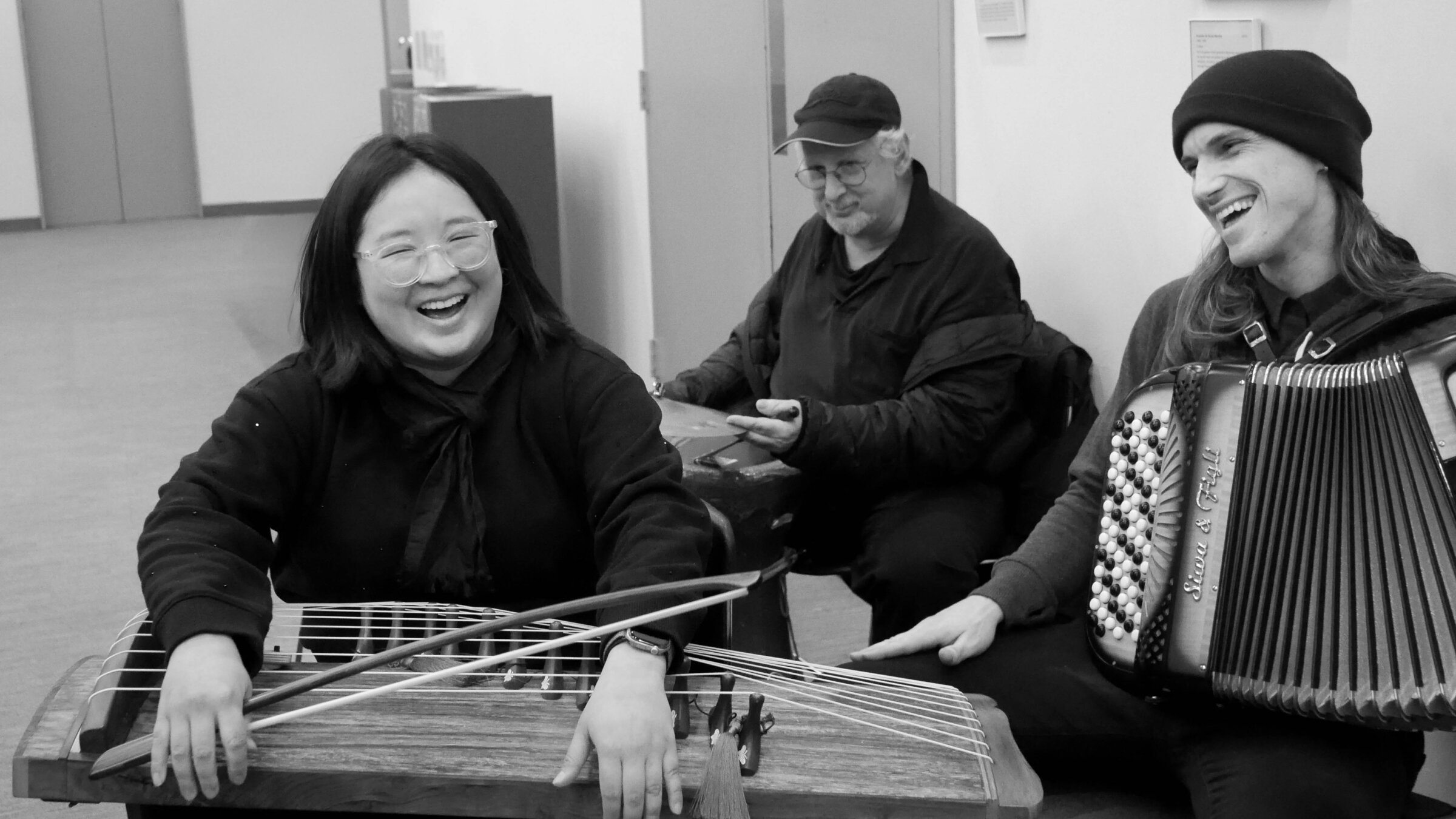
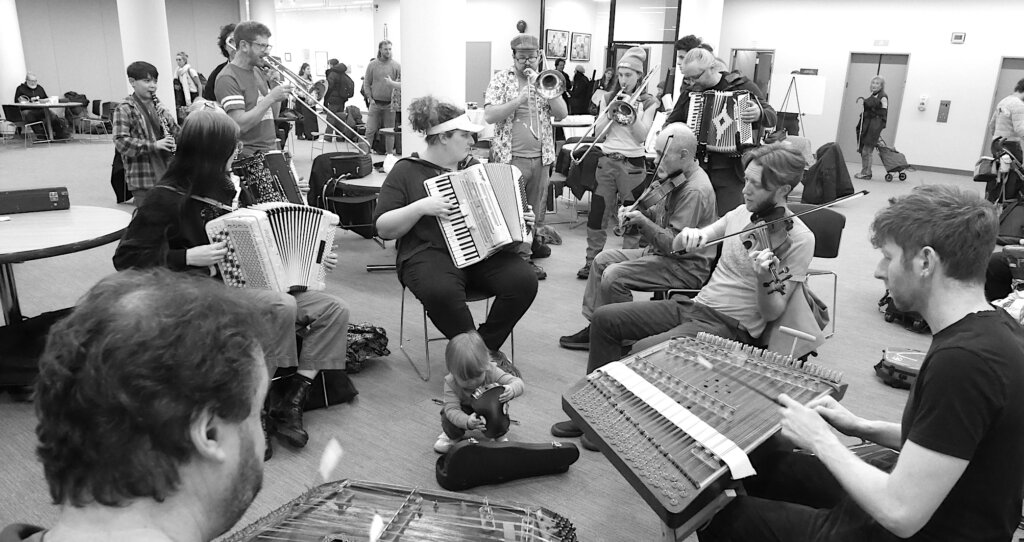
Festival participants during an informal klezmer jam session at Yiddish New York, in lower Manhattan Photo by Lloyd Wolf
A group of klezmer musicians was jamming in Lower Manhattan, when its fiddler suddenly stopped and encouraged a preteen clarinetist to lead a tune. After a moment, the young musician began playing a traditional Yiddish dance melody known as “der shtiler bulgar,” and the other musicians joined in.
This was one of many scenes at the 11th annual Yiddish New York festival that took place last month at the New York City campus of Hebrew Union College.
The size of the festival was impressive: Over 100 speakers, 700 participants and 200 workshops and sessions on various aspects of Yiddish culture.
Yiddish New York began after KlezKamp, a storied Yiddish cultural festival that had been held in the Catskills for three decades, made its decision to shut down. “It was 2014 and KlezKamp had announced its last festival,” said Pete Rushefsky, executive director of the Center for Traditional Music and Dance and one of the lead organizers of Yiddish New York. “A bunch of us got together and said ‘we can’t bear to face the world without our Yiddish festival.’”
Now that the college has announced the sale of its Manhattan campus to nearby New York University, the five-day festival will be searching for a new home for 2026. “We’re going to have to find a new venue,” said Rushefsky. “It will be a challenge we will have to overcome. I’d love to see a residential component moving forward — I think there’s an interest.”
When he wasn’t helping out with administrative tasks, Rushefsky spent much of the day behind a tsimbl (an Eastern European hammered string instrument with a long history in the klezmer tradition), leading informal klezmer jams.
The festival’s offerings were wide-ranging within the scope of Yiddish culture: practical workshops, lectures, concerts, film screenings and informal music jams. And, of course, plenty of schmoozing.
Concerts included an evening of music by the versatile Yiddish playwright and performer Mikhl Yashinsky whose setlist included original Yiddish tradaptations (adapting a text from one language to another to make it culturally relevant for a new audience) of Tom Lehrer’s “Hanukkah in Santa Monica” and Bob Dylan’s “With God on Our Side.” Yashinsky also performed, together with a group of collaborators, several original songs and scenes from his Yiddish stage works Feast of the Seven Sinners and The Gospel According to Chaim.
Cantor Sarah Myerson and Dr. Avia Moore led a Yiddish Dance Fellows program featuring four fellows from around the country: Hannah Mira Friedland (Chicago), Sarah Horowitz (Albuquerque), Yael Horowitz (NYC), and Rachel Linsky (Boston). All were already leading, teaching and in some cases even choreographing Yiddish dance in their communities.
But the training that Myerson and Moore gave them wasn’t just about learning dance steps. They also role-played typical scenes where dance sessions might not go so smoothly. “Avia and I offered the most common ‘disruptions’ we experience on the dance floor: ignoring the leader, talking loudly, doing the wrong steps, etc. The fellows adjusted with generous grace!” Myerson said.
There were also programs for younger audiences. Teens learned about a 1950s music group, the Jewish Young Folksingers, affiliated with the International Workers Order, a mutual aid organization targeted during the Second Red Scare. Yiddish folk singer Ethel Raim, who was a part of the Jewish Young Folksingers herself, taught songs from the group’s history and shared her experiences in it. On the last day of the festival, the teens presented a skit based on all they had learned.
“It was really exciting to have that many generations in one room; we were spanning almost eight decades,” said Ozzy Gold-Shapiro, one of the teen program’s organizers. The youngest was 10; the oldest — in her eighties. “I was especially moved watching the Teen Program kids express and perform their version of cultural exploration and participation,” said Raim, who is herself in her 80s.
On the last evening of the festival, people gathered for the awarding of the 14th “Adrienne Cooper Dreaming in Yiddish Award” to musician and researcher Michael Alpert, known affectionately by his Yiddish name, Meyshke. Cooper, a singer and Yiddish cultural activist who passed away in 2011, played a leading role in the contemporary revival of Yiddish music.
“I was inspired and touched by Adrienne’s ability to make the Yiddish tradition accessible,” Alpert said. “There was a time when I thought I’d be the last person in the world who knew how to sing old Yiddish ballads and obviously that’s not the case. The younger cohort of this remarkable intergenerational community is one of the great joys of my life.”
This is a moment of great uncertainty. Here’s what you can do about it.
We hope you appreciated this article. Before you go, we’d like to ask you to please support the Forward’s independent Jewish news this Passover. All donations are being matched by the Forward Board - up to $100,000.
This is a moment of great uncertainty for the news media, for the Jewish people, and for our sacred democracy. It is a time of confusion and declining trust in public institutions. An era in which we need humans to report facts, conduct investigations that hold power to account, tell stories that matter and share honest discourse on all that divides us.
With no paywall or subscriptions, the Forward is entirely supported by readers like you. Every dollar you give this Passover is invested in the future of the Forward — and telling the American Jewish story fully and fairly.
The Forward doesn’t rely on funding from institutions like governments or your local Jewish federation. There are thousands of readers like you who give us $18 or $36 or $100 each month or year.
Support our mission to tell the Jewish story fully and fairly.