Strong start for Virginia’s first Yiddish culture festival
Richmond Yiddish Week kicks off with a standing-room-only concert and a well-attended children’s program
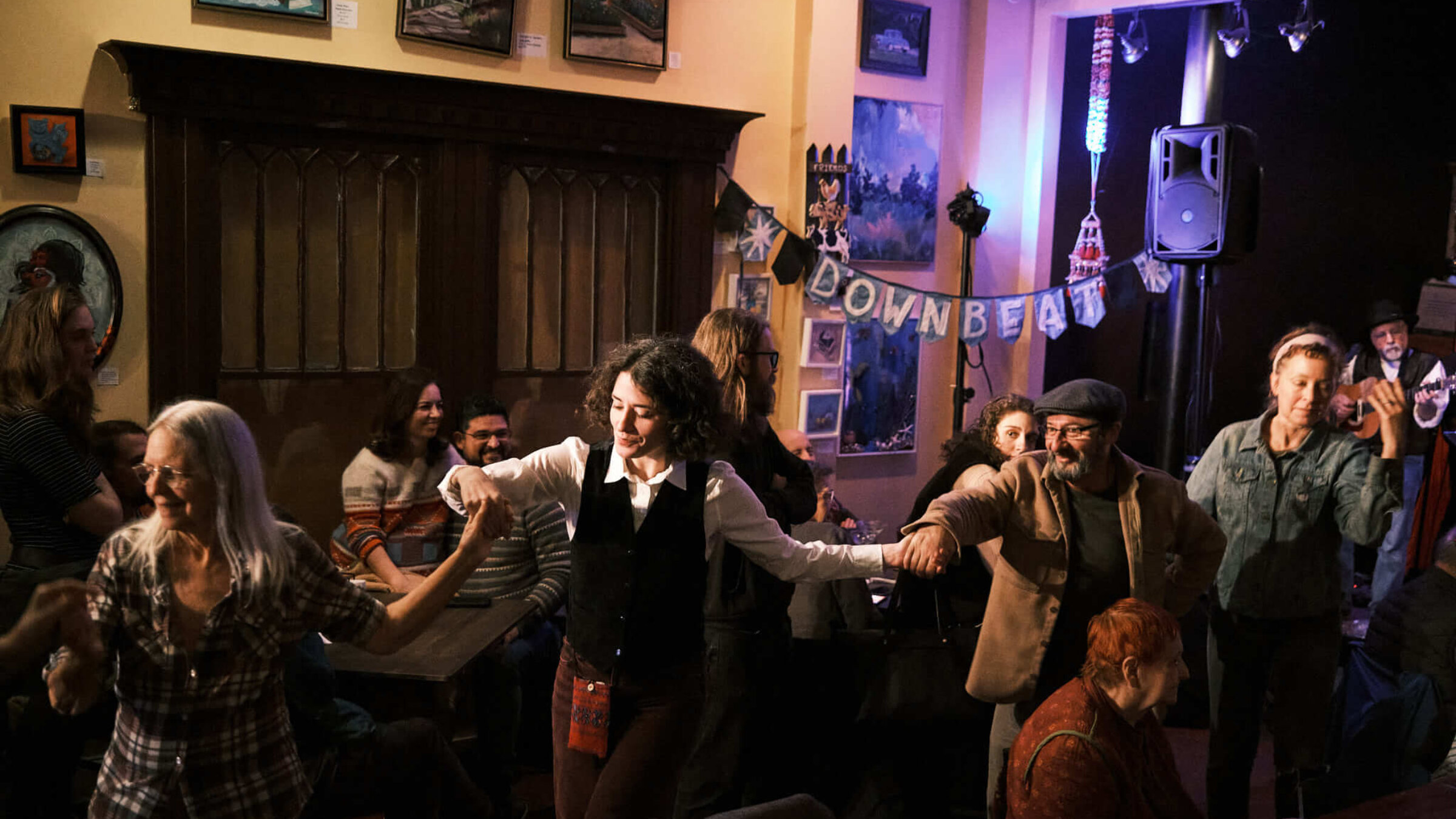
People dancing on the first night of the Richmond Yiddish Week festival, Jan. 10, at the Gold Lion Community Café in Richmond, Virginia. Photo by Vlad C.
By David Zakalik January 14, 2026
It’s not every day that you encounter a man in a Stetson hat singing Yiddish folksongs in the former capital of the Confederacy.
Yet that wasn’t the most unexpected thing this reporter experienced over Richmond Yiddish Week’s opening weekend. The grassroots Yiddish cultural festival, which began on Saturday, got off to an energetic, well-attended start. The festival continues until Jan. 16.
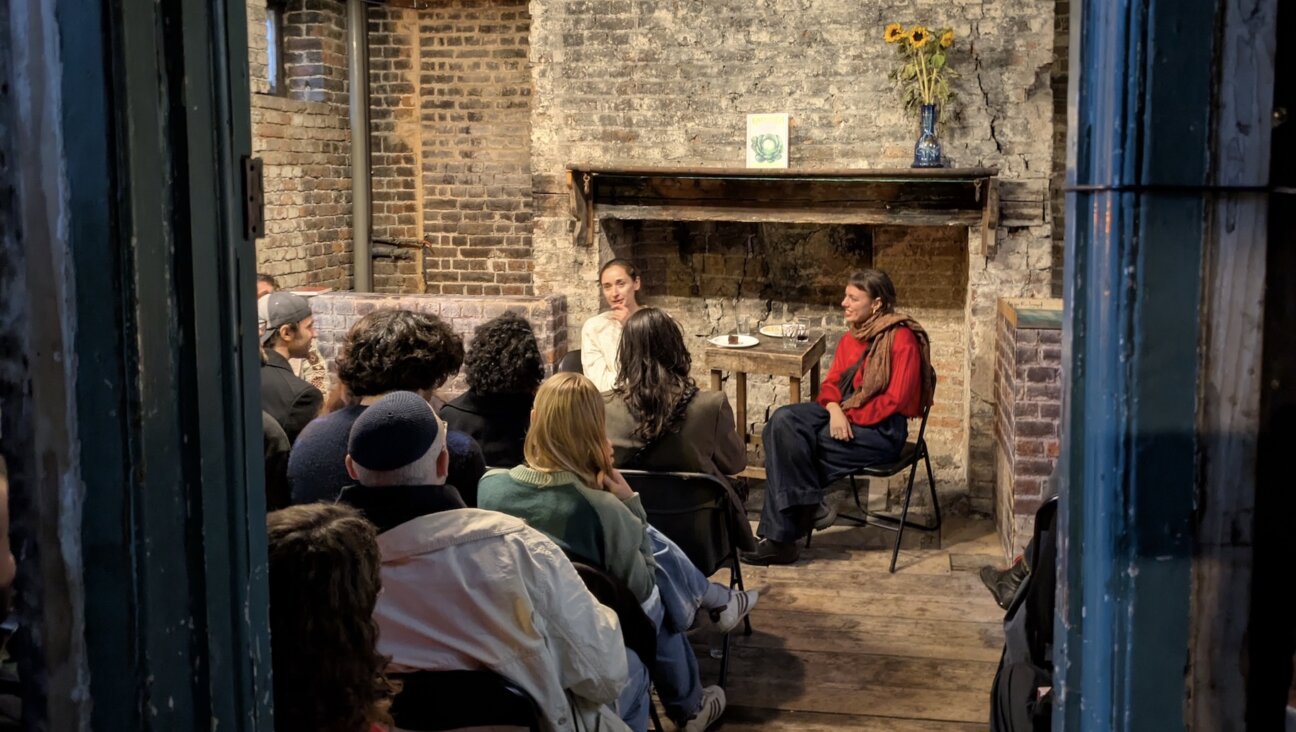
The festival’s opening concert, a double billing of local klezmer bands The Vulgar Bulgars and My Son The Doctor, took place Saturday night at Gold Lion Community Café, an art-space in Richmond’s up-and-coming Manchester neighborhood.
Even before the concert began, the venue was standing-room only. “This is clearly the place to be in Manchester tonight,” remarked one attendee as he squeezed into a seat.
Before the first set, festival co-founder Samantha Shokin addressed the audience, expressing her delight at the large turnout. “We weren’t sure how many like-minded people we were going to find for a Yiddish culture festival,” she said, “but judging by the crowd it seems like there are a lot of you.” Her remark elicited enthusiastic applause.
Thirty minutes into the first set, the space was so crowded that service staff had difficulty delivering customers’ food and drink orders to the tables. At least one woman gave up waiting in line to place her order until the break between sets.
The Vulgar Bulgars opened with several tightly harmonized and adventurously arranged klezmer instrumentals. Local singer Nina Lankin then joined in for a power ballad-esque and refreshingly non-maudlin rendition of the Yiddish theater classic Papirosn (Cigarettes).
She and the band also shined with a heartfelt rendition of the messianic Yiddish song Shnirele Perele (Ribbons and Pearls). Between sets, as attendees reordered food and drinks, this reporter had a chance to speak with a few attendees.
“I’ve been here for three years or so,” Rachel Enders, a local preschool teacher who told me she’s Catholic, said. “But I had no idea there was this big, vibrant Jewish community here.”
Festival co-founder Danny Kraft said that the local community has some “conservative and insular” tendencies. But at a time when many Jewish communities are retreating into explicitly Jewish spaces, the organizers of RYW chose more public venues for their programming. The local Jewish Federation lent support by funding security. One of Shokin’s and Kraft’s stated goals was to “bring some Yiddishkayt into the local arts community.”
Maribel Moheno — a language instructor at a local university who recently discovered her Jewish ancestry — was the first to start dancing. The rest of the audience got on their feet and joined Moheno during the second set. That set, played by My Son The Doctor, was less polished or interestingly arranged, but far more danceable.
Having finished the circle dance called a freylekhs with Moheno and a dozen or so others, this reporter refueled with a bagel made by local bakery Cupertino’s NY Bagels. It wasn’t bad. Also on offer was an unexpected soft drink called Palestine Cola.
As it turns out, the Gold Lion cafe has, like many such establishments of late, hosted pro-Palestine events. After some community members expressed concern about the festival being held there, the organizers explained that the festival had no stance vis-à-vis Israel-Palestine.
“People on both the left and the right who don’t know much about Yiddish think it’s synonymous with queer, anti-Zionist culture,” Kraft said. “That’s very reductive. Some people in the mainstream community saw this Yiddish event as a dog-whistle or code-word for anti-Zionism. Once we clarified this with the local Federation, that cleared the air a bit.”
“This is a week of celebrating Yiddishkeit,” said Shokin. “We’re focusing on arts and culture — politics, not so much.”
Despite this shturem in a glezl tey (tempest in a teacup), the opening concert had more than 100 people in attendance. Young families with toddlers and tweens mingled with elegantly dressed retirees, long-haired baby boomers, and 20- and 30-something hipsters.
The evening closed out with two lively songs that the audience joined in for: Ale Brider (We’re All Brothers), a popular anthem about Jewish unity, and the Yiddish birthday song Tsu Dayn Geburtstog in honor of an audience member’s birthday.
On Sunday afternoon, the Richmond Public Library’s main branch hosted a Yiddish story time event, which Kraft, who is also a poet and Yiddish translator, led. More than a dozen young families attended.
The program began with a brief Yiddish lesson. Kraft, himself the father of a toddler, then regaled children and parents with the unique Yiddish-Spanish-English picture book Beautiful Yetta: the Yiddish Chicken, using the book’s dialogue to teach more Yiddish phrases.
One high point of the afternoon was an interactive game called “Guess the Animal” where the audience learned the Yiddish terms for familiar animals, including the non-kosher khazer (pig), which got plenty of laughs.
A lot of Yiddish programming today tends to be adult-focused, often geared toward retirees. So a Yiddish festival for children and young parents seems like an expression of hope for Yiddish continuity — a leap of faith, even. Yet despite a small budget and all-volunteer staff, Kraft and Shokin seem to have stuck the landing.
This is a moment of great uncertainty. Here’s what you can do about it.
We hope you appreciated this article. Before you go, we’d like to ask you to please support the Forward’s independent Jewish news this Passover. All donations are being matched by the Forward Board - up to $100,000.
This is a moment of great uncertainty for the news media, for the Jewish people, and for our sacred democracy. It is a time of confusion and declining trust in public institutions. An era in which we need humans to report facts, conduct investigations that hold power to account, tell stories that matter and share honest discourse on all that divides us.
With no paywall or subscriptions, the Forward is entirely supported by readers like you. Every dollar you give this Passover is invested in the future of the Forward — and telling the American Jewish story fully and fairly.
The Forward doesn’t rely on funding from institutions like governments or your local Jewish federation. There are thousands of readers like you who give us $18 or $36 or $100 each month or year.
Support our mission to tell the Jewish story fully and fairly.