You can now enjoy the Yiddish Book Center’s exhibit on your phone
Here’s a selection of photos, videos and recordings from their permanent exhibition to get you started
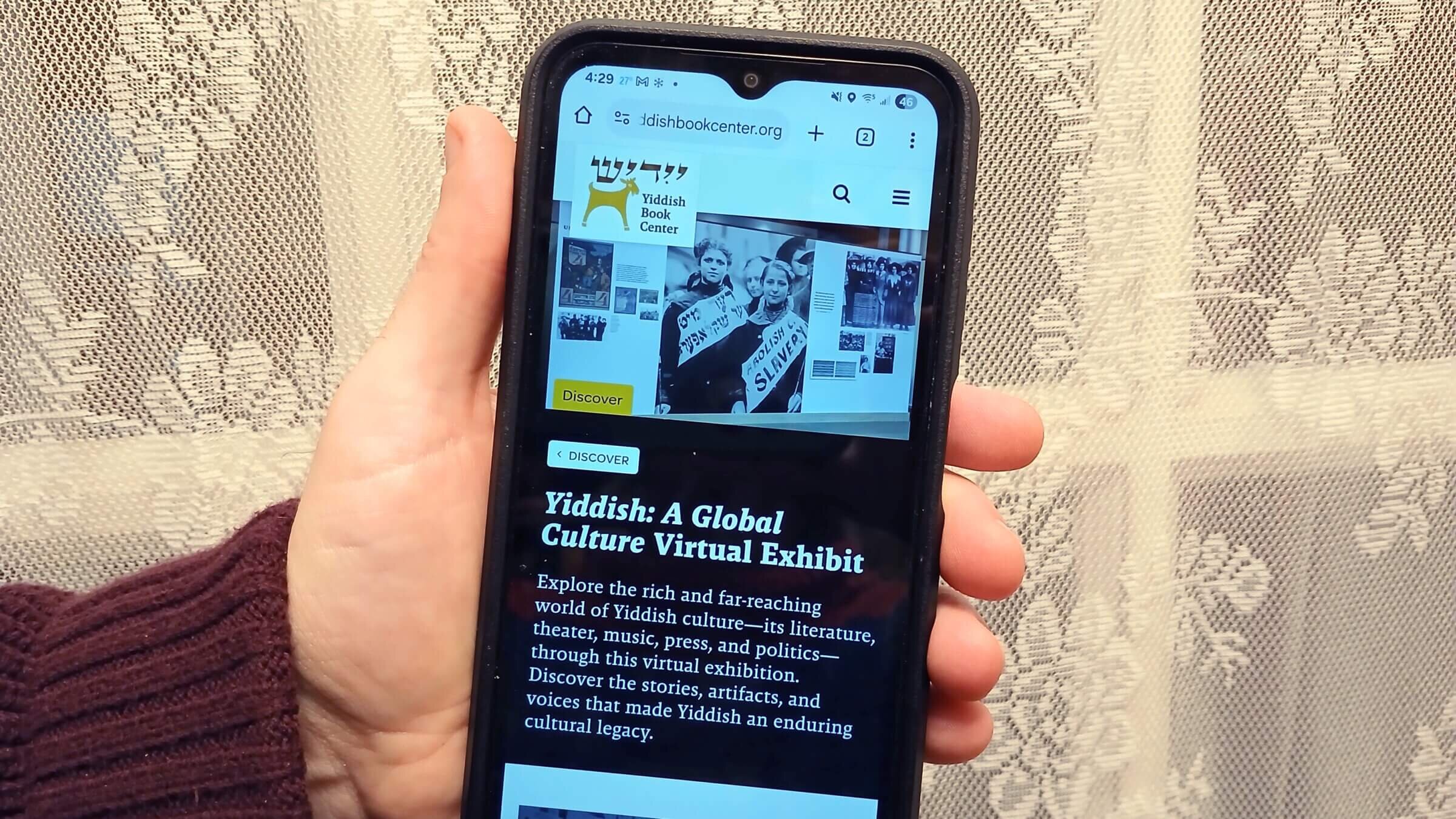
Photo by Jennifer A. Stern
Yiddish culture fans should take a look at the Yiddish Book Center’s recently launched website. Called Yiddish: A Global Culture, Virtual Exhibit, it’s an online version of their marvelous permanent exhibition that can be accessed on your cellphone.
If you know Yiddish, you may have read the Forverts article about the Book Center’s newly-published catalogue of its permanent exhibition. And I’ve described the transformative experience of visiting the exhibition at the Center’s campus in Amherst, Massachusetts. There’s nothing like spending time with the hundreds of Yiddish books on display — not to mention photographs, posters, musical scores, works of art, Yiddish typewriters used by famous authors and a giant linotype press once used to print the Forverts.
But thanks to the website, Yiddish enthusiasts who live far away from Massachusetts can now “visit” the exhibition on their phones. It’s a model of everything a website should be — clearly organized, visually attractive and free. And it makes excellent use of multimedia — not just photographs, but also videos and sound recordings.
Like the exhibition itself, the website is divided into 16 thematic sections, including “Women’s Voices,” “Theater” and “Press and Politics.” Each photograph or multimedia item is accompanied by a description that’s easy to understand, even for people who aren’t Yiddish mavens. The introductions and the descriptions were written by David Mazower, the curator of the exhibition and author of the new exhibition catalogue.
These are some of my favorite items on the website, but they represent only a small part of what’s available.
- Bold, brilliantly-colored illustrations by avant-garde Jewish artists Esther Karp and Ida Broyner for collections of Yiddish poems by Chaim Krul and Dovid Zitman. These limited edition books were published in Lodz, Poland, in 1921. Both the artists and the poets were active in the important Lodz-based Yiddish cultural movement, Yung-yidish. (To see this object, click here.)
- A postcard (ca. 1910) from Warsaw with a photo of the Yiddish and Hebrew writer Devorah Baron. She was hugely popular in Russia, and was practically the only Jewish female writer of her generation whose photo appeared on commercial postcards. (To see this object, click here.)
- Delightful illustrations by the avant-garde artist Issachar Ber Ryback for a Yiddish children’s book written by the Soviet-Yiddish poet Leib Kvitko, published in Berlin in 1921. Ryback was an innovative Jewish artist active in Kiev (Kyiv today), Berlin and Paris. Kvitko was among the 13 Soviet Jewish writers and public figures executed by Stalin in Moscow on Aug. 12, 1952. (To see this object, click here.)
- Amusing self-portrait doodles by the classic Yiddish writer I. L. Peretz, from his scrapbook. Peretz is revered as one of the “founding fathers” of modern Yiddish literature. The Book Center’s exhibition includes a reconstruction of his salon in Warsaw, where he helped shape an entire generation of young Yiddish writers. The self-portraits in his notebook show a lighter side of his character. (To see this object, click here.)
- A copy of Uncle Tom’s Cabin, Harriet Beecher Stowe’s novel about slavery in the American South, translated into Yiddish and published in 1911. A stage adaptation of Stowe’s novel was popular with American Yiddish-speaking audiences in the early 20th century. (To see this object, click here.)
- A Yiddish bookplate from Warsaw (ca. 1910) with a picture of a young girl reading by the light of a kerosene lamp. (To see this object, click here.)
- A photograph of Yiddish poet Esther Shumiatcher-Hirshbein standing with a geisha in Japan. Shumiatcher and her husband, Yiddish playwright and writer Peretz Hirshbein, were insatiable travelers. The steamer trunk that they carried with them all over the world is in the exhibition as well. (To see this object, click here.)
And some multimedia:
- Contemporary Yiddish actor, translator and scholar Mikhl Yashinsky reading a story (ca. 1908) about Max Spitzkopf, the fictional Jewish Viennese sleuth dubbed “the Yiddish Sherlock Holmes.” Yashinsky recently published his English translation of all 15 Spitzkopf stories. He reads here in English from his own translation. (To listen to this recording, click here.)
- A performance of the 1936 Yiddish song, “Our shtetl is burning” (Undzer shtetl brent), by poet and songwriter Mordkhe Gebirtig. During the Holocaust, Jews sang this song in the ghettos and concentration camps, and quickly came to think of it as a folksong. The performance on the website is by contemporary Jewish singer Bente Kahan. (To watch/listen to this performance, click here.)
- Historic recordings by the famous Yiddish singer-actresses Jennie Goldstein, Nellie Casman, Molly Picon, Pepi Litman and Bessie Thomashefsky. (To listen to these recordings, click here.)
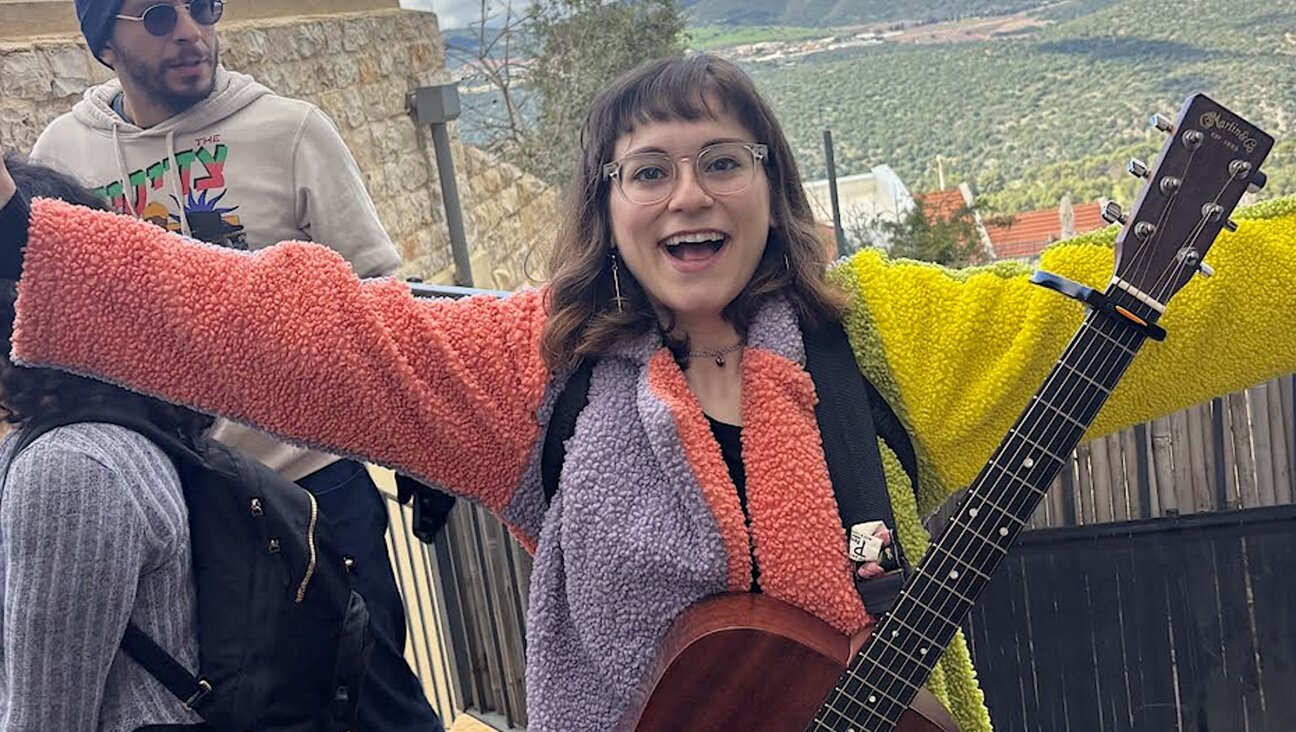
- An animation and reading of “Di Zogerin,” a 1922 short story by Rokhel Brokhes. Both the animation and the reading (in Yiddish) are by contemporary Yiddish actress, artist and scholar Alona Bach. The story describes the bitter life of a woman who served as a “zogerin” (also called a “zogerke”). These were women who recited prayers for other women who couldn’t read Hebrew — at home, in the synagogue or at the cemetery. (To watch/listen to the animation and reading, click here.)
Mazower told me that the website will expand and develop over time. “We plan to delve deeper into certain subjects, and hope to add some themes that space didn’t allow us to include in the permanent exhibition, such as the shtetl, Hasidism, organized labor and Yiddish in Israel,” he said.
You can access the exhibit online on the Yiddish Book Center’s website.
This is a moment of great uncertainty. Here’s what you can do about it.
We hope you appreciated this article. Before you go, we’d like to ask you to please support the Forward’s independent Jewish news this Passover. All donations are being matched by the Forward Board - up to $100,000.
This is a moment of great uncertainty for the news media, for the Jewish people, and for our sacred democracy. It is a time of confusion and declining trust in public institutions. An era in which we need humans to report facts, conduct investigations that hold power to account, tell stories that matter and share honest discourse on all that divides us.
With no paywall or subscriptions, the Forward is entirely supported by readers like you. Every dollar you give this Passover is invested in the future of the Forward — and telling the American Jewish story fully and fairly.
The Forward doesn’t rely on funding from institutions like governments or your local Jewish federation. There are thousands of readers like you who give us $18 or $36 or $100 each month or year.

Support our mission to tell the Jewish story fully and fairly.