Restored Yiddish film ‘I Have Sinned’ captures pre-war Polish Jewry
An illegitimate birth is a major plot element, which would have been unthinkable in a contemporaneous American movie
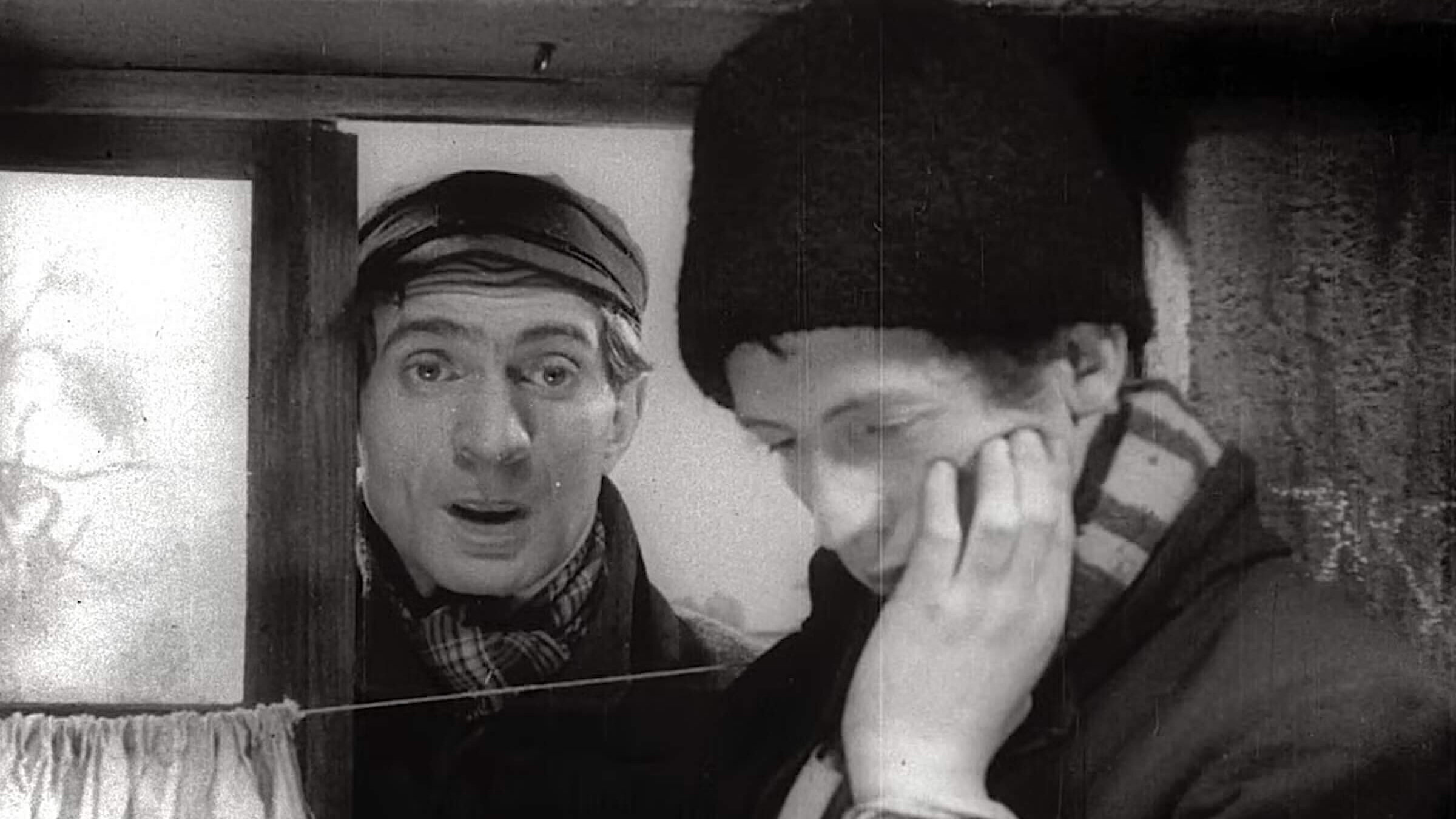
The comic duo Dzigan and Schumacher in a scene of the film. Courtesy of National Center for Jewish Film
There’s an old British expression, “a curate’s egg.” The story goes that a couple once hosted their vicar for dinner and served him an egg, not realizing that it wasn’t very fresh. When they asked him how he liked it, the vicar, a tactful person, said: “Parts of it were excellent.”
The 1936 Yiddish film Al Khet (I Have Sinned), digitally restored by the National Center for Jewish Film and screened this week at the New York Jewish Film Festival, is a curate’s egg.
On the one hand, it’s incredibly primitive, and not because of its age. Its story, about the ill-starred romance of a Jewish military officer and what happens 20 years later, is nothing with nothing; the second half is shamelessly melodramatic, and the pace is slow, too.
On the other hand, the legendary comic duo Dzigan and Schumacher, in their film debut, are superb; the rich Polish Yiddish is delicious, and as a snapshot of mid-1930s Polish Jewry, it’s extraordinary.
Al Khet was the first Yiddish talkie made in Poland, where even later Yiddish films had technical frailties. Even the beautifully produced and photographed The Dybbuk (1937) suffers from clumsy sound editing. But compared to American or French films from the same year, Al Khet looks prehistoric. Exterior scenes were shot silent and dialogue was dubbed in afterwards with zero regard for synchronization, so that at times people are shown to be speaking with their mouths completely closed.
The acting ranges from simple and straightforward to children’s-theater pantomime. There are errors in basic continuity: In one scene, an army officer says goodbye to his sweetheart, and in the next scene he asks his friends to say goodbye for him, because he can’t do it!
But Al Khet is the only Yiddish film — the only film in any language, actually, as far as I know — to deal with the effects of WWI on Eastern European Jewry. An illegitimate birth is a major plot element, which would have been unthinkable in a contemporaneous American movie.
And no film paints a more detailed picture of life in interwar Yiddishland. The unselfconscious coexistence between religious and secular Jews; the work life of tailors (Jews, under 10% of the population, made up almost half of Poland’s clothing industry); the veneration of America; the texture of religious life, with its daily prayers, crowded crack-of-dawn ‘slikhos‘ services before the holidays, tsitsis gone dingy from constant wear… they’re all there.
After some stock footage of WWI to establish the era, the opening few minutes are pure documentary: cobblestone alleys, wooden houses, a Jew leading a goat on a rope, a water-carrier bringing pails up to an apartment with no plumbing, and so on. A similar montage opens Yidl Mitn Fidl (“Yiddle with his Fiddle”) which was shot in Poland the following year, and I’ve long suspected that its purpose was to enable those who had long since left “the Old Country” to see a bit of it again.
The film’s biggest asset is, of course, Dzigan and Schumacher.
Al Khet is commonly assumed to be a comedy-team vehicle — the sort of thing Abbott and Costello used to turn out. But Dzigan and Schumacher did not play set characters, they varied what they did for each of their smart, satirical sketches; they were the Jewish grandfathers of Bob and Ray, so to speak. And they’re in supporting roles, playing the protagonists’ helpful friends — the traditional ‘comic relief’ slot.
Still, they walk off with the movie. Their acting is off-the-cuff and naturalistic, they have great chemistry and of course, they’re very funny. In the film’s best comedy scene, Schumacher stands in his room wearing his talis (prayer shawl) and tefilin (phylacteries) and mumble-chanting his way through shakharis, the morning prayer, when Dzigan enters and peppers him with questions. Of course Schumacher can’t answer (there’s no chatting allowed during prayer), but he drops Yiddish words and phrases into the Hebrew prayers, folding them right into his mumbling.
(At the NYJFF screening, this scene seemed to go over most of the audience’s heads. Either they couldn’t tell the difference between the Hebrew and the Yiddish, or the style of Jewish prayer had been lost somewhere in the generations. It’s a sad thought either way.)
Two other cast members are of interest. Kurt Katch, who plays a secular Jewish father in the film, began his career in the heyday of silent German cinema and wound up in Hollywood, where he appeared in some of the major titles of the 1940s, like Watch on the Rhine and The Mask of Dimitrios.
Ruth Turkow, born Ruth Kaminska, who played his daughter, was genuine Yiddish theater royalty: her mother, Ida Kaminska, one of the most important figures in mid-century Yiddish theater, was nominated for a Best Actress Oscar for her performance in The Shop on Main Street, and her grandmother was Ester-Rokhl Kaminska, known as “the mother of Yiddish theater.”
The film features a fine score by Henokh Kon (who also composed the score for The Dybbuk). One song he wrote for Al Khet, “Shpil zhe mir a lidele in yidish” (“Play Me A Yiddish Song”), became a standard that’s still in the repertoire.
The new English subtitles are also a bit of a mixed bag. For example, when the Al Khet prayer is recited, no subtitle appears — even though it’s the title of the film! On the other hand, the translator (the talented Mikhl Yashinsky) is smart enough to keep the language colloquial. Too many new subtitle translations use dry, clinical language — the sort of thing you get from GoogleTranslate — and have no feel for idiomatic speech, so that the audience often has no idea what the characters are really saying. Still, some subtitles go by too fast to be read, or they scroll by at a steady high speed that forces the viewer to stare at the bottom of the screen and avoid looking at the actual movie.
And there are some nice things to look at. Though the picture quality varies with the different source materials used in the restoration, the cinematographer’s eye is still evident, and the exterior long-shots especially have some arresting compositions.
I wouldn’t recommend Al Khet as anyone’s first Yiddish movie — that ought to be Grine Felder, Overture to Glory or Uncle Moses — but for those with an interest in juicy, authentic Yiddish or pre-war Jewish life in Europe, it’s invaluable.
This is a moment of great uncertainty. Here’s what you can do about it.
We hope you appreciated this article. Before you go, we’d like to ask you to please support the Forward’s independent Jewish news this Passover.
This is a moment of great uncertainty for the news media, for the Jewish people, and for our sacred democracy. It is a time of confusion and declining trust in public institutions. An era in which we need humans to report facts, conduct investigations that hold power to account, tell stories that matter and share honest discourse on all that divides us.
With no paywall or subscriptions, the Forward is entirely supported by readers like you. Every dollar you give this Passover is invested in the future of the Forward — and telling the American Jewish story fully and fairly.
The Forward doesn’t rely on funding from institutions like governments or your local Jewish federation. There are thousands of readers like you who give us $18 or $36 or $100 each month or year.
Support our mission to tell the Jewish story fully and fairly.