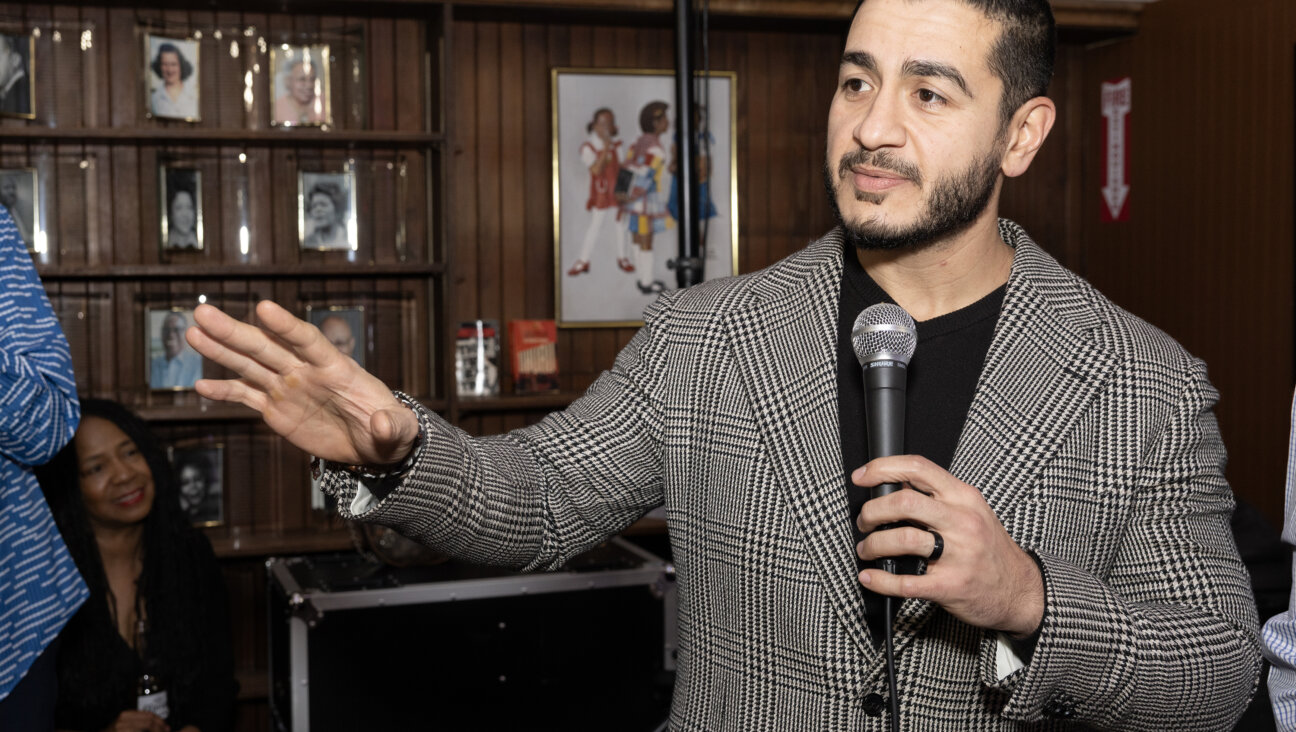
Yiddish theater is revived in Tbilisi, Georgia after 100 years
Born to Christian parents, historian Lasha Shakulashvili was stunned to find Yiddish theater posters in Georgia’s national archives
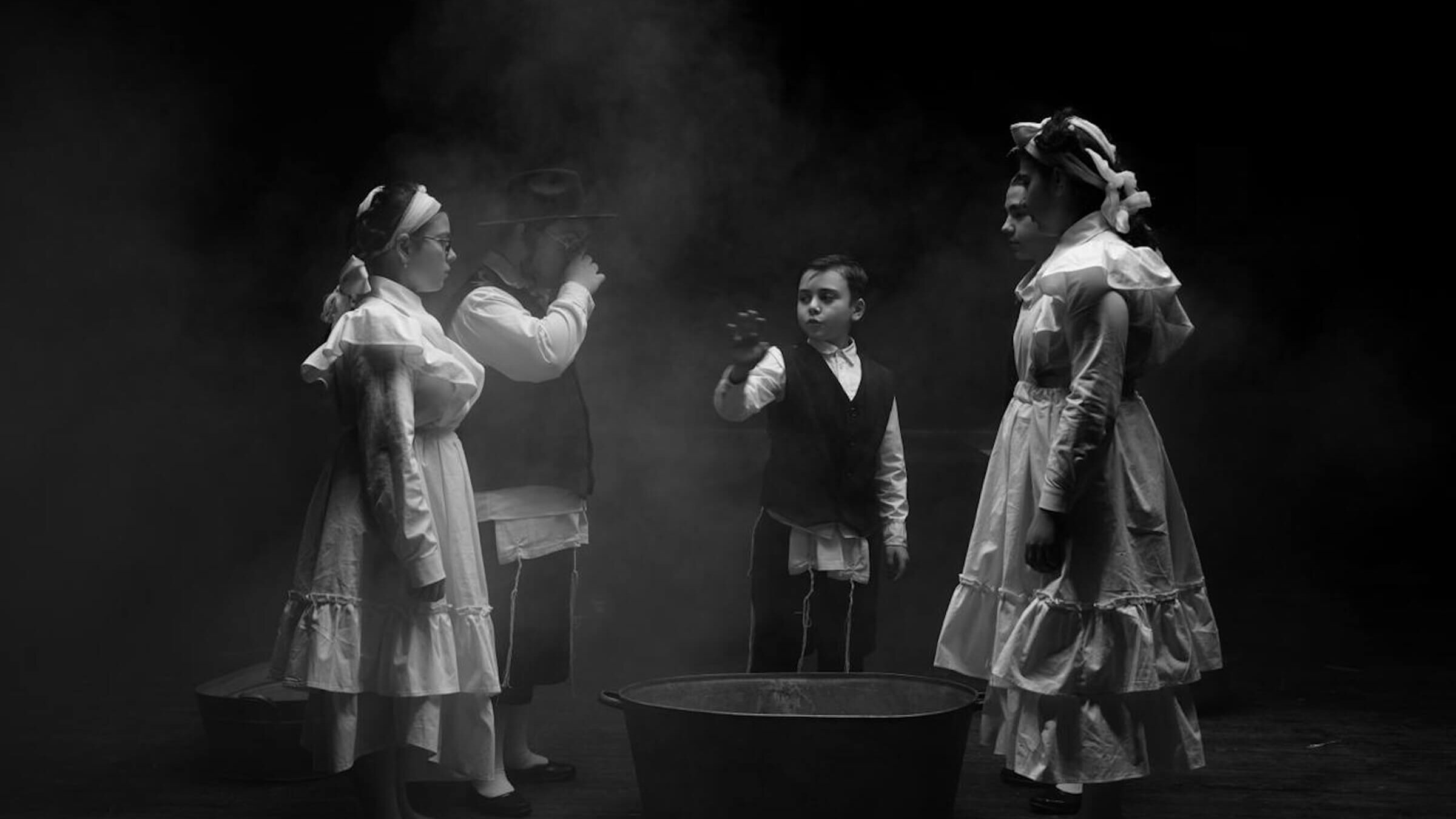
A scene in the Yiddish play “Shema Yisroel,” staged in Tbilisi in 2023 Photo by Ana Sanaia
When Lasha Shakulashvili was a grad student at Tbilisi State University in 2019, he stumbled onto something unbelievable. In the National Archives of Georgia, he found Yiddish posters from 1910 announcing theater performances put on by a grassroots, community-run troupe in Tbilisi in what was then still part of the Russian Empire. The troupe was called the Jewish Division of Musical-Melodrama Art.
The posters were fragile and there were only a few of them. Along with them was a single photo he found in a 1917 copy of The Jewish Daily Forward, found in the archives of the National Library of Israel. The paper had a short dispatch mentioning the Ashkenazi school in Tbilisi and the photo showed a teacher writing the Yiddish word friling — spring — on a chalkboard.
Shakulashvili was surprised. Almost nothing had been written about Ashkenazi Jewish heritage in Georgia because most Jews in Georgia were kartveli ebraelebi or Georgian Jews; ‘Mountain Jews’ (Jewish inhabitants of the eastern and northern Caucasus) and Sephardic Jews. Shakulashvili was eager to find out more.
Born in Tbilisi to Orthodox Christian parents, he was raised in part by a Jewish nanny who taught him Russian and Yiddish. That early exposure set him on his scholarly path – and instilled in him a love for Yiddish and Ashkenazi culture.
Before turning to academia, Shakulashvili, who’s now a Yiddish scholar, Jewish history educator and digital storyteller, worked as a diplomat for Georgia’s Permanent Mission to the United Nations and the Georgian Foreign Ministry. Thanks to this career, he told me: “I look at things as an academic and a diplomat. As a diplomat, you have to be cautious but also persistent. A scholar does that, too.”
That persistence led him to write a dissertation on his findings, and publish some of his early discoveries in the Forward in 2022. His thesis is on the role of Yiddish theater in Georgia in the Jewish enlightenment. “Yiddish theater was groundbreaking at a time when Georgia was a very conservative place,”Shakulashvili said. “There were more actresses than actors, women were leading it, and there were plays that explored arranged marriages and women getting revenge. It was a ‘Belle Epoque’: Ashkenazis had been in Georgia less than a century and they changed the life of the whole community.”
Shakulashvili traced how Ashkenazi Jews began arriving in Georgia in the late 19th and early 20th centuries, fleeing poverty and pogroms in densely populated communities in the Russian Empire’s Pale of Settlement. Before the 1917 Revolution, about 5,000 Ashkenazim lived in Georgia, joining an already diverse Jewish population.
Shakulashvili visited Jewish cemeteries, eventually finding graves of every actor whose name was mentioned on the 1910 theater posters. He conducted oral history interviews with Jewish residents of Georgia from different Jewish communities and learned how interconnected different Jewish populations were: Sephardic and Georgian-Jewish sources told him about their grandmothers being educated at the Yiddish school in a time when many schools didn’t accept girls. In turn, the Sephardic community has taken on the task of preserving the two historic Ashkenazi synagogues.
His journey took him to archives in Tbilisi, Jerusalem and Oxford, England. “I had to bring these stories back to life somehow,” he said. “It’s one thing to find a poster and prove the theater existed, but who played there and where did they come from and how did they learn? My curiosity for the theater led me to find out more about the Yiddish schools. One thing led to another — there was a school, there was a society, a whole culture. I wanted to find a complete picture.”
The majority of Georgian-born Jews have since emigrated to Israel or the United States. According to his interviews, most of them did so not because of fear or persecution, but simply for better economic opportunities after the collapse of the Soviet Union.
Shakulashvili shared discoveries with his students at the Paideia Institute in Stockholm and Tbilisi State University, where he was lecturing. He then began sharing his discoveries on Instagram. One early video he posted showed him offering his mostly non-Jewish students cookies shaped like letters of the alef-beyz (the Hebrew alphabet) — a traditional way of welcoming children into Jewish learning.
When Shakulashvili started speaking publicly about the long-lost Yiddish theater, non-Jewish Georgian actors and directors reached out. Many were stunned to learn that Tbilisi once had a Yiddish stage, shut down in 1926 by Soviet authorities. A question emerged: Could the theater be revived?
Shakulashvili’s discovery and networks forged online brought together Georgian historians, Jewish community leaders and actors of all backgrounds. Ana Sanaia, a prominent Georgian actress, director and playwright emerged as the producer who’d make this dream a reality.
A century after its last performance, the Tbilisi Yiddish Theater reopened in 2023. The first production – performed in Yiddish and old Russian, with Georgian supertitles – was Osip Dymov’s 1907 drama Shema Yisroel (named for a centerpiece prayer in Judaism). Jewish protagonists convert to Christianity to survive, only to be rejected by their families and left stranded between identities.
The reopening in Tbilisi came at a tense time. Since the Oct. 7 attacks on Israel and the war in Gaza, Jewish cultural institutions elsewhere have faced protests and boycotts. Georgia has largely avoided that backlash, something Shakulashvili attributes to the country’s strong identification with its Jewish history.
Still, Georgia is politically polarized, especially as Russia’s war in Ukraine continues to shape regional affairs. The theater is self-funded exclusively through independent fundraising, Ana Sanaia, the theater’s producer, told me.
While Shakulashvili has since stepped back from the theater, his research paved the way for recovering the forgotten Yiddish culture of Georgia. He is now based in Israel, where he produces digital content, leads heritage tours and travels for lectures. He still spends the spring semester teaching in Tbilisi.
Meanwhile, Sanaia continues to produce plays, raise funds and recruit actors. She is currently producing her own play in Georgian about the Yiddish-speaking community and their relationship with Abkhaz Muslims in a Black Sea town in 1907.
Shakulashvili’s latest project focuses on online public education about the diverse arts, culture and languages of the Jewish people, through a platform he calls “Jewish Storytelling.” He is also working on a memoir about his discovery and the journey it sent him on.
“I’m proud to be a Georgian Orthodox Christian, and I am proud to work in Jewish studies,” Shakulashvili said. “Everyday I say ‘thank you’ to God that I have been able to do what I love.”
This is a moment of great uncertainty. Here’s what you can do about it.
We hope you appreciated this article. Before you go, we’d like to ask you to please support the Forward’s independent Jewish news this Passover. All donations are being matched by the Forward Board - up to $100,000.
This is a moment of great uncertainty for the news media, for the Jewish people, and for our sacred democracy. It is a time of confusion and declining trust in public institutions. An era in which we need humans to report facts, conduct investigations that hold power to account, tell stories that matter and share honest discourse on all that divides us.
With no paywall or subscriptions, the Forward is entirely supported by readers like you. Every dollar you give this Passover is invested in the future of the Forward — and telling the American Jewish story fully and fairly.
The Forward doesn’t rely on funding from institutions like governments or your local Jewish federation. There are thousands of readers like you who give us $18 or $36 or $100 each month or year.
Support our mission to tell the Jewish story fully and fairly.