The Regime Change Israel Needs

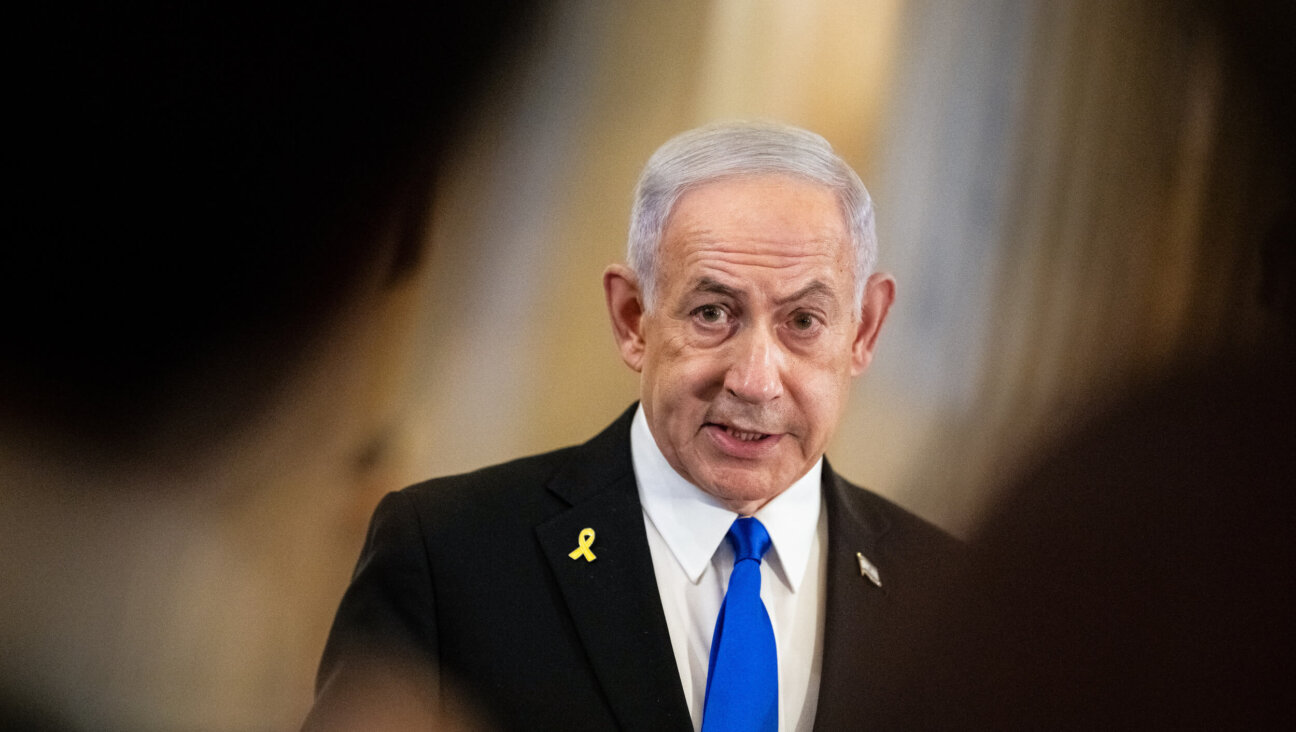
Next: Before his government was sworn in, Benjamin Netanyahu (right) spoke to Ehud Olmert, his predecessor as prime minister. Image by GETTY IMAGES
It is difficult for Israelis not to be a little bit envious as we watch the early days of Barack Obama’s term as president. From the economy to foreign policy, America’s new president is taking bold actions aimed at addressing the formidable challenges facing his country and the world.
Israel also faces critical challenges. Unfortunately, Prime Minister Benjamin Netanyahu’s new government is unlikely to be able to move with necessary boldness in tackling them. His governing coalition is composed of an unwieldy mix of six parties, some of which strongly disagree with each other on major issues — a recipe for deadlock.
Netanyahu, however, cannot be blamed for his government’s congenital defects. Instead, the unworkable composition and cumbersome size of Israel’s government (30 ministers!) provide further proof that the present regime, what we might call Israel’s First Republic, having performed heroically in the state’s first several decades, is now in a deep crisis of obsolescence.

This crisis has been building for a long time, but its present acute form couldn’t come at a worse time. From the global economic downturn to the Iranian threat, the challenges confronting the new government will be difficult to address under the current broken governmental regime.
On issues of peace and security in particular, Israel stands at fateful crossroads. Increasingly, it is clear that a piecemeal approach to negotiating with the Palestinians or with Syria is futile, as a stable peace depends on stabilizing the Middle East as a whole. Nothing less justifies Israel taking the risks of giving up limited bargaining and security assets. Therefore, a grand design for the Middle East, based in part on the Arab peace initiative with major changes, is the vital new paradigm.
Such creative statecraft, however, requires decisive decision-making power, governmental stability, high-quality Cabinet ministers who agree on basics and broad societal legitimacy — all of which Israel’s present regime, as reflected in the new government, cannot effectively provide.
There is a wide consensus that Israel’s regime needs to be radically reformed. Reforms currently being discussed include proposals to raise the electoral threshold a party must reach to gain representation in the Knesset, having a portion of the Knesset selected in single- or multiple-constituency districts and requiring that the head of the Knesset’s largest party be given the first chance to form a new government. But these proposals do not adequately address the problems and may even aggravate them.
The only reform that can meet Israel’s critical needs is the institution of a presidential regime. I would suggest a system with direct elections of a president and vice president for five-year terms, along with retention of proportional elections for the Knesset, in order to ensure that all sectors of the population continue to have a voice in the political process. The president would appoint Cabinet ministers and direct government policy. A set of checks and balances would prevent misuse of power. The president would have the power to call for new Knesset elections to prevent dangerous stalemates, while an enlarged majority of the Knesset could call for new presidential and parliamentary elections as a check on executive power. This system would ensure adequate executive power, governmental stability and political as well as social legitimacy.
Details, of course, need careful consideration. Some will note the risk of electing an unqualified president. But this risk is less dangerous than the certainty that the present regime cannot cope with existential problems.
It is up to Israel’s political class to summon the wisdom and the courage to bring about a Second Israeli Republic — one that is suited to meeting 21st-century challenges and can yield achievements comparable to those of Israel’s First Republic. Let’s hope that it doesn’t take a genuine disaster to overcome the tyranny of the status quo.
Yehezkel Dror is a professor of political science emeritus at the Hebrew University of Jerusalem. He is a recipient of the Israel Prize and was the founding president of the Jewish People Policy Planning Institute.