Ark Art: Actually Christian Imagery?
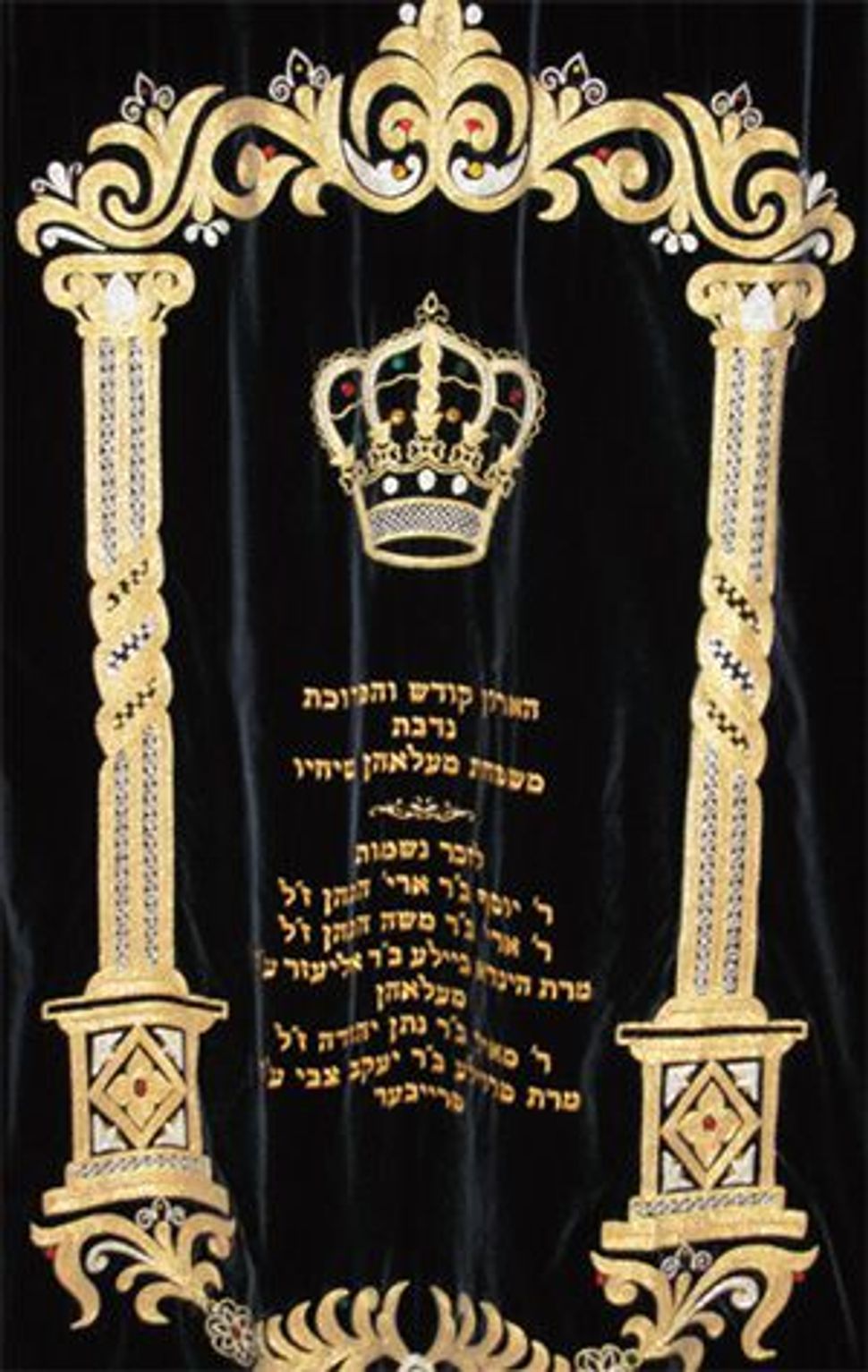
Twisted History: Do curly columns on ark covers actually portray medieval Catholic propaganda? Image by Courtesy of Menachem Wecker
As synagogues swap their regular ark curtains for the white High Holy Day versions, many will unwittingly showcase a pair of symbols not only of Christian origin, but whose very content symbolizes God’s rejection of the Jews.
The culprits — two twisted or vine-encircled pillars — appear in places as august and storied as Safed’s 16th-century Ari Ashkenazi Synagogue and the 18th-century synagogue in Cherasco, Italy. Even the ultra-Orthodox Ponevezh Yeshiva’s ornate ark in Bnei Brak, Israel, features curly columns.
So what’s so unkosher about twisted columns? The answer centers on the world’s most famous curly pillars, housed at St. Peter’s Basilica in Vatican City. In 1438, Cardinal Giordano Orsini had one of the basilica’s 12 pillars adorned with an inscription identifying them as loot from Solomon’s Temple. Indeed, 1 Kings 7:21 and 2 Chronicles 3:17, in the King James Version, refer to two Solomonic pillars — named Yachin and Boaz — that featured “nets of checker work,” “wreaths of chain work,” and lily and pomegranate imagery “round about” the chapiters.
Claiming that the Vatican had improved upon Solomon’s holy architecture by using it to construct St. Peter’s would have been a significant propaganda coup. In the pillars, churchgoers would have seen physical proof of the church replacing the synagogue.
Yet, experts agree that the cardinal’s claim is highly implausible. “The Temple was burned in 586 BCE, and nothing subsequent would suggest the pillars survived and got to Rome,” said the Rev. Thomas Trapp, professor of religion and theology at Concordia University in St. Paul, Minn. “There is no connected link of one to the other, and it is wholly made up for effect.”
“How could they have been looted when the church was only being born at the time of the destruction of the Second Temple?” said Dianne Bergant, professor of Old Testament studies at the Chicago-based Catholic Theological Union, in agreement.
Despite the cardinal’s failure to account for a nearly millennium-long gap between the destruction of Solomon’s Temple and the founding of St. Peter’s, there is a scholarly consensus that the symbol of the curly pillars, as adopted by the medieval church, is unmistakable, though the symbol’s origin is debatable.
According to Ori Soltes, author of “Our Sacred Signs: How Jewish, Christian, and Muslim Art Draw From the Same Source” (Basic Books, 2005) and professorial lecturer in theology at Georgetown University, the rumors about the St. Peter’s architecture were not so dubious.
A 15th-century baldachin (canopy above an altar) created by Gianlorenzo Bernini alluded to Second Temple remains, Soltes said. St. Helen, mother of the Emperor Constantine, allegedly discovered the pillars while on a pilgrimage to the Holy Land in the fourth century. In bringing the pillar fragments and the True Cross to Italy, St. Helen intended Rome to be the New Jerusalem and St. Peter’s the new synagogue.
Fifteenth-century French painter and illuminator Jean Fouquet showed Solomon’s Temple with curly pillars in his illumination of Flavius Josephus’s “Antiquities of the Jews,” which may account, in part, for the motif finding its way into the Jewish community.
But some scholars warn about overstating the curly pillars’ significance as a religious form. “In fact, the twisted column is a standard late antique and Baroque form, nothing more — unless someone wants to make more of it,” said Steven Fine, chair of Yeshiva University’s Jewish history department. “This is not about theology, but visual vocabulary and culture.”
Steven Ostrow, chair of the University of Minnesota’s art history department, agreed that the twisted column is not a religious symbol per se, but one that came to be associated with Solomon’s Temple in the European tradition.
Spiral and vine-encircled columns, which are “obviously pagan in origin,” also appear in imperial Roman architecture, Ostrow cautioned. Some later Christian adaptations include grapes in the vines or tendrils, which allude to the Sacrament of the Eucharist, he added, but the pillars remain rooted, through myth and symbolism, in the Jewish (Solomonic) past.
The pillars’ Jewish past might make them appropriate synagogue additions, according to Dov Schochet, a Toronto-based rabbi who answers Jewish legal questions at AskMoses.com.
Schochet, who was unaware of the St. Peter’s pillars, thought those on ark curtains might refer to the pillars outside the Holy of Holies in Solomon’s Temple. “If it did have a Jewish significance,” he said, “who cares if other religions find significance in it, as well?”
Soltes sees it a bit differently. Bernini’s baldachin influenced both Christian and Jewish artists over the next few centuries, he explained, and the motif had two parallel meanings. Christians saw the Sacrament in the vines (and a reference to Jesus, who, like the wine-god Dionysus, was born to a human mother and a divine father), while Jews saw a reference to Isaiah 5:7, which compares the House of Israel to the “vineyard of God.”
With all this in mind, Soltes can’t help but smile when he sees the pillars in synagogues. “I respect the unwitting, unknowing effort, not realizing that the twisting idea originates with Christianity,” he said. “That really speaks to this larger issue of borrowing ideas.”
Menachem Wecker, who blogs on religion and the arts at Iconia.canonist.com, is based in Washington, D.C.
Why I became the Forward’s Editor-in-Chief

You are surely a friend of the Forward if you’re reading this. And so it’s with excitement and awe — of all that the Forward is, was, and will be — that I introduce myself to you as the Forward’s newest editor-in-chief.
And what a time to step into the leadership of this storied Jewish institution! For 129 years, the Forward has shaped and told the American Jewish story. I’m stepping in at an intense time for Jews the world over. We urgently need the Forward’s courageous, unflinching journalism — not only as a source of reliable information, but to provide inspiration, healing and hope.
Support our mission to tell the Jewish story fully and fairly.