One of Most Relevant Thinkers You’ve Never Heard Of

Graphic by Angelie Zaslavsky
The Life and Thought of Hans Jonas: Jewish Dimensions
By Christian Wiese Brandeis University Press, 292 pages, $50.
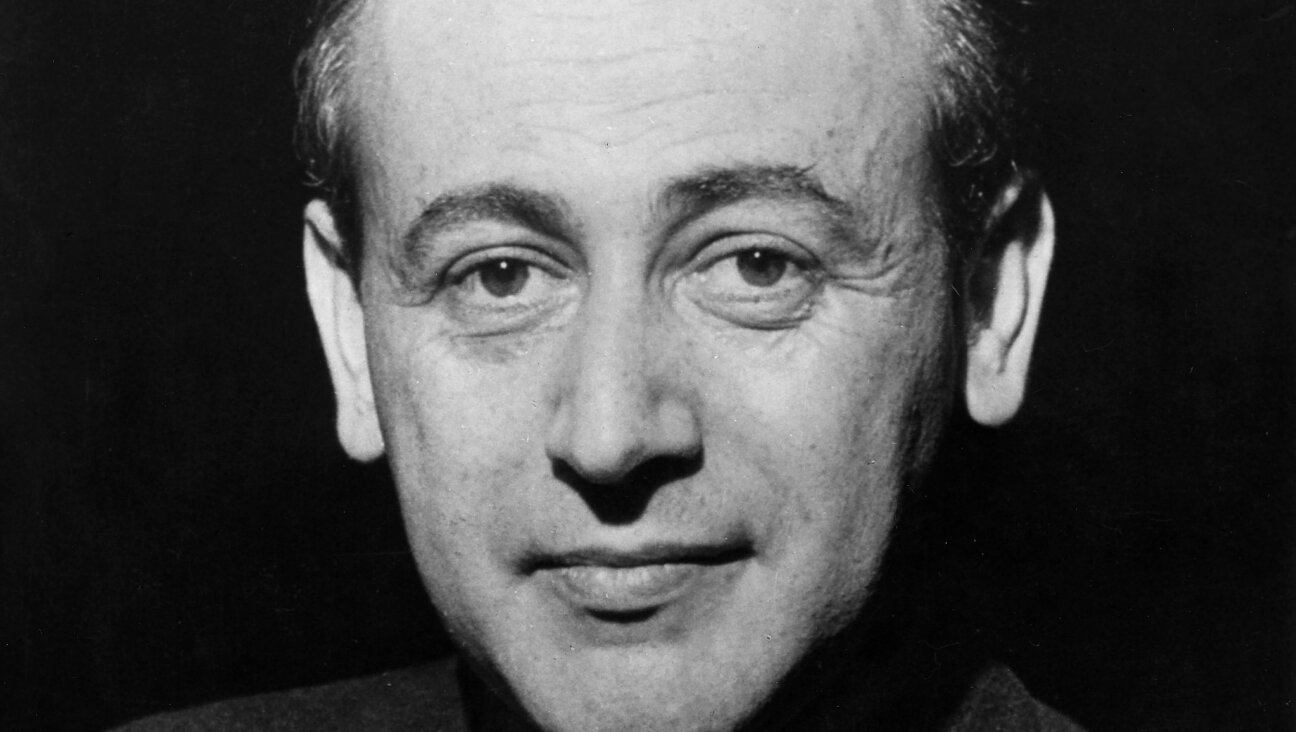
Like most things German, the philosophy of Hans Jonas is complicated. But its main thrust can be summed up by its leading moral imperative: “Act so that the effects of your action do not destroy the future potential of [human] life on earth.” Jonas, who died in 1993 at the age of 90, demanded that we be responsible for the whole of creation, not just for our fellow humans. He insisted that we be guided by the future, not only those of our children and our children’s children, but of all people and of the world that sustains them. Jonas was therefore one of the more relevant thinkers you have never heard of.
Jonas’s life, as outlined in Christian Wiese’s lucid account, was also interesting because of the considerable personal risks he took in order to honor his commitments. Born to a solidly middle-class assimilated family in Mönchengladbach, Germany, he became a lifelong Zionist and fled to Palestine (by way of England) after the Nazi seizure of power in 1933. When war finally broke out, he insisted on fighting the Nazis face to face, and so he served in the British military for five years. (He rejected a safe position as an intelligence officer in order to put his life on the line in combat.) When he returned to Germany at the end of the war — this time with a victorious army — he found out that his mother had been exterminated at Auschwitz. He then returned to Palestine, where he fought — at 45 — in the War of Independence. After spending most of the 1940s in the military, he left Israel in the early 1950s to teach in Canada and then lived the rest of his life in the United States.
Jonas wrote his major philosophical works here in America. In these books and essays, he developed an ethics of responsibility that he felt would counter the loss of value, the nihilism, that marks the modern world. By drawing on evolutionary biology, Jonas argued that life itself — the inexhaustible drive to live and live on — is the sole possible ground of value. In claiming this, Jonas tried to lay to rest the notion that the mastery of nature is a proper goal for human activity. In short, Jonas provided a far-reaching defense of ecology.
Wiese, who has been able to draw on an array of unpublished letters and manuscripts, has set for himself the task of finding the specifically Jewish roots of Jonas’s thought. And this makes perfect sense. After all, Jonas was a strong Zionist. He formed some of his closest friendships with such outstanding Jewish thinkers as Gershom Scholem, Leo Strauss and Hannah Arendt. (As German Jewish intellectuals tend to be a prickly bunch, these friendships were always a little tense.) Jonas frequently resorted to religious concepts, like creation. What’s more, at the end of his life, Jonas took the plunge and wrote overtly theological essays, the most famous of which is “The Concept of God After Auschwitz: A Jewish Voice.”
But Wiese admits that his search for the religious origins of Jonas’s philosophy has been both frustrating as well as fruitful. Like that of many liberal German Jews of the early 20th century, Jonas’s notion of Judaism derived not from the Torah or the Talmud but from the spirit of the prophets. His engagement with the traditions of Jewish thought was therefore both eclectic and haphazard. While Jonas claimed in conversation that he did indeed believe in God, his later essays show that his concept of God was hardly orthodox. Jonas, who would not brook the idea that the Holocaust represented any kind of justice, argued that after Auschwitz, we cannot possibly consider God to be both omnipotent and righteous. As Jonas was unwilling to give up the ideal of divine righteousness, he dispensed with God’s redeeming power and thus God’s ability to act in history.
Jonas refused all dreams of messianic fulfillment. Instead, he embraced the adventure of creation, of a “God who runs a risk.” His is a suffering and caring God, one who will receive back his divinity from “the chance harvest of unforeseeable experience” — that is, from what we make of the world. In this theology it is humanity, not God, that assumes both the blessing and the burden of making things right. History is our problem. Auschwitz marks mankind’s failure, not God’s.
This provocative stuff is the product of a deep and contradictory mind. Wiese ends up telling the story of a man — a secular Zionist — torn between his desire to submit ethics to the sole standard of reason and his desire to employ “a highly charged religious language.” Jonas chose to resolve the traditional opposition between Athens and Jerusalem, between philosophy and religion, by using religious language in his philosophy and philosophical language in his religious works. A beautiful example of this double play comes at the end of Jonas’s essay “The Outcry of Mute Things”:
The latest revelation—from no Mount Sinai, from no Mount of the Sermon, from no Bo (tree of Buddha)—is the outcry of mute things themselves that we must heed by curbing our powers over creation, lest we perish together on a wasteland of what was creation.
Is this secular or religious? It is of course both and therefore neither. Given the passion of his expression and the importance of his message, though, the distinction might not really matter in the end.
David Kaufmann teaches literature at George Mason University.
I’m personally matching all gifts to the Forward, up to $36,000. Can I match your gift now?

Hello, fellow Forward reader! I’m Joel Brown, a Forward reader and supporter for more than 15 years, and currently the chair of the board of directors.
I’m an avid Forward reader because it ticks so many of my essential boxes: excellent journalism, Jewish focus and diverse viewpoints. In today’s political climate, what I most appreciate is the Forward’s independence — made possible by the generosity of its membership.
The Forward is committed to bringing you unbiased, nuanced Jewish news. From my position as board chair, I see an exciting future as we expand our position as the definitive independent voice of contemporary American Judaism.
— Joel Brown, Forward board chair
Support our mission to tell the Jewish story fully and fairly.