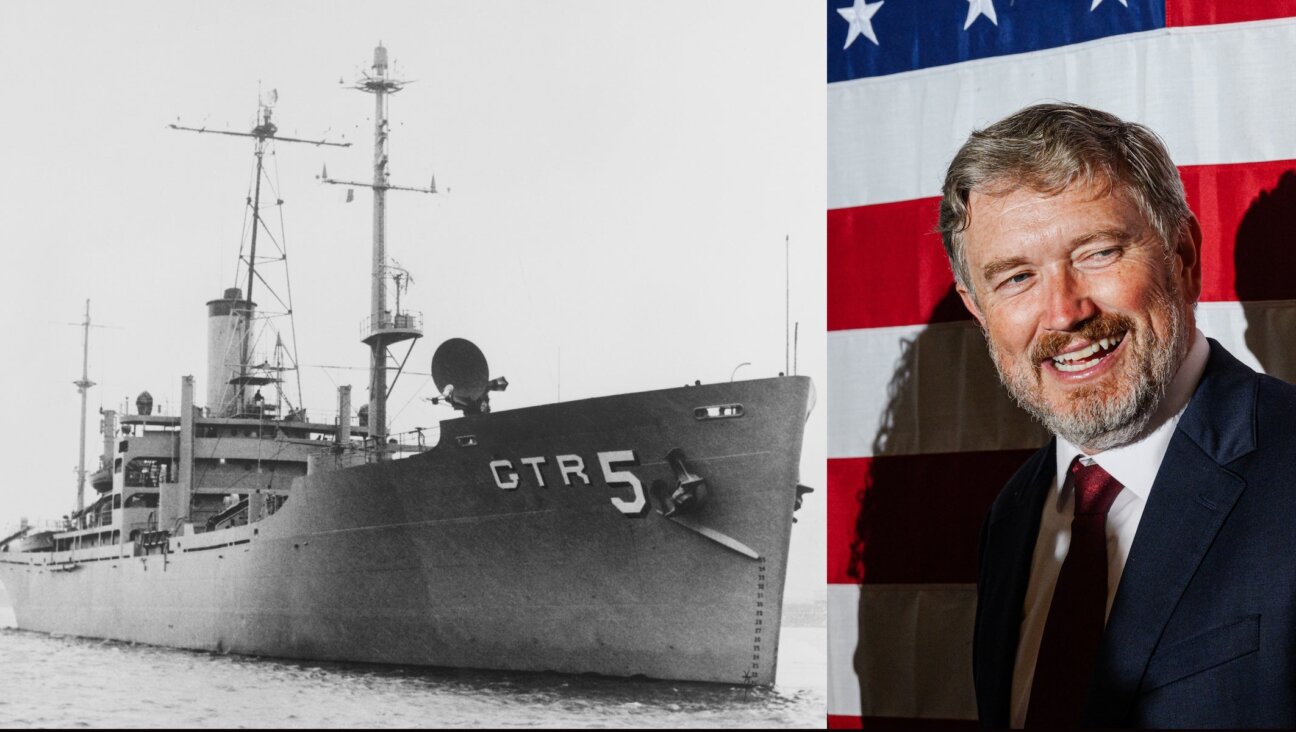
Foxman Fever Doesn’t Discriminate

Good Fences

By J.J. Goldberg

Published February 10, 2010, issue of February 19, 2010.
  • Print
  • Share Share

With the Academy Awards almost upon us, Oscar Fever is running high. And, in a rare confluence of circumstances, it’s colliding with a more exotic virus, one that might be called Foxman Fever.

Some observers have been struck by the fact that three of the 10 Best Picture nominees this year have an intensely Jewish focus. Especially striking is that none of the three films is particularly flattering to Jews. “Inglourious Basterds” portrays Jewish GIs gleefully slaughtering Nazis. “A Serious Man” depicts rabbis as blathering fools. Most controversially, “An Education” tells of a 16-year-old girl seduced by an unscrupulous Jewish businessman. A few reviewers have called “An Education” outright antisemitic.

And this is where Oscar Fever collides with Foxman Fever. Los Angeles Times entertainment blogger Patrick Goldstein, in a February 3 post, noted that “all sorts of smart folks” were untroubled by these films’ Jewish imagery, including historian Neal Gabler and media scholar Howard Suber. Then Goldstein delivers his coup de grace: “Even Anti-Defamation League national director Abraham Foxman supports ‘An Education.’”

What Goldstein means, of course, is that if Abe Foxman doesn’t see antisemitism, it isn’t there. He doesn’t bother spelling this out, since it’s presumably clear to most thinking Americans — at least the “smart folks” among us — that Foxman is the country’s most prolific antisemitism-spotter, the gevalt guy who sees Jew-haters under every bed and invents them if he can’t find them.

This view of Foxman as Chicken Little has gained near-universal currency, with the exception of Foxman’s most sworn admirers and adoring (and aging) donors. Journalist and author James Traub, a respected chronicler of societal trends, put forward this image of Foxman in a 2007 New York Times Magazine profile. In his telling, Foxman is “the hanging-judge of anti-Semitism,” an “anachronism” who continues to “harp on Jewish insecurity” in a world where Jews have become “the most widely admired religious group in America, as well as the most successful.” Portraying him as a blustering alarmist, Traub seemed bemused by Foxman’s warnings about “jihadist” antisemitism as a serious threat in today’s world and troubled by Foxman’s focus on “good for the Jews, bad for the Jews” to the exclusion of broader goals of “promoting tolerance and diversity.”

“Foxman upset many of his colleagues by extending a welcome to Christian conservatives, whose leaders tended to be strongly pro-Israel even as they spoke in disturbing terms of America’s ‘Christian’ identity,” Traub wrote. “Foxman was willing to cut them some slack on issues of social justice, and even of church-state relations, in the name of solidarity toward Israel.”

Similar themes are sounded by critics on all sides. Oddly, though, the critiques are constantly twisting around, mirroring and contradicting each other, sharing nothing but a certainty that Foxman is a loudmouthed bully. That’s Foxman Fever.

In recent months, for example, Republicans have been savaging Foxman for doing precisely what Traub accuses him of not doing: attacking right-wing extremists even when they support Israel. Last November, for example, Commentary editor Jonathan Tobin wrote that the ADL had “stepped over the line” and was trying to stifle criticism of the Obama administration with the publication of a report, “Rage Grows in America: Anti-Government Conspiracies,” which warned of anti-democratic tendencies and intolerance in far-right movements like the Tea Parties and in the rhetoric of media figures like Glenn Beck.

In January, Foxman drew more ire from the conservatives when he attacked Rush Limbaugh,a accusing him of “borderline anti-Semitic” stereotyping. Foxman had taken Limbaugh to task for saying that President Obama was “assaulting bankers. He’s assaulting money people. And a lot of those people on Wall Street are Jewish. So I wonder if there’s — if there’s starting to be some buyer’s remorse there.” In response, Norman Podhoretz claimed that Foxman “has a long history of seeing an anti-Semite under every conservative bed” and demanded that he “apologize for the defamatory accusation of anti-Semitism that he himself has hurled against so loyal a friend of Israel as Rush Limbaugh.”

Others on the right have been even harsher. Boston activist Charles Jacobs, founder of the David Project and Americans for Peace and Tolerance, recently called for a “second ADL” to battle radical Islam, accusing Foxman of “silence,” “PC-denial” and “timidity.” Allies have piled on, calling him “leftist,” “cowardly” and even “fetid.” One activist called for a class-action lawsuit by ADL donors to demand a new leadership.

The fact is that Foxman has been going after right and left alike with more or less equal gusto for decades, charging antisemitism when he thinks he sees it and publicly rejecting the charge when he thinks it’s unfounded, as he did with the Oscar nominees. He outraged the left in the 1990s by accepting Pat Robertson’s apology for using bigoted language, only to have Robertson accuse him in 2002 of shilling for the Democrats when he criticized a Robertson video with Christ-killer imagery. He alienated black leaders in the 1980s for blasting Jesse Jackson’s Hymietown-style language, and then angered the right when he publicly embraced Jackson as a friend in 1992.

In the end Foxman seems to embody for each critic whatever it is that the critic most dislikes about Jewish advocacy, whether for being too liberal or too conservative, too militant or too pragmatic. If he’s everyone’s target of choice, that’s largely because he’s the only Jewish communal spokesman that most Americans, Jewish or non-Jewish, have ever heard of. He’s constantly taking it on the chin because just about everybody seems to have some sort of beef with the Jewish community these days. Which proves either that Jews have truly arrived or that Foxman’s worst fears are coming true.


  • Print
  • Share Share

The Forward welcomes reader comments in order to promote thoughtful discussion on issues of importance to the Jewish community. In the interest of maintaining a civil forum, the Forward requires that all commenters be appropriately respectful toward our writers, other commenters and the subjects of the articles. Vigorous debate and reasoned critique are welcome; name-calling and personal invective are not. While we generally do not seek to edit or actively moderate comments, the Forward reserves the right to remove comments for any reason.


Comments
Andrew in CT Sun. Feb 14, 2010

Intereesting editorial JJ.

Foxman to me is a person who is a left wing liberal. He may even have given heavily to the DNC for obama's campaign. The ADL remember was honoring Bertlemann before they were reminded that this company was being used for propaganda in video taping Jews in concentration camps the Nazis used to show the world that Jews were not being murdered or tortured. I don't know what Foxman's religious beliefs are, though it is strange that he is very threatened by right wing Christian groups. Do left wing Christian groups threaten him equally?

I have listened to Rush for a long time, I have not found him anti-semetic. The book he quoted was written by a Jew who does bring in questionable actions he found with the Jewish vote. The republicans I have always found have been more pro - Israel than democrats. I remember when Rumsfeld praised the IDF for the way it was built, and respected it.

The ADL needs to get a person in charge who is a centrist. In this way there is no question of prejudice at all, the person can make rightful complaints on either side, and to any religious group.

Jenny Hazan Sun. Feb 14, 2010

David Sussman used to be a Phishhead. The self-defined former “stinky dreadlocked hippie” was born and bred in Boston and followed the band across the U.S., taking in more than 150 shows by the time he was 23. Three years later, Sussman found himself amidst the ruins of the terror attack at Mike’s Place in Tel Aviv, where he worked as a bartender and manager. Two years after that, in 2006, he was faced with death again, serving as an infantry soldier with the IDF, on the front lines of the Lebanon war.

How does a person go from the Phish concert peace trail to the heart of the Middle East conflict? According to Sussman, pretty darn strenuously, but the 32-year-old tour guide and yeshiva student, who now lives in the Old City of Jerusalem, maintains that both life paths stem from the same desire: to connect with the world around us and make it a better place.

Q1. Where were you when the terror attack on Mike’s Place took place?

It was April 30, 2003. I had the night off. But as soon as I heard what had happened, I went there straight away. I won’t go into detail about what I saw, but it was horrific. In addition to injuring dozens of my friends, those two terrorists killed a waitress and a close friend of mine, Dominique Hass.

As it was, those were pretty hard times in Israel. Bombs were going off in malls and cafes, buses and nightclubs, weddings and Passover Seders. Every week there were attacks. Tourism was down. There was little joy on the streets. The attack on Mike’s Place was the last straw for me. I decided to make aliyah and become an Israeli citizen.

I felt that by doing so I was doing my part to keep this thing that is Israel, alive. As Jews, wherever we are, we are in this together. And I wanted to show that I wasn’t about to throw in the towel. After that, at the ripe age of 27, I joined the IDF. After all, sometimes you have to fight for what is right.

Q2. How do you reconcile your hippie roots with your later identity as an Israeli soldier? Isn’t there a contradiction in philosophies there?

No. First of all, the transition didn’t happen overnight. I first came to Israel to visit my brother in August 2001 and stayed, though I didn’t become a citizen until 2003, and only then joined the army in 2004. Becoming a soldier was for me the culmination of nationalistic feelings that had developed over time. Especially after what happened at Mike’s Place, I felt the need to participate in protecting the people I loved, the city I lived in, and my country.

Being a Phishhead and an Israeli soldier have a common goal. I don’t see a philosophical conflict between being a Phishhead and an Israeli soldier. Both have a common goal of becoming part of a community, sharing with and loving your neighbor as yourself, and both stem from a desire to connect to something deeper and more meaningful. Of course, as a Jew, an Israeli and as a soldier, I feel a much deeper sense of connection to history, to community, and to the world than I ever did as a hippie. But the quest is the same.

Q3. Did you imagine when you joined the IDF that you would end up in the Lebanon War?

No way. I was part of an artillery unit that fought in Lebanon longer than any other unit. I was there for 28 blistering hot days with no showers, no toilets, no beds. Just blood, sweat and tears, as fellow soldiers were killed all around me.

On August 2, 2006, possibly the heaviest day of fighting, there was an ambush on our position. A recconaissance unit was sent by Hezbollah to scope out our location. Until then, the rockets being fired at us would land randomly, in our general vicinity. Not anymore. We could see them coming closer and closer. Out of the corner of my eye I could see, in what seemed like slow motion, a rocket land no further than 60 feet from me. I fell to the ground, clutching my head with my hands. It was a dud. Click. My heart was racing. Before long, our whole encampment was on fire.__

I found myself putting out fires that were beginning to encroach on the area where we had stockpiled our explosives. If these went off, no one would survive. The scene that day was crazy: fire, smoke, explosions, gunfire. By the time we got the orders to retreat, 12 soldiers had been killed.

I found myself thinking what the heck am I doing here? I should be in America, for cryin’ out loud! I should be at a festival, dancing with girls who wear sparkles on their faces, not in the middle of a battle field! Why did I join the IDF? Why was I in Israel? I was about to die for this country, that I felt so connected to, but I barely understood why. That’s when I realized I had to learn more about the history of our land, and what it meant to be Jewish.

Q4. Is that why you went into tour guiding?

Yes. After Lebanon, I quit my job and decided to learn, full-time, about the country I had just fought for. I joined the Archeological Seminars school in Jerusalem. Our first reading assignment was the Torah: Genesis, Exodus, Judges, Joshua and the conquest of the land, and Shmuel and the stories of King David. Alongside the readings, we visited the sites and really got down and dirty with it, sometimes even taking part in excavations.

I discovered things that had not been seen or touched in thousands of years; uncovered history, but not just any history, Jewish history, my history. I couldn’t help but think, man, this stuff is real. It’s all right here. The archeology matches the stories. This stuff ain’t fiction, like I always thought. This wasn’t like Greek mythology. These stories were real.

I am proud to say that I am now a certified Ministry of Tourism educator and guide. This is definitely the career for me. Now I spend a chunk of my time taking families around Israel in the hopes of inspiring them to connect, the way I have connected, to this amazing country, and fill them with the pride that every Jew should feel for who they are, the gifts their ancestors bestowed upon the world, and the wonderful accomplishments of the modern state of Israel even in the face of terrorism and the constant threat of war.

Q5. How else did the war impact you?

It inspired me to eventually go learn in a yeshiva. There I was at the age of 29 and about to die, and all along I didn’t really know what I was living for. Amidst the chaos of that day during the Lebanon War was this tank driver, an 'ultra-orthodox' Jew who even brought his black hat with him to battle. I thought he was nuts, until I got to know the guy.

Hot coals were falling into the tank which was covered with explosives and gun powder. So we were all sitting in this tank and for some reason the top wouldn’t close. From inside the tank all I could see was trees burning overhead and ash. Hot coals were falling into the tank which was covered with explosives and gun powder. One guy was on his knees inside the tank, clapping out the coals before they hit the floor and ‘Boom!’ – we'd be no more. We were white in the face, with fear in our eyes.

And the whole time this driver was singing. Singing songs! 'Am Yisrael Chai, Am Yisrael Chai.' I knew right then that this guy had something I didn’t, and it was something I wanted. At the time, I just didn’t know what it was.

That inspired me to look deeper into what it meant to be a Jew, and with the background I had learned in guiding, I was already partway there. I followed my curiosity and began exploring the stories behind the stories I had learned.

Q6. What was one of the most important things you learned in yeshiva?

When I first started to study about the meaning of being Jewish, Rabbi Noah Weinberg, the Rosh Yeshiva of Aish HaTorah where I was studying, asked me, ‘What are you willing to live for?’ I had thought about the opposite, more passive form of the question, what am I willing to die for, many times. But never 'what am I willing to live for.' If you’re willing to die for something, you should be willing to live for it. It should be at the forefront of your mind, all the time -- whether it’s your family, your country, your people, God, whatever. It’s about taking an active role, sitting in the driver’s seat of your life.

I try to live my life true to that ideal and stay constantly conscious of the things I live for, and devote myself to them. I think that’s how you make a difference in the world. When you really connect to the things you care about, it makes the world a better place.

Q7. Do you ever get itchy for your Phish-following days?

It definitely happens, for sure. They are still one of my favorite bands. And I have lots of fond memories of those days. But the connection I have found in Israel is much more fulfilling. Sometimes when I look back at my Phish days, I feel like I wasted time. There was a lot of great energy there that never really went anywhere, never accomplished anything. There would be this explosion of energy at concerts, but they always ended flat. With Judaism, I feel like I've tapped into something real, long-lasting, even infinite. Living in Israel as a religious Jew provides a framework with boundaries to contain that energy, and now I feel I am investing my energy much more wisely, toward a real greater good, toward ‘tikkun olam’, trying to truly repair the world.

Hershon Hashkin Tue. Feb 16, 2010

An area of over 450 dunams in the heart of Jerusalem, now forming the Mamillah Cemetery, is to be converted into a business centre. The townplan is being completed under the supervision of the Supreme Moslem Council in conjunction with the Government Town Planning Adviser. A six-storeyed building to house the Supreme Moslem Council and other offices, a four-storeyed hotel, a bank and other buildings suitable for a college, a club and a factory are to be the main structures. There will also be a park to be called the Salah ed Din Park, after the Moslem warrior of Crusader times.

The remains buried in the Cemetery are being transfer red to a spot round the tomb of al Sayid al Kurashi, ancestor of the Dajani family, in a 40 dunams walled reserve.

In an interview with “Al Wihda,” the Jerusalem weekly, a member of the Supreme Moslem Council stated that the use of Moslem cemeteries in the public interest had many precedents both in Palestine and elsewhere. He quoted the cases of the Bab al Sahira (Herod’s Gate) Cemetery, which formerly stretched down Saint Stephen‘s Gate; the Jaffa Cemetery, which was converted into a commercial centre and Queen Farida Square in Cairo, which not long ago was a cemetery.

The member added that the Supreme Moslem Council intended to publish a statement containing dispensations by Egyptian, Hejazi and Damascene clerics sanctioning the building programme. He pointed out that the work would be carried out in stages and by public tender. Several companies had already been formed in anticipation, and funds were plentiful, the correspondent concluded.

Mordechai Levy Jewish Defense Organization Fri. Feb 19, 2010

B’SD JEWISH DEFENSE ORGANIZATION PO BOX 646 FDR Station NEW YORK, N.Y .10150 TELEPHONE (212)-252-3383 WWW.JEWISHDEFENSE.ORG

FOXMAN MUST GO !

Dear Editor, In response to your article defending Foxman ( Foxman Fever Doesn’t Discriminate by JJ Goldbeg Feb 10,2010 ) the fact is JDO is very clear why it has launched a campaign to get him fired.First Foxman was invisible during the Crown Heights Pogrom . Second Foxman refused to lift a finger to help free Jonathan Pollard , but did go to bat to orechestrate a pardon for two bit con man Marc Rich from Clinton.In fact when the Rich Foxman pardon broke that Foxman did it for two hundred fifty thousand dolllar donation bribe the Forward editorial ten called for Foxman to lose his job. JDO says that now, that the cowarsly ADL Board must fire Foxman today, before the nect scandal that hurts Jews done from his weak and appeasing mis-leadership.

Yours Fighting Anti-Semites Mordechai Levy JEWISH DEFENSE ORGANIZATION


    Would you like to receive updates about new stories?


    We will not share your e-mail address or other personal information.

    Already subscribed? Manage your subscription.