Small Blast Damages a Swedish Synagogue

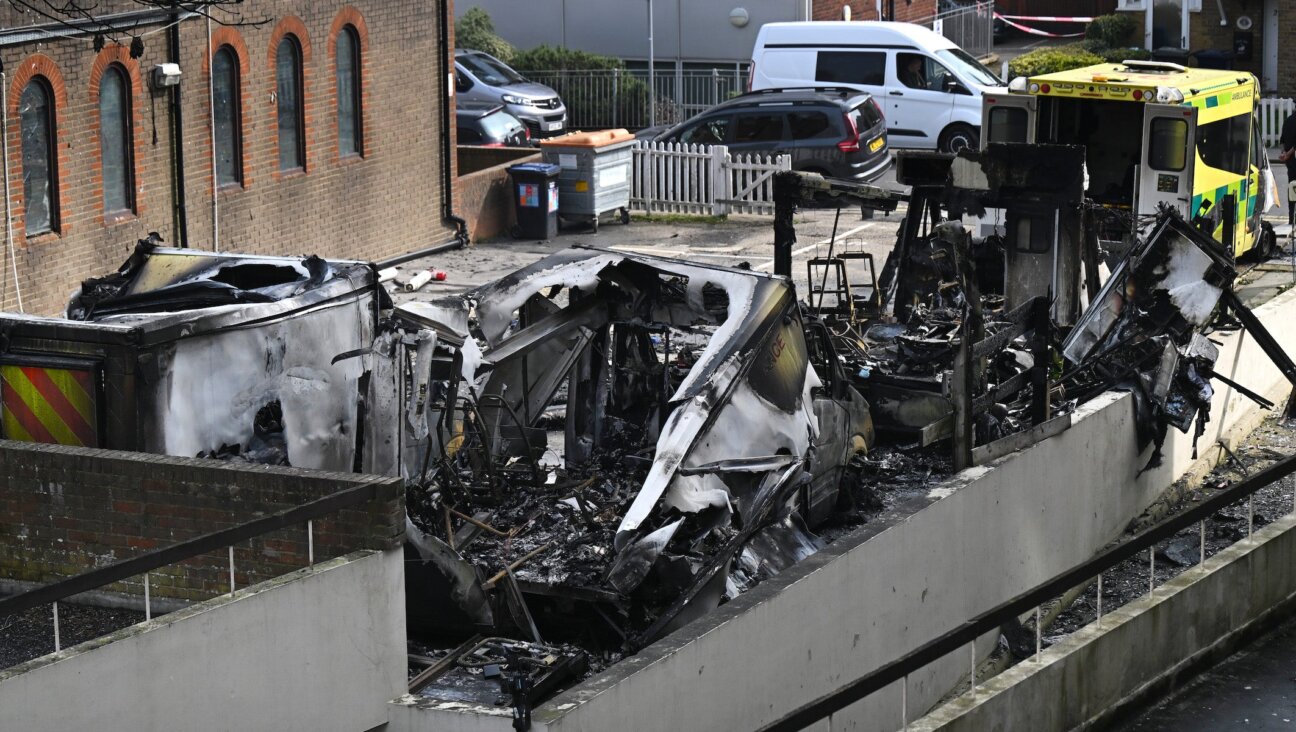
Powerful Firecrackers: Police officials in Malmo said the explosion at the shul?s front door (right) shattered three windows. Image by COURTESY OF FREDRIK SIERADzKI

By Maia Efrem July 28, 2010
A local Jewish leader reported that fears and tensions were rising in his community in Malmo, Sweden, after a small explosive device went off at the door of the local synagogue early on the morning of July 23.
Though no one was hurt, the blast’s impact shattered three windows and damaged the remaining five windows and the door of the 107-year-old Moorish-style synagogue.
The incident comes amid what local Jews described as repeated anti-Semitic episodes, many coming from local Muslims angered over Israeli policies and over the Malmo Jewish community’s perceived support for them.
In a phone interview, Malmo’s police superintendent, Mats Atten, attributed the blast to powerful fire crackers placed at the synagogue’s door and said the reverbrating sounds of the explosion could be heard even in distant parts of the city. Damage from the blast was immediately repaired, and evidence of the destruction it left was removed. The police currently have no suspects. “If no one has seen anything, and we have no leads, we can’t do anything, and the investigation will close. We are not magicians,” said Atten.
Malmo, with a population of 300,000, is home to 760 Jews alongside a rising Muslim population of 45,000. The friction between the two communities reached a boiling point during a 2009 support rally for Israel after the Gaza military operation. Police were unable to subdue a crowd of Muslim and leftist protesters who screamed obscenities and threw bottles and firecrackers at rally participants, forcing the rally to be aborted.
Fredrik Sieradzki, the Jewish community leader in Malmo, was taken aback by the attack on the synagogue. Though there have been continuing incidents involving individuals, he said, there have been no direct threats to the Jewish community as a whole since the January 2009 Gaza rally. “[It] was a comparatively small explosive device, but it was enough to sow terror,” he said of the synagogue event. “We see this as an attack; someone purposefully put it there to prove a point. It’s an anti-Semitic point. ‘Beware,’ it says,” Sieradzki said.
There has been no official comment from Malmo Mayor Ilmar Reepalu. Following the aborted Gaza rally, Reepalu criticized local Jews for organizing their pro-Israel demonstration rather than taking a stand against Israel’s invasion of Gaza.
“Reepalu has not said anything before about any attacks, and no one is expecting him to do it now. I would be surprised if he did,” Sieradzki said.
Like others in Sweden, the mayor was on vacation. When reached for comment, he said: “I’m sorry, I’m sailing. I don’t know much of what is going on in Malmo,” before hanging up.
But the community is not without supporters. “We can’t be like the mayor in Malmo and say the Jews only can blame themselves for their problems,” said Patrick Persson, a Malmo photojournalist who covered the attack on the synagogue and last year’s demonstration. “If I was a Jew in Malmo, I would not feel safe.”
“All of these things are terrible, but there are no pogroms on Jews here, and I want to make clear that the majority of people here are not anti-Semitic,” Sieradzki said. “We are watchful and on our toes, and hopefully this won’t go any further, but you never know.”
Contact Maia Efrem at [email protected]
This is a moment of great uncertainty. Here’s what you can do about it.
We hope you appreciated this article. Before you go, we’d like to ask you to please support the Forward’s independent Jewish news this Passover. All donations are being matched by the Forward Board - up to $100,000.
This is a moment of great uncertainty for the news media, for the Jewish people, and for our sacred democracy. It is a time of confusion and declining trust in public institutions. An era in which we need humans to report facts, conduct investigations that hold power to account, tell stories that matter and share honest discourse on all that divides us.
With no paywall or subscriptions, the Forward is entirely supported by readers like you. Every dollar you give this Passover is invested in the future of the Forward — and telling the American Jewish story fully and fairly.
The Forward doesn’t rely on funding from institutions like governments or your local Jewish federation. There are thousands of readers like you who give us $18 or $36 or $100 each month or year.
Support our mission to tell the Jewish story fully and fairly.