We Weren’t Always United by Indissoluble Bonds

Graphic by Angelie Zaslavsky
Michael Oren May 1, 2008
On June 1, some 100,000 people are expected to celebrate the 60th anniversary of Israeli independence at the annual Israel Day Parade in New York. And over the course of this year, as many as 30,000 young American Jews will visit Israel through Birthright, a program created to strengthen Israeli-Diaspora relations, and thousands more will come on educational exchanges and volunteer programs in distressed communities, kibbutzim and the army.
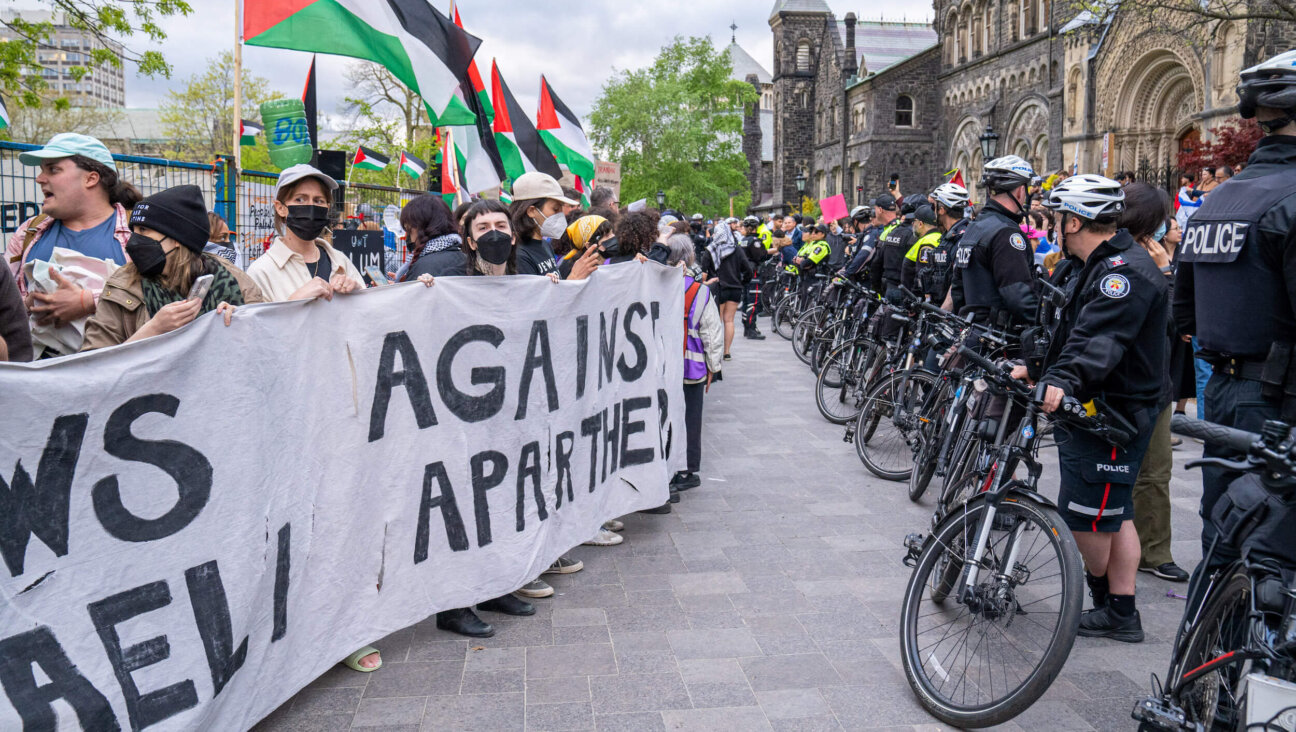
To be sure, some of the Jewish attendees at the Israel Day parade will be protesting Israeli policies, and a shadow Birthright program has been set up to bring American Jews to Palestinian refugee camps. But these critics of Israel represent only a tiny fraction of the American Jewish community.
Six decades after the birth of Israel, the bulk of American Jews continue to support the Jewish state and view it as an essential component of their identity. This wasn’t always the case, however.
In the past, many American Jews were ambivalent about Zionism and the renewal of Jewish sovereignty in the Land of Israel. Some rejected the Jewish state as a violation of God’s monopoly over redemption, while others feared that it called into question their loyalty as Americans. Others denied that the Jews were a nation at all or deserving of a separate state.
Indeed, throughout much of history, the American Jewish advocates of Zionism and Israel have been a small and sometimes infinitesimal minority.
The difficulties of rallying American Jews around the Zionist idea were experienced by the first American Jewish proponent of Jewish statehood, the famed journalist, statesman and soldier, Mordechai Manuel Noah. In a speech at a New York synagogue in 1818, Noah called for the renewal of Jewish sovereignty in the Holy Land.
“Where can we plead the independence for the Children of Israel with greater confidence than in the cradle of American liberty?” he asked. As a way station en route to Zion, Noah secured the rights to a Niagara River island that he renamed Ararat, where Jews could prepare for the burdens of sovereignty. Though blessed by Christian “restorationists” who viewed the Jews’ return to Palestine as the prerequisite for Jesus’ Second Coming, Ararat was ignored by most American Jews. Mostly German-born, the roughly 15,000 Jews of Noah’s America were more interested in acclimating to their new Promised Land — America — than in relocating to their old one.
A similar disappointment awaited Emma Lazarus, the American Jewish poet whose welcome to the world’s tired, poor, huddled masses adorned the Statue of Liberty. Appalled by pogroms against Russian Jews in 1881, she promoted the reestablishment of Jewish statehood in Palestine as “a home for the homeless, an asylum for the persecuted, a nation for the denationalized.”
Lazarus created the first American Jewish Zionist organization in New York, but failed to attract followers. Orthodox Jews condemned her for arrogating God’s exclusive right to redeem the Jewish people, while Reform rabbis lambasted her for suggesting that Jews were a nation separate from America.
Consequently, Christians remained the most ardent exponents of Zionism in the United States. A petition calling for the immediate transformation of Palestine into a Jewish state, submitted to the White House in 1891, was signed by 400 prominent Americans, among them John D. Rockefeller, J.P. Morgan and William McKinley, but very few Jews. Of the nearly 200 delegates to the First Zionist Congress in 1897, only four hailed from America.
The dawn of the 20th century brought no major awakening of American Jewish backing for Zionism. Out of a total Jewish population of 3 million in 1914, only 10,000 were members of the American Zionist Federation. Fortunately, the president of the federation was Louis Brandeis, the future Supreme Court justice who managed to expand its membership ten-fold by the end of World War I. “Every American Jew who aids in advancing the Jewish settlement in Palestine,” Brandeis declared, “will be a better American for doing so.”
Still, only a small number of American Jews heeded his call, and far fewer followed the example of young Goldie Mabovitch — later Golda Meir — and left the United States for Palestine. Some of the leading American Jewish organizations were cool toward Zionism, if not openly inimical.
The rise of Nazism might have spurred American Jews to greater Zionist activism, but the increase in Depression-era antisemitism and the reluctance of American Jews to pressure a popular president acted as counterweights. Roosevelt did nothing to challenge Britain’s decision to close Palestine to Jewish immigration in 1939, effectively dooming European Jewry, and American Jews did little to push him.
Such passivity reached tragic heights during the Holocaust. Shocked by the revelations of the Nazi genocide, American Jews flooded the Truman White House with pro-Zionist telegrams, pressed the government to approve the partition of Palestine in November 1947 and, the following May, to recognize the newly created Jewish state.
Yet no sooner was Israel established than American Jewry returned to quiescence. Almost none of them protested President Eisenhower’s threat to impose sanctions on Israel during the 1956 Sinai Campaign, or his refusal to sell it arms.
Not many more denounced President Johnson’s failure to defend Israel in the period before the 1967 Six Day War. Though deeply concerned for Israel’s fate, most American Jews watched helplessly while the Jewish state was again surrounded by Arab armies sworn to annihilate it.
The Six Day War, however, represented a turning point for American Jewish-Israeli relations. Empowered by Israel’s feat of arms, American Jewish organizations unambiguously proclaimed their support for the Jewish state and exhibited an unprecedented readiness to champion its interests in Washington.
The American Israel Public Affairs Committee was established in 1953, but only became a powerful lobby in 1975, when it marshaled congressional opposition to President Ford’s “reassessment” of American aid to Israel. Since then, the influence of Aipac and other pro-Israel organizations has grown to the point that incumbents and candidates alike routinely visit Israel and affirm their commitment to its defense.
Nevertheless, recent years have seen diminishing support for Israel in certain sectors of the American Jewish community, particularly among the unaffiliated and those too young to remember the Holocaust or the Six Day War. Anti-Israel biases on campuses have also had a deleterious impact, as have harsh media images of Israeli settlers in the West Bank and Israeli warplanes over Lebanon. Only 60% of American Jews have visited Israel, and 40% of American Jews under the age of 50 describe their attachment to Israel as low. Israel’s largest reservoir of affection in the United States may no longer be American Jews but, once again, Christian Zionists.
These statistics, however, do not reflect the immense upsurge of Israel activism among a committed core of American Jews. That energy has served to galvanize the wellspring of pro-Israel sentiment that has long existed in the Unites States and which exercises a profound influence on American foreign policy.
In addition, one must not lose sight of the contributions of American Jews to virtually every aspect of Israeli life — to education, religion, culture and politics on both the left and right. Today, as Israel embarks on its seventh decade of independence, indissoluble bonds unite American Jews and the Jewish state, assuring the continuity and vitality of both.
Michael Oren, a senior fellow at the Shalem Center in Jerusalem, is the author of “Power, Faith, and Fantasy: America in the Middle East, 1776 to the Present” (W. W. Norton, 2007).
I’m personally matching all gifts to the Forward, up to $36,000. Can I match your gift now?

Hello, fellow Forward reader! I’m Joel Brown, a Forward reader and supporter for more than 15 years, and currently the chair of the board of directors.
I’m an avid Forward reader because it ticks so many of my essential boxes: excellent journalism, Jewish focus and diverse viewpoints. In today’s political climate, what I most appreciate is the Forward’s independence — made possible by the generosity of its membership.
The Forward is committed to bringing you unbiased, nuanced Jewish news. From my position as board chair, I see an exciting future as we expand our position as the definitive independent voice of contemporary American Judaism.
— Joel Brown, Forward board chair
Support our mission to tell the Jewish story fully and fairly.