Puppet Golem Strikes Again

Graphic by Angelie Zaslavsky

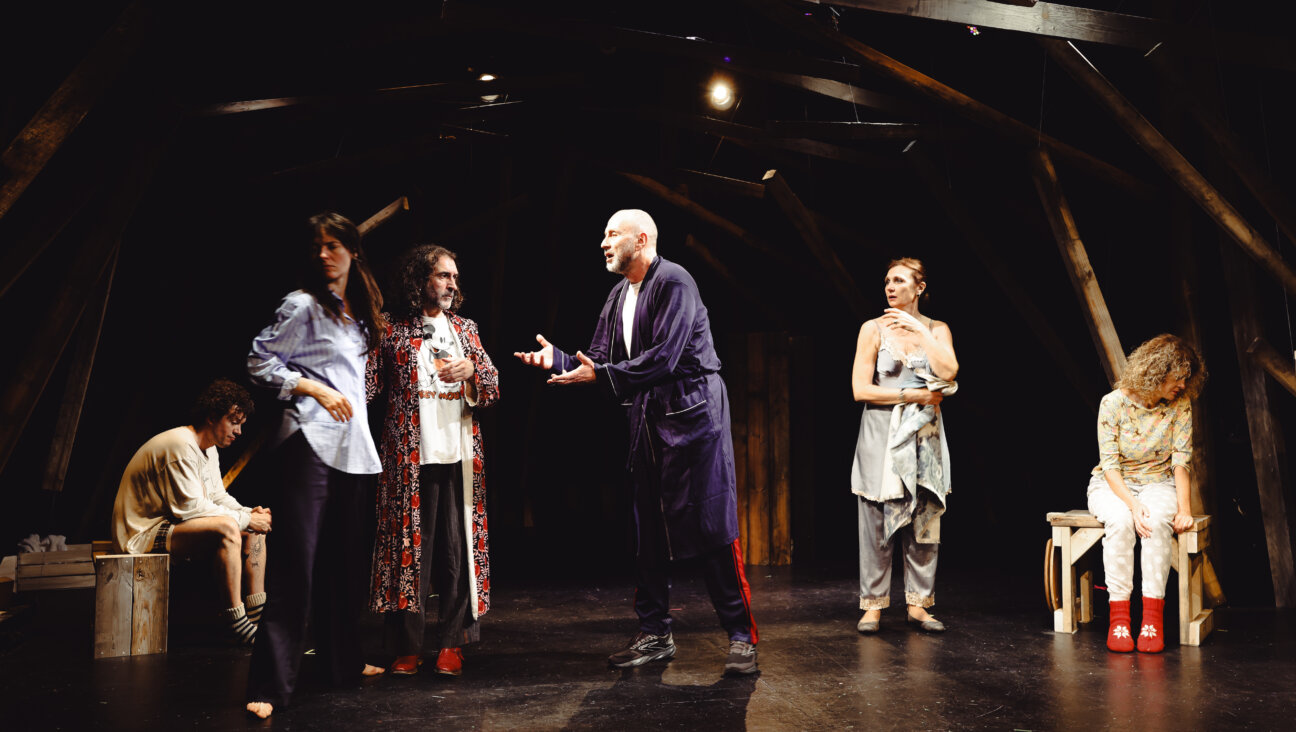
Man of Clay : The story of the Golem is well known in Prague, where legend says it was created to protect the Jews from pogroms. Image by lee wexler/ images for innovation
In the Czechoslovak-American Marionette Theatre’s production of “Golem,” the people are puppets (except for a ghost), and the man of clay is danced by a human being (Steven Ryan). And that’s how it should be, for although he doesn’t speak, Golem is a stand-in for man. He’s a creature who didn’t ask to be born, doesn’t understand his purpose and seeks love and receives punishment, both of which he accepts unquestioningly. Unlike Adam in the Garden, though, you couldn’t credit Golem with any kind of deceit — making him somewhat better, or at least more guileless, than the creature made by God.
The CAMT production that finished on December 4 — with original music by Frank London of The Klezmatics (and a seven-piece band), abstracted cage/building set pieces by Roman Hladík, and 20 marionettes of all sizes created by Jakub “Kuba” Krejcí, and moved by nine dancers/puppeteers — is hard to forget. For children it’s a romp, fun and different; for adults it’s all that, but tinged with sadness. What could be more Jewish?
The story of the Golem is less well known in America than in Prague, where Golem pictures rival those of Mozart and Kafka on souvenir mugs, chocolates and T-shirts. It helps to know the story, because there isn’t much dialogue — much of the show is danced (creative choreography by Naomi Goldberg Haas) — but you get enough from the narrator, Cantor (Ronny Wasserstrom), who sits at a potter’s wheel at the show’s opening and exhorts Rabbi Judah Loew ben Bezalel to create the man of clay in the first place.
As the legend goes, in 16th century Prague, Loew, the chief rabbi, created a clay man, a “Golem,” solely to protect the Jewish ghetto from pogroms. After a while, the rabbi’s wife couldn’t resist using Golem once or twice to help with chores, which was outside of his extremely narrow ken. When asked to mop, he nearly drowned everyone. When asked to get fish for the Sabbath, he comically overdid it. Eventually, angered, he destroyed buildings and gentiles, and the rabbi had to take out the emet, or truth, placed in the Golem’s forehead, which had brought him to life. Legend has it that the Golem still lies in the attic of the Alt Neu Shul, in Prague, where the Nazis went to look for him.
The CAMT production was first presented at La MaMa Experimental Theater Club in New York City in 1997 (though with different cast members and choreography), after having been developed at several workshops, including one in Poland. It now reappears as part of La MaMa’s 50th-anniversary season. Since its debut it has also appeared at the Henson International Festival of Puppet Theatre, while “Golem Tants,” a wordless tune commissioned for this piece, was recorded by Itzhak Perlman and The Klezmatics for “Live in the Fiddler’s House.” CAMT, under the direction of Vít Hořejš, is not just a puppet company, but one of the most consistently exciting, truly forward-thinking theater troupes in town.
Hořejš, who also wrote the piece, tells a story with every element of theatricality available to him. The character of the village Yenta (Alex Megan Schell) is his invention, and the Cantor associating the rabbi’s students, Isaac and Jacob (Fang Du and Scott Crawford), with elements of fire and water is both kabbalistic and atmospheric.
The puppets are not just wooden puppets on strings; they are also found objects. The fish, for example, are oven mitts, while the rabbinic students are instruments. In fact, one has a body shaped somewhat like a cello. The show is performed without an intermission and has a dreamlike quality to it. Throughout, it’s hard to separate the dancers from their puppets. During the wedding of the Rabbi and his fiancée, Perl (both slightly larger marionettes, operated, respectively, by Alan Barnes Netherton and Deborah Beshaw), barefoot dancers twirl in a whirl of their puppets. It’s wild, but also logical. Afterward, a cloth is removed from the matriarch-in-waiting, Perl, so that we see babies carved inside her and small puppet babies at her feet.
London clearly has klezmer overtones in his music, but he also makes liberal use of jazz and improvisation. The animation of the Golem begins with a long percussive section that sounds like cowbells. A great bald baby who doesn’t know his strength, the Golem is three times the size of the puppets that brought him to life. He’s a gentle giant, though, and as he mimics the Rabbi’s hand gestures, his intrinsic sweetness is palpable. In a wonderful sequence, a wide-eyed Golem strolls through Prague, with alleys created by dancers, absorbing the world and its wonders with enthusiasm.
Prague seems almost another character in the play. The set consists mostly of wired, spired, rolling pieces that can come together to form a cage, or stand in a row to form a backdrop of the city. Dancers move the buildings and also play them: Their black costumes (by Boris Čakširan, Anne Morrow, Kenney Alysia Raycraft, and Theresa Linnihan) have building windows painted on the back, so when they put up their hoods and face upstage, they form Prague. When Golem destroys them in his rage, they fall to the floor in eloquent heaps. Haas’s expressive choreography has the dancers whirl to the music, spinning the puppets at a wedding, or rolling as waves, with fish in them.
Some sequences eluded me: I didn’t quite understand what was happening with an apple cart (operated by La Mama family member Kiku Sakai) that Golem upset, which contained the head of a man. And in an early pogrom sequence, I was confused when it looked as though Perl had died. I think now that it was meant to be the mother of his adopted daughter, whose wedding happens later in the play. But these details didn’t really detract from the overall power of the piece. Wasserstrom’s ghostly Cantor is appropriately plaintive, particularly when singing Kaddish after a pogrom. His speech alternates gentle, Yiddish-inflected English to tell the story with somber, more ghostly statements about God, man and the world. There are many lessons to take from the production — man is unable to control his instruments; man shouldn’t attempt to be like God — but the one that especially touched me was how Golem, pushed to the limit, did not turn on the Rabbi. In some versions, he does, but it’s more effective here, where he doesn’t. It brings him to the level of an ideal servant, of a Creator unworthy of him. Fairy tale, indeed.
Gwen Orel is the only journalist who writes for both the Forward and Irish Examiner. She publishes the blog New York Irish Arts and has a doctorate from the University of Pittsburgh.
I’m personally matching all gifts to the Forward, up to $36,000. Can I match your gift now?

Hello, fellow Forward reader! I’m Joel Brown, a Forward reader and supporter for more than 15 years, and currently the chair of the board of directors.
I’m an avid Forward reader because it ticks so many of my essential boxes: excellent journalism, Jewish focus and diverse viewpoints. In today’s political climate, what I most appreciate is the Forward’s independence — made possible by the generosity of its membership.
The Forward is committed to bringing you unbiased, nuanced Jewish news. From my position as board chair, I see an exciting future as we expand our position as the definitive independent voice of contemporary American Judaism.
— Joel Brown, Forward board chair
Support our mission to tell the Jewish story fully and fairly.