Guns With No Bloodstains
Michael Carasyk writes from Philadelphia:
“It might be time for a column on the Hebrew expression *tohar ha-neshek, *which I haven’t heard in a while.”
The Hebrew words *tohar ha-neshek *— literally, “the purity of arms,” or “the purity of the gun” — are known to every Israeli, and they refer to the moral duty of a soldier in combat to avoid harming innocent civilians as much as possible. I assume that Mr. Carasyk thought the phrase a timely one because of the fighting going on in Gaza when he sent his e-mail.
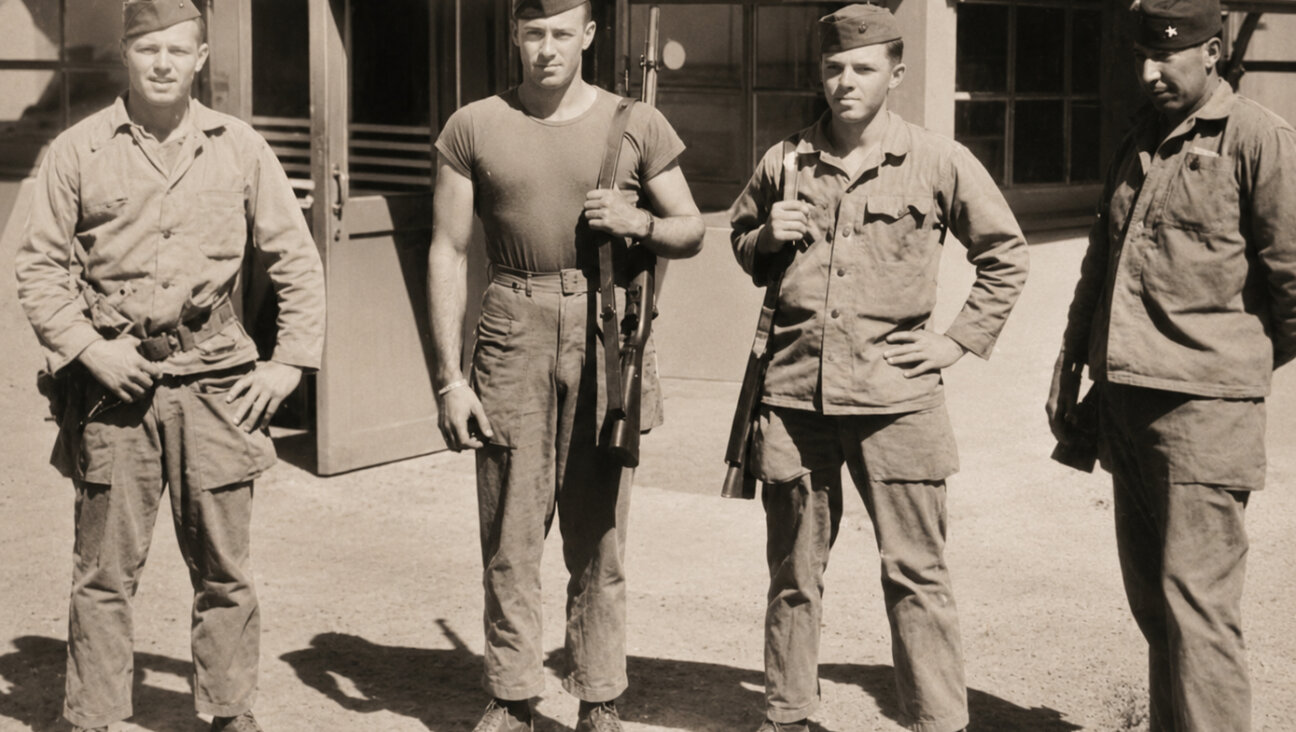
But before we get to Gaza, a bit of linguistic history. Although not an ancient Hebrew expression, *tohar ha-neshek *predates the State of Israel. It was coined following an address given at the 21st Zionist Congress in August 1939 by Berl Katzenelson, a prominent figure in Mapai, the Palestine Workers Party headed by David Ben-Gurion. Widely regarded as Mapai’s moral conscience, Katzenelson spoke about *havlaga, *or “self-restraint,” the notion that Palestine’s Jewish community should not respond in kind to the anti-Jewish terrorism perpetrated by the Arab revolt that took place from 1936 to 1939. *Havlaga *was a key issue dividing the fighting forces of the left-wing Haganah and the right-wing Irgun, which advocated and practiced counter-terrorism, and Katzenelson said in his address:
“The meaning of havlaga *is that our arms must remain pure [yehi nishkenu tahor*]. We must learn to use arms, we must bear arms, we must defend ourselves against whoever attacks us. But we do not want our arms to be stained by innocent blood.”
*Yehi nishkenu tahor *yielded *tohar ha-neshek, *which became part of the basic vocabulary of the Haganah and its elite commando unit, the Palmach. With the establishment of Israel in 1948, the Jewish state’s new army, the Israel Defense Forces, adopted the term. In the IDF’s official Ethical Code, drawn up in 1992, there is a passage that reads:
“The IDF serviceman’s purity of arms calls for self-control in the use of armed force. He will use his arms only for the purpose of achieving his mission, without inflicting unnecessary injury to human life or limb, or dignity or property, of both soldiers and civilians, with special consideration for the defenseless, whether in wartime, during routine security operations, or in times of peace.”
And now back to Gaza. Mr. Carasyk, I take it, is asking whether *tohar ha-neshek *was indeed a principle guiding the IDF’s recent operations or if it was mostly honored in the breach.
This isn’t a question that a column like this can answer. There already is, and will continue to be for a long time, a fierce debate in Israel and in the world over the “purity of arms” of the IDF’s military campaign in Gaza, and the issue is obviously not a linguistic one.
Still, a language columnist might be permitted to observe that the crucial word in the IDF Ethical Code’s definition of tohar ha-neshek is the ambiguous “unnecessary,” there often being no objective way of determining what is “necessary” in a war and what is not. If, for example, you are commanding a squad of soldiers that has been pinned down by sniper fire from a four-story building on a street in Gaza, is it “necessary,” in order to protect your own men, to call in a helicopter gunship to rocket the building at the risk of killing, besides the sniper, innocent people in it? The answer given by the soldiers under fire is likely to be different from that given by the civilians in the building. Who is to say which is the correct one?
There have been many arguments in Israel’s military history that concern the interpretation of *tohar ha-neshek — *one of the first, and probably the best known to this day, dates to the early months of Israel’s War of Independence. In January 1948, a platoon of 35 Palmach soldiers set out on foot from Jerusalem to help reinforce the Jewish settlements of the Etzion Bloc, then besieged by the Arab Legion and Palestinian irregulars. On its way at night through the Judean Hills, the platoon encountered an Arab shepherd. The pace of the platoon’s march made it impossible for it to take the shepherd along as a prisoner, and after a brief debate, it was decided to let him go on his way. This he did — straight to the nearest Arab fighting unit. The 35 Palmachniks were soon surrounded. And in the battle that followed, every one of them was killed.
It had been, it turned out, “necessary” to kill the shepherd — but who could have known this for a certainty in advance? Moreover, if he had been killed, the soldiers who killed him might have been haunted for the rest of their lives by the belief that they had done so unnecessarily.
Multiply this kind of dilemma by a thousandfold, and you have the fighting in Gaza. And there is not much time on the battlefield to make such decisions; often, they have to be arrived at in a matter of seconds. As a principle, *tohar ha-neshek *is an admirable one; in practice, it can be excruciatingly difficult to apply. One would have to study what happened on a case-by-case basis in order to come to any reasonable conclusion about how well the IDF applied it in Gaza.
Questions for Philologos can be sent to [email protected].

Did you know that only 2% of Forward readers donate to support our nonprofit newsroom? That 2% make it possible for millions to read the Forward without a paywall or subscription — removing any barriers to the full and fair Jewish story.
But while the Forward is free to read, it isn’t free to produce. Big stories — like deep dives into the antisemitism data, political scoops or reporting trips to college campuses — take months of research and fact-checking. All while we keep you informed of what you need to know each day.
— Rachel Fishman Feddersen, Forward Publisher & CEO
Support our mission to tell the Jewish story fully and fairly.