Don’t Blame All Ultra-Orthodox for Actions of One Stabber
Graphic by Angelie Zaslavsky
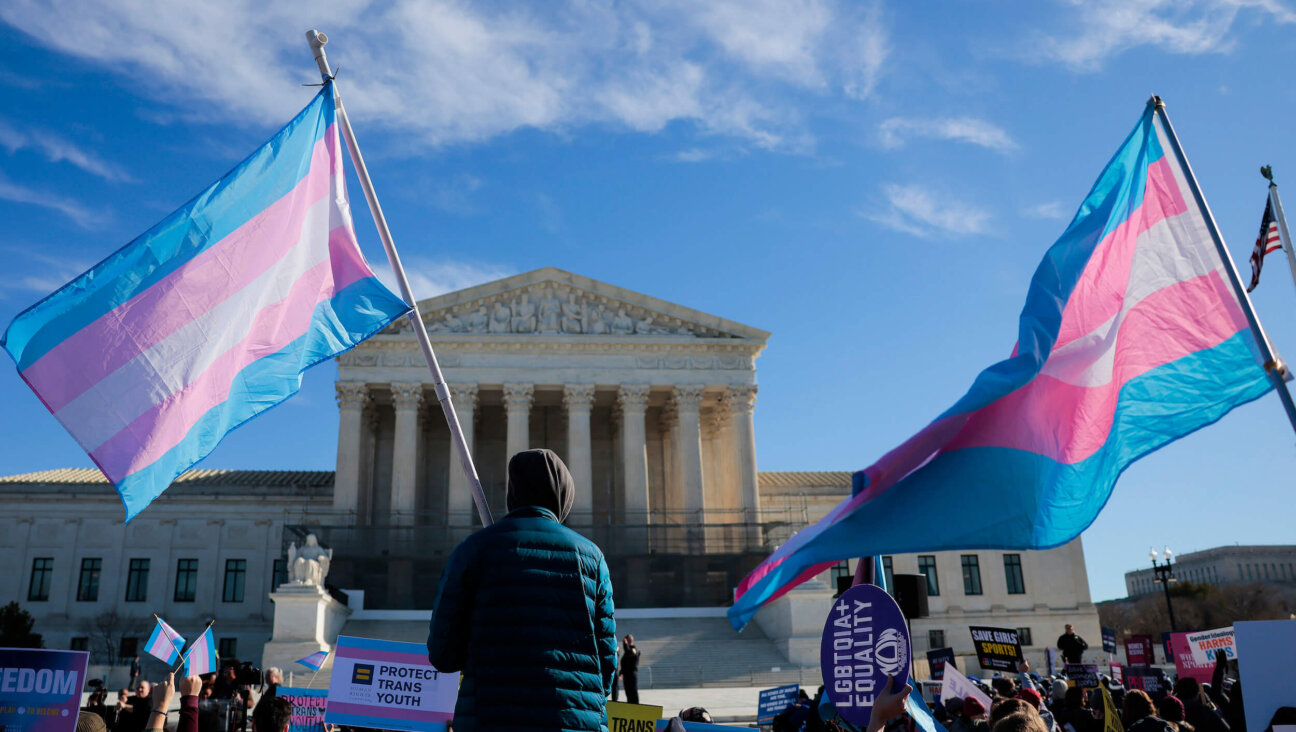
The death of Shira Banki, one of the six marchers stabbed at the recent Gay Pride Parade in Jerusalem, was a horrific exclamation point to the indefensible rampage.
Indefensible as well, though, were some reactions to the stabbings.
Forward columnist declared that the actions of the stabber, now murderer, Yishai Schlissel, were the result of Jewish religious leaders preaching “over and over again, that gay people deserved to be killed.”
Which presumably explains why there have been so very many attempted murders of gay people by Haredim in Israel. Only there haven’t been.
At last count, to the best of my knowledge, there were two such outrages. Both perpetrated, in fact, by the same fellow. The earlier one, a decade ago, was also the deranged act of the same Schlissel. He was released from prison mere weeks ago, after serving a decade for his first crime. May he be dealt with by the Israeli criminal justice system in an appropriate way; and may his surviving victims have speedy and full recoveries.
Michaelson seems unfazed by the rather salient fact that only Schlissel, and not a single one of the other hundreds of thousands of Haredim who hang on to their leaders’ every word, seems to have heeded the ostensible rabbinic exhortations to murder sinners. Could it be because… there haven’t been any such exhortations?
That is in fact the case. The Torah’s prescription of capital punishment for a number of serious sins, including male homosexual sex, is a mandate for the Jewish Sanhedrin (court) of the Temple Era, nor for our times, and not for individual vigilantes.
Further, even in the time of the Sanhedrin, due process requirements for capital punishment are such that the penalty was rarely if ever employed. Rabbi Elazar ben Azaryah, in the Mishna, asserts that a Sanhedrin that executed a single person over the course of 70 years was considered a “violent” one. The severity of the punishment is intended to signal the severity of the sin, not as license for vigilantism. Killing a sinner, in the Torah’s eyes, is no less murder than killing a righteous person.
Michaelson demands, among other things, that slander “against LGBT people, by individuals or organizations” must end — an astoundingly ironic demand, considering that, in Judaism, stating that what the Torah describes as sin is sin does not constitute slander, but accusing others falsely of fostering violence certainly does.
The columnist also calls on the Orthodox world to support or create organizations to provide “affirming counseling” for Jews with same-sex attraction; to renounce psychological counseling for Jews seeking to overcome such attraction; and to quash the publication of stories of people who claim to have rid themselves of homosexual tendencies.
But affirming acts that the Torah considers wrong is not an option for any Jew who takes Jewish tradition seriously. As to squelching personal experiences that don’t fit snugly into the politically correct party line, well, so much for liberal open-mindedness.
Another Forward writer, Rabbi Ysoscher Katz, writes that he knows Yishai Schlissel. Not the actual man, but the type. Katz grew up in a Hasidic environment, he explains, where people were dedicated to “religious sanctity and spiritual purity.”
Haredim, he explains, subscribe to the “dangerous” notion that “Man acts and God reacts.” The concept that our actions are meaningful in an ultimate sense, however, is a most basic Jewish belief. Katz, as a proponent of what calls itself “Open Orthodoxy,” may not subscribe to some bases of Judaism. But he really should not characterize those who do as potentially violently crazed.
Michaelson and Katz might take a quiet moment to ponder the fact that while there was one mentally ill Haredi stabbing people at the recent parade, other Haredim there were rushing to administer first aid to the wounded.
Those Haredim’s actions, not the indefensible act of the stabber, were the true expression of Haredi dedication to Judaism.
This is a moment of great uncertainty. Here’s what you can do about it.
We hope you appreciated this article. Before you go, we’d like to ask you to please support the Forward’s independent Jewish news this Passover. All donations are being matched by the Forward Board - up to $100,000.
This is a moment of great uncertainty for the news media, for the Jewish people, and for our sacred democracy. It is a time of confusion and declining trust in public institutions. An era in which we need humans to report facts, conduct investigations that hold power to account, tell stories that matter and share honest discourse on all that divides us.
With no paywall or subscriptions, the Forward is entirely supported by readers like you. Every dollar you give this Passover is invested in the future of the Forward — and telling the American Jewish story fully and fairly.
The Forward doesn’t rely on funding from institutions like governments or your local Jewish federation. There are thousands of readers like you who give us $18 or $36 or $100 each month or year.
Support our mission to tell the Jewish story fully and fairly.