In 1974, Amos Oz Wasn’t World-Famous — But He Was Already A Political Rebel

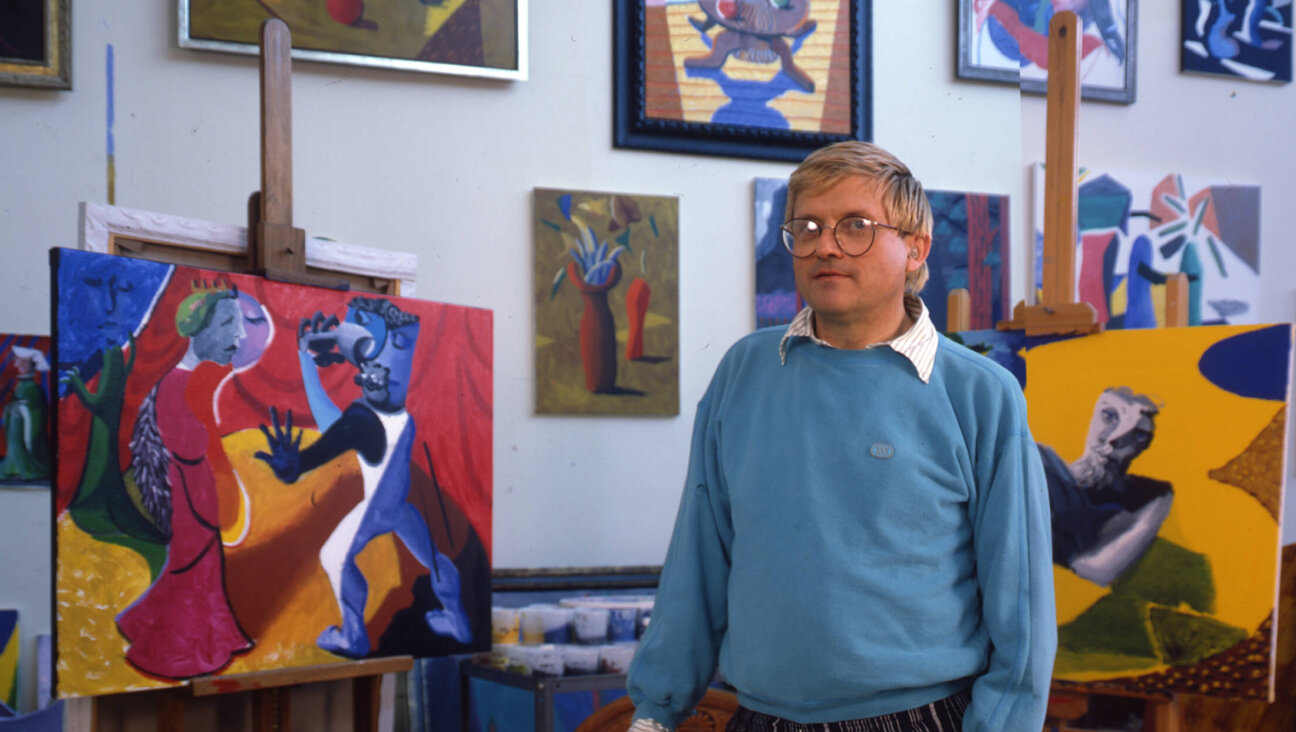
Amos Oz, circa 1970s Image by Forward Archives
Editor’s note: Amos Oz died on December 28, 2018. To commemorate his life, we revisited this glimpse of Oz before he became a figure of international renown, originally published by the Forverts on December 4, 1974.
Last week at the 92nd St. Y in Manhattan a young and famous writer from Israel — Amos Oz — gave a lecture.
I knew his name for several reasons. For one thing, he’s one of the young generation’s most talented writers. He’s been translated into several languages and so is well-known outside of Israel. Secondly, Amos Oz belongs to that young Israeli generation who have discarded much old-timey Zionist romantic sentimentality. Born in Jerusalem, he’s active in Israeli politics, especially concerning the Palestinian issue. As such, he’s one of the rare Israelis personally engaging with Palestinian Arabs and their intelligentsia.
Amos Oz has long claimed the Israeli government ignores the Palestinian existence and rightly, repeatedly spoke of the injustices caused them.
At the Y, packed with American-born youth, the atmosphere was tense.
There were two reasons for that suspense. The first was Oz’s reputation, best described as “controversial.” He has previously attacked the politics of Golda Meir’s government, and now he opposes Yitzhak Rabin. But the main reason was that on the very same day Amos Oz arrived in New York, the leader of the Palestinians, Yasser Arafat, who has alleged terrorist ties, also arrived here. And so, one waited anxiously to hear what the young rebel writer bearing the name of the prophet Amos had to say about the Palestinians.
And Amos Oz did not disappoint.
First and foremost, Amos Oz is a writer, and so he discussed the current Israeli zeitgeist as reflected in contemporary Israeli literature.
To start, the Palestinian Arab doesn’t exist anywhere, he said: Not in the country itself nor in its literature. In 1901, the British author Israel Zangwill famously wrote that “Palestine is a country without a people; the Jews are a people without a country.” This idea has been absorbed not only in the popular mindset of the early Jewish halutzim, or immigrants to Israel, but also in the pages of Israeli literature.
It endured until Hebrew writer Moshe Smilansky wrote about Palestinians in his books, depicting them as siblings from our foundational biblical family, whose newly arrived European relatives came bearing the “light of progress.”
The first Arab pogroms in the 1920s are considered to have been not so much as a conflict between Palestinians and Jews as a British machination. The first writer who perceived the danger of friction between Palestinians and Jews was S.Y. Agnon, who in the 1930s penned an allegorical story that made a huge impression. Agnon wrote about a farmer arriving in a new country to work the fields who, with each attempt, was felled by a windstorm that ripped out what he had only recently planted. He raised a hut, also to no avail. So he then built a massively strong house. And the windstorm came again, only this time the house remained unmoved. And the farmer not only came to believe his home was secured, but also that the windstorm would transform into a mild breeze caressing his brow after a day’s labors.
Oz extracted the moral from that allegory. Agnon, he said, was half right. When the storms of 1948, 1957 and 1968 came, the house of Israel remained upright. But the windstorms were not a mild breeze but a twister that would rage on.
The Palestinian issue remains unresolved, Oz said. And it can’t be resolved through outside forces nor via any super-power.
The only things Soviet Russia could do would lead to Israel’s extinction.
And all that America can do is save Israel from annihilation.
Only the two directly involved parties themselves — Israel and the Arabs — can bring about a peace. But, and this is the main point of Amos Oz’s speech: talks with the Arabs can only take place under one condition — that the one recognizes the other and does not call for the other’s destruction.
The upshot of the young Israeli rebel writer wasn’t optimistic. But that outcome revealed a compassionate consideration for the tension faced by Jews living in Israel. And it differs from that of so-called liberals who are please to repeat the indifferent and ridiculous phrase: I told you so.
This article was translated by Forward archivist Chana Pollack. To read it in the original Yiddish, visit the Historical Jewish Press Archive/].

Hello, fellow Forward reader! I’m Joel Brown, a Forward reader and supporter for more than 15 years, and currently the chair of the board of directors.
I’m an avid Forward reader because it ticks so many of my essential boxes: excellent journalism, Jewish focus and diverse viewpoints. In today’s political climate, what I most appreciate is the Forward’s independence — made possible by the generosity of its membership.
The Forward is committed to bringing you unbiased, nuanced Jewish news. From my position as board chair, I see an exciting future as we expand our position as the definitive independent voice of contemporary American Judaism.
That’s why I’m paying it Forward, by matching $36,000 of reader gifts. It’s an investment in the Forward’s newsroom, to continue telling the American Jewish story with truth and independence.
— Joel Brown, Forward board chair
Support our mission to tell the Jewish story fully and fairly.