Charlie Kirk kept a ‘Jewish Sabbath.’ What did he mean by that?
The conservative influencer was due to publish a book on a tech-free Shabbat this December
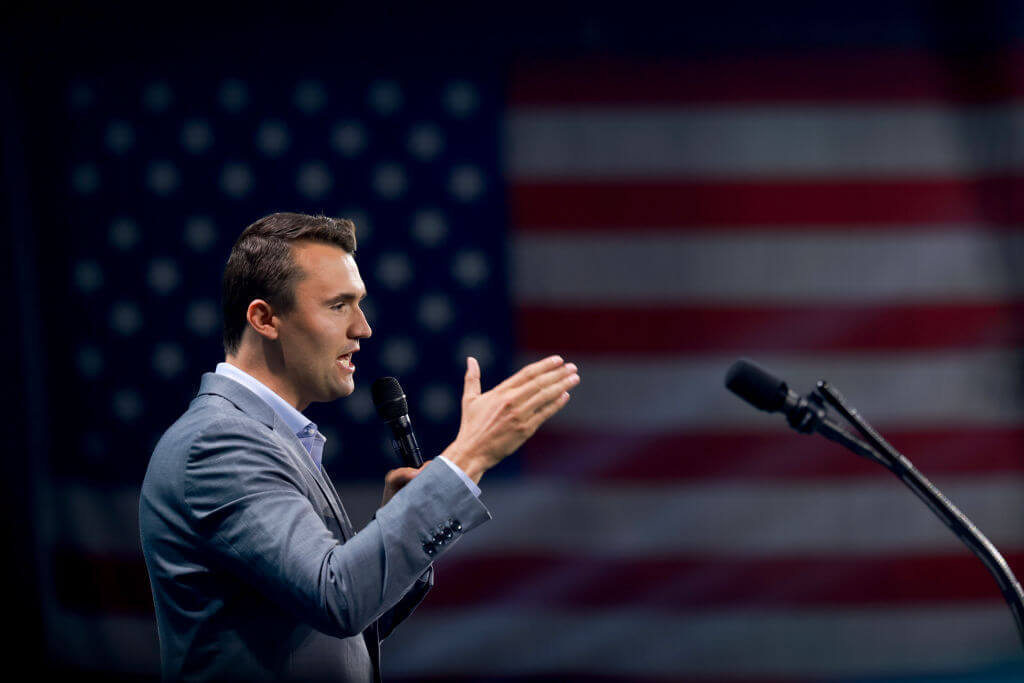
Charlie Kirk, who founded Turning Point USA, speaks before former President Donald Trump’s arrival during a Turning Point USA Believers Summit conference at the Palm Beach Convention Center on July 26, 2024 in West Palm Beach, Florida. Trump had earlier in the day met with Israeli Prime Minister Benjamin Netanyahu at Mar-a-Lago. Photo by Joe Raedle/Getty Images

By Mira Fox September 12, 2025
Charlie Kirk’s views on Jews paint a contradictory picture. The conservative activist, who was killed on Wednesday, was a proponent of Christian nationalism, though he rejected the label, instead calling himself “a Christian and a nationalist.” He regularly criticized Jews and repeatedly trafficked in ideas like the Great Replacement Theory, an old antisemitic canard.
But he had also more recently become fascinated by, and an advocate for, certain Jewish practices — in particular, keeping Shabbat. He was even due to publish a book on the subject, Stop, in the Name of God: Why Honoring the Sabbath Will Change Your Life, which is now slated to come out posthumously in December.
Many right-wing Jews, mourning his death, have pointed to this as a sign of Kirk’s appreciation for Judaism and Jewish culture, and as a way of defusing accusations of antisemitism he faced. But Kirk’s views on Shabbat — which he referred to as the Sabbath — didn’t primarily reflect an appreciation of Judaism, but rather his ability to incorporate the tradition of Shabbat into his Christianity.
At a January event held by Turning Point USA, the powerful conservative political group he founded at age 18, Kirk said he began keeping a tech-free Sabbath in 2021 after a “pastor friend” convinced him it was what he needed, both spiritually and personally.
“Every Friday night, I keep a Jewish Sabbath,” he said. “I turn off my phone, Friday night to Saturday night. The world cannot reach me, and I get nothing from the world. It will bless you infinitely.” He went on to assert that keeping a tech-free Sabbath would reduce anxiety and depression, and generally help the health of American families.
But to understand this purely as love for Judaism is incorrect. Kirk, who has said he grew up Presbyterian before transitioning to a church he described as “not quite Calvinist, not Pentecostal, something in the middle,” took pains to justify keeping the Sabbath as a Christian commandment. And he explained, in a speech with Christian group Wisdom Pearl, that he initially pushed back on the suggestion that he keep Shabbat, telling the pastor that keeping the Sabbath is a Jewish commandment that does not apply to Christians.
This difference may seem subtle, but it highlights the ways in which many Christians who adopt Jewish practices, whether that be a tech-free weekend day or a Seder, do so in a way that erases Judaism. Christian Seders generally change the ritual to be about Christianity, and interpret each symbol as predicting the coming of Jesus. Kirk’s Christian Shabbat, too, needed to be redefined and theologically justified. Otherwise, it would be unacceptable in many conservative sects of Christianity, even termed “Judaizing,” a form of heresy.
Still, many Jews — including Benjamin Netanyahu — saw Kirk’s support for Shabbat and Israel as signs of a shared set of “Judeo-Christian values.” Yet the idea of a single Judeo-Christian culture is a false one, used most often as a way of subsuming Jewish differences into Christianity.
This is the same fallacy underpinning not only Kirk’s adoption of a tech-free Shabbat, but also many of his stated reasons for supporting Israel, which weren’t rooted in a desire to aid or protect Jews, but stemmed from the fact that Christian holy sites are in Jerusalem.
Of course, the fact that Kirk’s Shabbat observance came from Christianity, not as a way of honoring Judaism, is not surprising; he was an outspoken Christian who supported a Christian U.S. government. But this doesn’t mean he didn’t also appreciate Jews for keeping Shabbat — he did, at least in some cases.
He just seemed unable to appreciate Jews, or Judaism, on their own merits. They had to be doing something Christian to be valuable.
This is a moment of great uncertainty. Here’s what you can do about it.
We hope you appreciated this article. Before you go, we’d like to ask you to please support the Forward’s independent Jewish news this Passover. All donations are being matched by the Forward Board - up to $100,000.
This is a moment of great uncertainty for the news media, for the Jewish people, and for our sacred democracy. It is a time of confusion and declining trust in public institutions. An era in which we need humans to report facts, conduct investigations that hold power to account, tell stories that matter and share honest discourse on all that divides us.
With no paywall or subscriptions, the Forward is entirely supported by readers like you. Every dollar you give this Passover is invested in the future of the Forward — and telling the American Jewish story fully and fairly.
The Forward doesn’t rely on funding from institutions like governments or your local Jewish federation. There are thousands of readers like you who give us $18 or $36 or $100 each month or year.
Support our mission to tell the Jewish story fully and fairly.