What this year’s Hallmark Hanukkah movie says about America
Hallmark is the epitome of mainstream, making its Hanukkah movies a good barometer for the place of Jewish culture in the U.S.
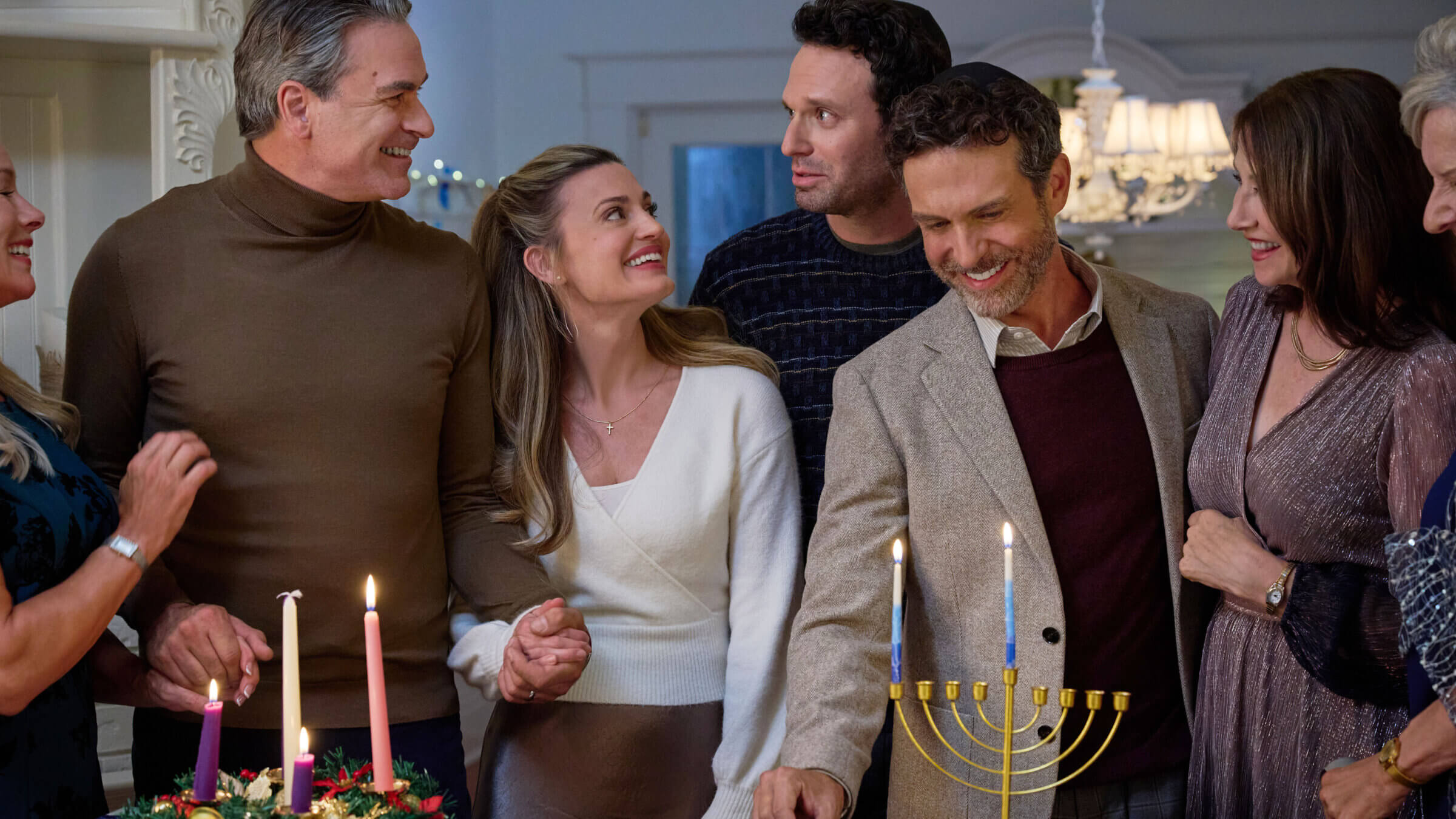
This may look like a Jewish scene, but half the candles are for Advent. After all, what is Hanukkah without Christmas? Courtesy of Hallmark

By Mira Fox December 12, 2025
I really try not to be a grinch (sorry) about Hallmark holiday movies. They’re not meant to be high art — their formulaic nature is part of their charm because you know there will be a happy ending with a side of holiday cheer. A small town boy will meet a big city girl — or vice versa — while home for the holidays; maybe they are rivals or perhaps simply an unlikely pair, but by the end they will fall in love and open an adorable bakery/bookshop/sweater emporium.
So I’m not looking for anything groundbreaking when I watch each year’s single Hanukkah installment among the dozens of Christmas movies that make up the channel’s holiday lineup; all they really need to do is not be offensive and not be completely inaccurate.
The reason I watch these movies at all is because Hallmark is, in an odd way, a great barometer of America’s mainstream culture. It aims for the center, not the cutting edge, with the goal of comforting, frictionless viewing, not stoking culture wars. Hallmark avoids the slightest whiff of controversy. That makes its movies a good reflection of the middle of America’s mainstream. And Hallmark is pretty good at it; in 2020, the channel was the number one cable network for women between 25 and 54 during December, and in some markets, the number one cable channel, full-stop.
Unfortunately, Oy to the World, this year’s Hallmark Hanukkah entry, lives up to its name. Which, I believe, implies a shift in Judaism’s place in American culture.
The issue is not just Hallmark’s usual clumsiness with Judaism. (Though there’s plenty of that — the line, “We’re Jewish, talking about people we haven’t seen in 20 years is as much of a tradition as lighting the menorah” efficiently managed to deliver Jewish stereotypes and clumsy Hanukkah exposition in one sentence.) It’s the basic concept that’s the problem: It’s all about Christmas.
The Hallmark Channel is a Christian company, not just in its heartland feel, but literally. It was formed when two Christian networks, the American Christian Television System and the Vision Interfaith Satellite Network merged into the Faith and Values Network, which was eventually acquired by the greeting card company. Christmas movies became its main growth strategy, and a highly successful one.
So it’s not surprising that its very first Hanukkah movie wasn’t until 2019, nor that the first few stabs at a Jewish holiday movie catered to an audience that creators seemed to assume had never met a Jew. The first attempts were full of clumsy explanations, stereotypes and, most importantly, more Christmas than Hanukkah.
But in the most recent few years, they seemed to genuinely be trying to make a movie some Jews might enjoy watching. One featured a deli war. In 2023, which was a Hanukkah-themed Groundhog Day ripoff, was actually quite sweet and even a little clever. Most importantly, they were actually about Jews.
This year, however, Hallmark relapsed.
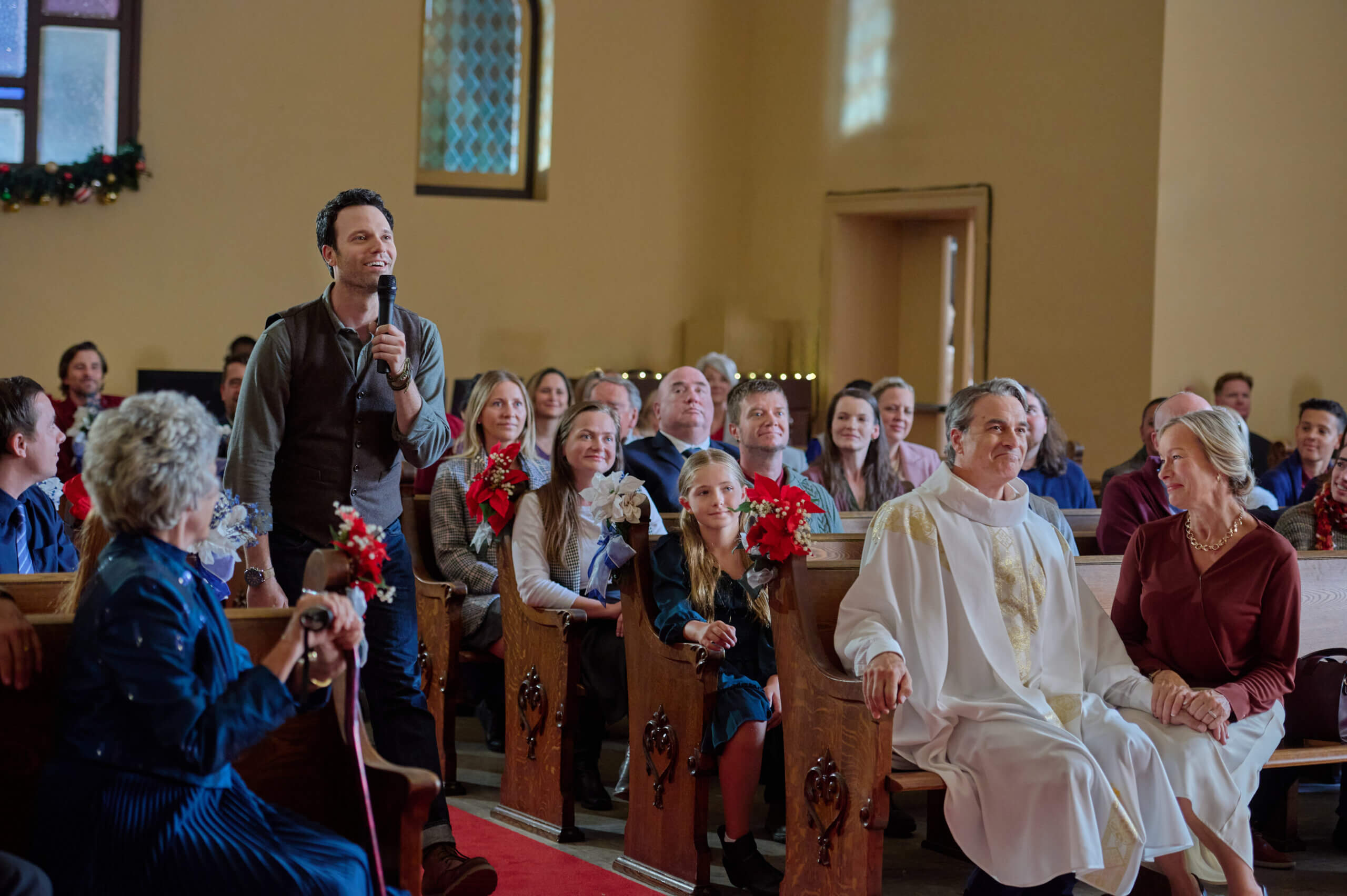
Let me give you the basic outline: Oy to the World’s central pair are Jake, a rabbi’s son who is now a musician living in New York, and Nikki, the daughter of a pastor and the church choir director in their hometown. They are, of course, childhood rivals because Jake beat Nikki in a school talent show way back when.
When a pipe bursts in the synagogue right before Hanukkah, Jake, despite having no plumbing expertise, rushes home. Everyone is terribly stressed because Hanukkah is coming and they can’t use the synagogue — “Where are you going to hold the candle lighting and other services?” someone exclaims in distress — when Nikki’s pastor dad invites them to celebrate Hanukkah on Christmas Eve in his Episcopalian church; they will combine services. (Though we have no idea whether the Jews are Reform, Conservative or something else altogether, we do know very specifically that the church is Episcopalian. And, pointedly, that they welcome interfaith marriages.)
There are obviously some accuracy issues here. Hanukkah is not celebrated in a synagogue and is, in fact, one of the most minor holidays of the Jewish calendar religiously speaking — though of course it has acquired more cultural weight thanks to its proximity to Christmas. Plus, some Jews hold that they should not even enter a church, much less combine services.
But I’m going to try to give the movie a little credit: Some synagogues, particularly smaller ones that cannot afford their own spaces, do meet in churches and occasionally they host candlelightings during Hanukkah. Sharing services is unusual but I’ll keep an open mind to interfaith ritual. The movie even notes that Hanukkah will end at sunset on Christmas Eve, which does not map to Hanukkah’s dates in 2025, but good on you, Hallmark, for knowing that Jewish holidays start and end at sunset!
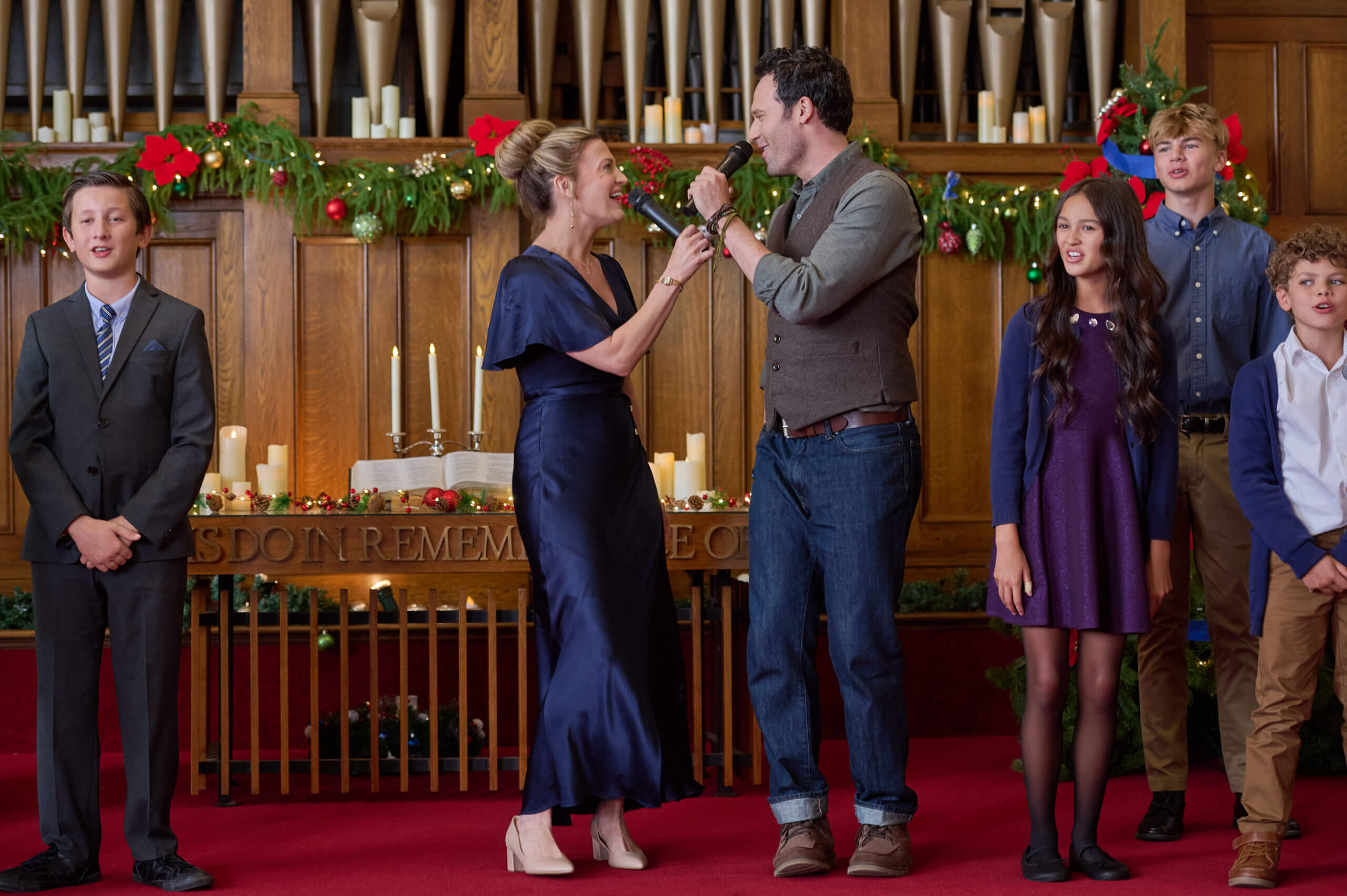
Still, fundamentally, this makes for a movie about Christmas, albeit with some Hanukkah details thrown in. Nikki and Jake are forced, by their preaching parents, to work together, and they combine the synagogue’s choir with the church choir, make cookies for a holiday bake-off (they accidentally combine their two families’ cookie recipes for gingerbread and rugelach, somehow) and go shopping for a Christmas tree — and a Hanukkah bush, which Jake notes is “not a thing” — to decorate the church.
Which left me wondering: What caused the relapse? There are two possibilities. One is that the script was written by AI, which feels plausible; it’s pretty clunky. The other is that Hallmark is, as ever, reflecting our current cultural moment.
A few years ago when the Black Lives Matter movement, LGBTQ+ rights and DEI were all dominating discourse, Hallmark’s output slowly shifted to align with a slightly more progressive perspective. Women had real jobs. Some of the characters weren’t white. And the Hanukkah movies stopped being about Christmas. This way, they could avoid controversy.
Today, however, Christians dominate not only our government but also our culture, with even the most extreme Christian nationalists like Nick Fuentes finding themselves in mainstream discourse, making the rounds on talk shows. Trump, who, in his first presidential term, stoked the idea of a war on Christmas, established a task force to combat “anti-Christian bias,” and formed a Commission on Religious Liberty with only one non-Christian member.
Hallmark, it seems, is reading — and reflecting — these tea leaves.
“Find your holiday spirit,” Nikki’s pastor dad admonishes the pair when they are butting heads. “It’s kinda hard to do when you’re always at odds with each other.” Later, he reiterates the message: “When we focus on our differences, we lose our commonality.” Sure, the differences in question are arguably, uh, losing a talent show in grade school, but I think we can read between the lines.
Of course, working together is a nice message, but in this context, it seems to imply that Jews are welcome as long as they are happy to participate fully in Christmas. In fact, Jake actually has more Christmas spirit than Nikki, which is how they ultimately bond and we reach our predestined happy ending. Hanukkah is also welcome, sure, but it needs to look and feel like Christmas, with a decorated bush, cookies and carols.
The same is true in real life. The invitations for JD Vance’s Hanukkah party at the vice president’s residence this year included the message, “Golden Noel: Celebrating 50 years of Christmas,” the theme for all the Vice Presidential holiday parties this year. Come for Hanukkah, but don’t forget the real reason for the season is Christmas.
To be clear, plenty of American Jews do celebrate Christmas, whether as a secular celebration or because they’re part of an interfaith family. My own family does. But plenty don’t, and don’t want to feel pressured to do so.
This is still arguably an improvement on Hallmark’s earliest Hanukkah efforts, though, in which Jews were portrayed as total outsiders to American society and treated with mild suspicion. Now we’re welcome! Part of things!
And I will give credit where credit is due: Hallmark has improved its Jewish representation in one big way. David Julian Hirsch, who plays the rabbi, can actually pronounce the “ch” in Hanukkah.
This is a moment of great uncertainty. Here’s what you can do about it.
We hope you appreciated this article. Before you go, we’d like to ask you to please support the Forward’s independent Jewish news this Passover. All donations are being matched by the Forward Board - up to $100,000.
This is a moment of great uncertainty for the news media, for the Jewish people, and for our sacred democracy. It is a time of confusion and declining trust in public institutions. An era in which we need humans to report facts, conduct investigations that hold power to account, tell stories that matter and share honest discourse on all that divides us.
With no paywall or subscriptions, the Forward is entirely supported by readers like you. Every dollar you give this Passover is invested in the future of the Forward — and telling the American Jewish story fully and fairly.
The Forward doesn’t rely on funding from institutions like governments or your local Jewish federation. There are thousands of readers like you who give us $18 or $36 or $100 each month or year.
Support our mission to tell the Jewish story fully and fairly.