When a Jewish paperboy played Santa — and the journalist who never forgot him
A 1967 UPI holiday story resonated far beyond Christmas Eve — for its writer, its subject, and the era they lived through
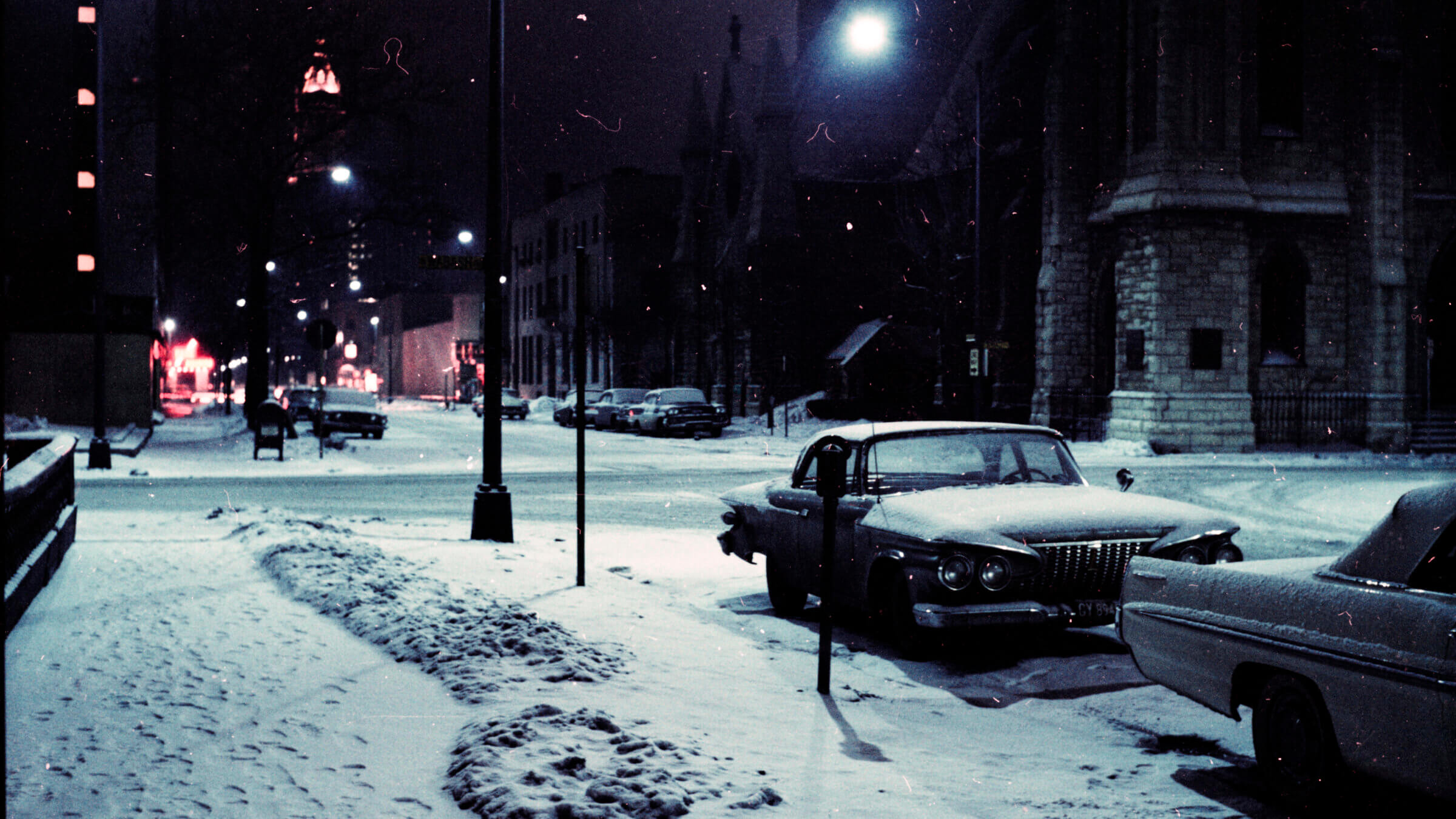
Chicago’s Michigan Avenue during a snowstorm, circa 1960s. Photo by Calvin M Hutchinson/Chicago History Museum/Getty Images

By Robin Washington December 22, 2025
On a blizzardy Chicago night in December 1967, a reporter named Leonard Fisher happened upon a 10-year-old boy dragging a newspaper sack and buying an item at a Magnificent Mile gift shop.
“Looks like you’re playing Santa Claus this Christmas,” Fisher said to the youngster.
“No, this is for my mom,” the boy replied. “She’s Jewish — it’s a Hanukkah present. I’m Jewish too. See, if your mom is Jewish, you are too.”
The boy went on to explain that his father wasn’t Jewish, so he bought him a Christmas present, as well as gifts for other members of his interfaith family. He also had a present from a customer on his newspaper route, and a pocketful of holiday tips.
I know that story well because I was that kid.
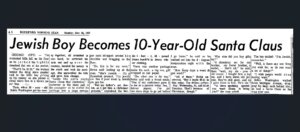
I also know details I may have otherwise forgotten because of the article Fisher wrote about our encounter for United Press International. It ran in newspapers nationwide, under headlines like “Jewish Boy Becomes 10-Year-Old Santa Claus.”
The response was overwhelming, with readers across the country sending me cards and checks. I picked them up at the UPI office, and visited Fisher a few times after that.
Eventually, however, we lost touch — until 2017, 50 years later.
While searching online, I came across my name in The East Hampton Star, a community paper near Fisher’s Long Island home. After retirement, he’d rewritten the story, calling it one of the most memorable of his career.
By then, I too had become a journalist, and Fisher’s son, Ari, found my byline in The Boston Globe.
There weren’t many Lenny Fishers listed on Long Island. I called the first one I found.
“Hello, I’m looking for Leonard Fisher,” I said.
“This is he.”
“This is Robin Washington.”
“Oh, you’re kidding! I’ve been meaning to call you to see if you were the same guy. You fit all the descriptions and that kind of stuff. You’re the same guy, yes?”
“I’m the same guy.”
“Incredible. Fifty years later!”
Fisher recalled our first meeting.
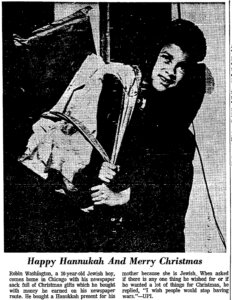
“I watched you walk down the street that day,” he said, recalling my 4-foot-4 frame braving the elements. “The wind was howling. And I said to myself, you know, ‘If ever” — and I’m Jewish — “if ever there was a Santa Claus, man, there he goes, right there.”
He also said he was blown away by the mail that came in. “I’ve never seen such a response. For people to send money in on a story, you know, a lot of people were moved by it.”
A large part of that was in the way Fisher told it: Describing every detail, capturing me perfectly, as in this exchange:
“Is there anything special you want Santa to bring you?” the man asked.
The boy smiled: “I’m Jewish, remember?”
“Well, is there any one thing you wish for, or do you want a lot of things?”
“I wish people would stop having wars.”
That had to strike a nerve in 1967.
Fisher’s wife Susanna said the story stayed with him because it broke from the corruption and calamity more typical of his career, most of it at the Newark Star-Ledger.
“He covered 9-11, but he was really kind of shell-shocked by that. Couldn’t stand loud noises and stuff,” she said. “The story about you was a really positive thing. And, as you know, in the news business, there aren’t a lot of really positive stories.”
He framed a copy, which his daughter Rachel has on her apartment wall.
“He had particular stories that he would tell us as kids over and over again,” Rachel said. “It was like a holiday movie. I could really just picture it.”
Fisher asked if he influenced me in going into the business. I usually answer that I had few mentors, but if there was anyone, it was him. Those visits to the UPI office were formative, and as paperboys, I said, “we always felt we were in the newspaper business. You didn’t disabuse me of that notion.”
And making up for a half-century, we swapped journalism tales, including stories we both covered and people we both knew in the business. Most importantly, we planned to meet in person.
We never did.
Lenny Fisher died in 2024. A tree-planting and celebration at his favorite restaurant in the Village was planned for his yahrtzeit last June, but postponed; I’m sure it’ll happen in due time.
Because we were both journalists, we knew to record the call, by the way.
“Go ahead, record,” he said. “This is the perfect Christmas/Hanukkah story,” he said. “You can’t make this up.”
This is a moment of great uncertainty. Here’s what you can do about it.
We hope you appreciated this article. Before you go, we’d like to ask you to please support the Forward’s independent Jewish news this Passover. All donations are being matched by the Forward Board - up to $100,000.
This is a moment of great uncertainty for the news media, for the Jewish people, and for our sacred democracy. It is a time of confusion and declining trust in public institutions. An era in which we need humans to report facts, conduct investigations that hold power to account, tell stories that matter and share honest discourse on all that divides us.
With no paywall or subscriptions, the Forward is entirely supported by readers like you. Every dollar you give this Passover is invested in the future of the Forward — and telling the American Jewish story fully and fairly.
The Forward doesn’t rely on funding from institutions like governments or your local Jewish federation. There are thousands of readers like you who give us $18 or $36 or $100 each month or year.
Support our mission to tell the Jewish story fully and fairly.