2025’s Jewish highlights — from ‘Marty Supreme’ to Max Fried’s menschy move
It was a whirlwind year, for Jews and the world
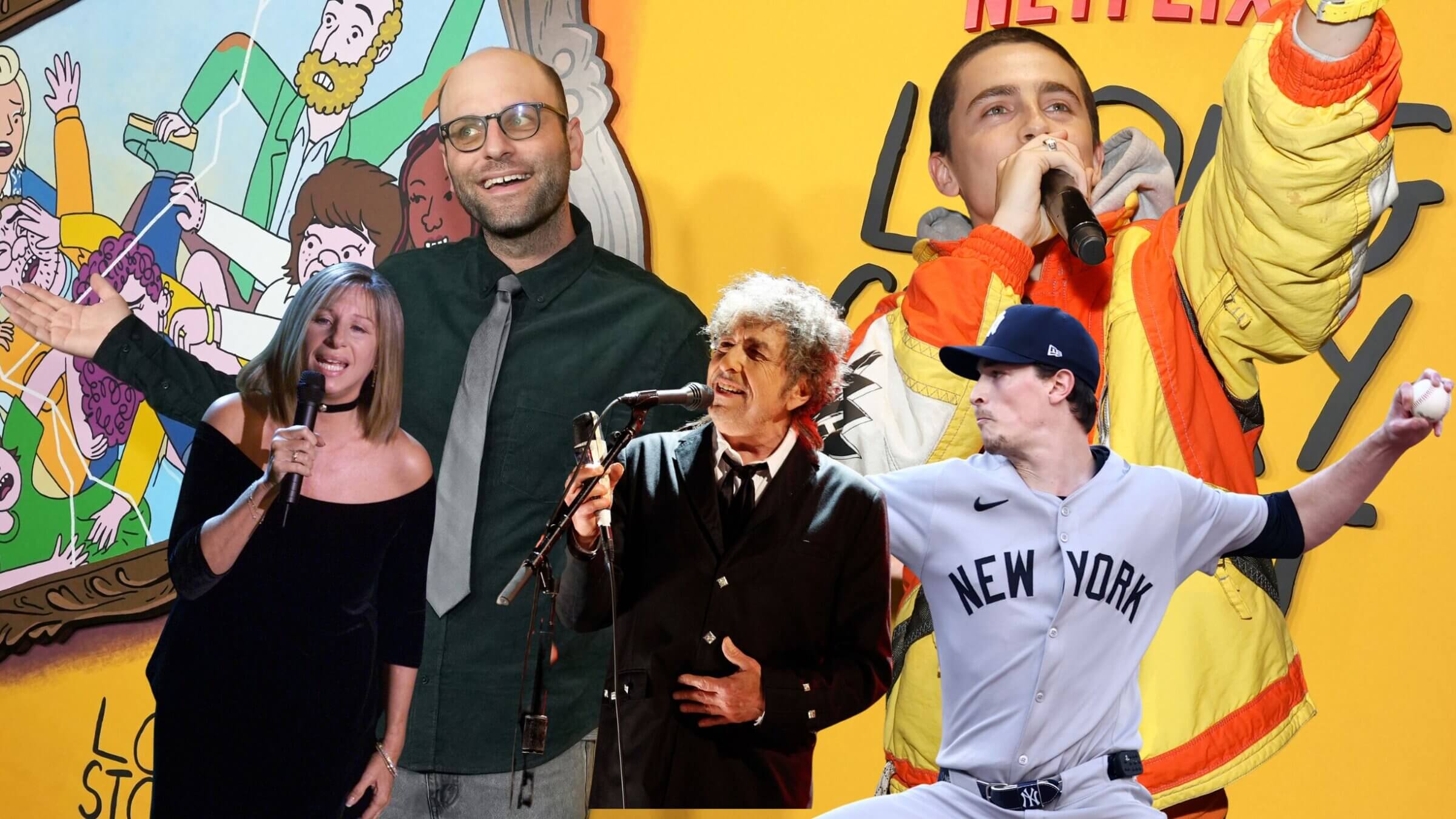
Can you name all the Jews who made the news? Graphic by Getty Images/Canva




By Mira Fox, PJ Grisar, Olivia Haynie and Louis KeeneDecember 24, 2025
Jews have been in the spotlight in the past years for all kinds of reasons, many of them less-than-fun: Gaza, war, hostages, protests. But looking back, we wanted to boil it down into highlights. Or at least things that were just really, really Jewish. Basically, everything we thought was worth making note of in the last year, whether for its merits, its lack thereof, or just for its pure oddity.
You may notice reading that there seem to be a few doubles in these categories. But, you see, the “best Jewish movie” is not necessarily the “most Jewish movie.” That’s because there has been a glut of loudly Jewish content that’s awfully hard to ignore, screaming for our attention. That doesn’t mean it’s good, but it’s notable.
So read on for the Jewish things you should remember — whether you want to or not — from 2025.
Best Jewish movie
It’s apparently a Safdie family tradition to induce anxiety in movie-going Jews on Christmas. (Uncut Gems arrived Dec. 25, 2019.) Josh Safdie’s film, about salesman-hustler-table-tennis dynamo Marty Mauser, accumulates Yiddishkeit as it goes, including a brief cameo by a Forward delivery truck. Timothée Chalamet dons thick-rim glasses and hangs a Magen David over his chest as he jousts with a Holocaust survivor opponent (there were a few ping-pong champs who did, in fact, survive Auschwitz). A character in the tradition of Sammy Glick and Duddy Kravitz, Marty is as magnetic as he is entitled. While the film’s concerns are universal, it is perhaps primarily a portrait of the New Jew, not of the Nordau school, but the American one, who regarded success as something he’s owed.
Most Jewish movie
These days, there is such a glut of Holocaust content that each new book, movie or show has to find a unique niche. Nuremberg did so by focusing on the relationship between Hermann Goering, Hitler’s right-hand man, and the psychiatrist assigned to analyze him before the eponymous trials, a man who hoped to find some genetic or mental component for evil that he can diagnose.
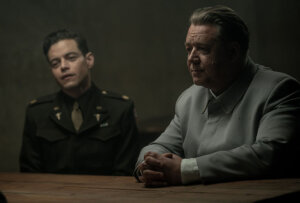
But the movie is so intent on being informative that it neglects to actually develop its characters and give real insight into Goering’s mind and motivations, or anyone else’s. Though it purports to be a movie about the banality of evil, it was actually just banal. It culminates in the shocking realization that evil has no genetic component, and most of its reveals carry just as little weight. Its most impactful moment is actually a piece of another film: the archival footage shown during the actual trial, which the movie excerpts.
Most Jewish movie that isn’t actually Jewish
Sentimental Value
In Joachim Trier’s film, which won the Grand Prix prize at Cannes, aging filmmaker Gustav Borg pursues reconciliation with his daughters by trying to cast them in his next film, which is a dramatization of his life. He wants the younger sister Nora, a theater actress who battles crippling anxiety, to play his mother who died by suicide; he’s cast the preteen son of Agnes, the elder sister, as a younger version of himself.
The Norwegian family depicted in this film isn’t Jewish. But Trier introduces all the classic beats of Jewish cultural concern: inherited trauma, the artist’s struggle, and the allure/disappointment of goyish blondes (this one played distractingly by Elle Fanning).
(Bonus points for Jewish musical-comedy darling Catherine Cohen’s bit part as Fanning’s phone-addicted manager.)
Most Jewish TV
The second season of Netflix’s Hot Rabbi hit rom-com, once again dominated Jewish conversations — and the streamer’s most-watched list. But much like its huge first season, the second left something to be desired in terms of its representation of Jews, who once again seemed to be incredibly limited by their religious identity and beliefs, and yet simultaneously eager to cast them off given the right opportunity. Stereotypes — like Jews being bad at sports or good at complaining — do a lot of the work of making the show Jewish. The effect is that Nobody Wants This doesn’t feel Jewish so much as it screams at the audience “this is a Jewish show!”
The show’s approach to Jewishness is perhaps best captured by the fact that menorahs, inexplicably, constantly appear in the background, even though it’s not Hanukkah at any point in either season. But without a hanukkiah on display — and, sometimes, lit — how would we know it’s Jewish?
Best Jewish TV
Long Story Short
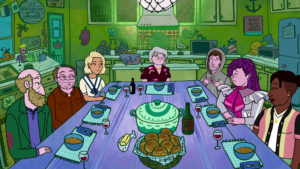
The animated show from the creator of the surrealist show Bojack Horseman, Raphael Bob-Waksberg, managed to avoid the pitfalls that so often plague very Jewish media — namely heavy-handedness around Israel, or antisemitism, or leaning on clumsy exposition to define Jewish practices for a gentile audience. Instead, the show just lets its Jewish family be, while also showcasing a wide range of Jewish diversity; the family includes a Black Jewish convert, both a ba’al teshuva son and another son who struggles to connect with his Jewishness, and a queer couple. Each character feels deeply familiar to anyone who spends time in Jewish community, but the show doesn’t try to make the jokes easy to read to non-Jews. Maybe that means some of them fly over the heads of anyone not in the tribe, but that means it’s pitch-perfect for those of us looking for a deeper, subtler representation of Jewish life.
Most Jewish play
The latest play from writer and actress Liba Vaynberg, imagines how six of the Biblical matriarchs — Miriam, Sara, Rebecca, Rachel, Leah and Tziporrah — would have lived today. Set over the course of decades, the girls start the play as 13-year olds and end it in the late stages of adulthood. Each girl’s path is a smart imitation of their matriarch’s actual story, transposed into the modern day. Sara struggles with infertility. Miriam becomes a rabbi, believing that studying Torah will help her lead a good life and avoid misfortune. Leah’s mandrake root is substituted by weed edibles. With humor and an impressive amount of Jewish references that only those steeped in biblical expertise might catch, the play asks: Why is life full of sacrifices, especially ones that seem unjustified? Vaynberg is not interested in giving a solid answer, but still provides a satisfying ending, assuring that life, no matter what it brings, is meant to be lived in full.
Best Jewish play
Slam Frank
Ragebait maestro Andrew Fox’s opus, which reimagines Anne Frank as Anna Franco, a pansexual Latinx immigrant from the “barrios of Frankfurt,” is a piece with many moving parts: a social media campaign that shames the Auschwitz-Birkenau Museum for not including chanclas in their mountains of shoes and, yes, also a “real musical,” despite the doubts of many online who assumed it was pure trolling. In fact, it’s a lucid commentary on the state of woke, where identity boxes serve as proxies for character development, and stops just short of being a full referendum on inclusion.
The piece, riffing on nearly every virtue-signalled mega-musical of the last two decades, is at its most knotty when it takes on Jewishness; Fox knows being Jewish doesn’t map neatly to the fashionable formulas of white privilege and oppressor-oppressed. In the end, it is the reimagined attic residents’ existence as Jews that unravels the simple binaries of progressive politics.

Most Jewish book
Sam Sussman’s novel takes the author’s own nebulous biography as its subject — and the suspicion that Bob Dylan may be his father. If this wasn’t Jewish enough, the initial meeting of his mother and the future-Nobel Laureate took place in the studio of painter Norman Raeben, whose father was Solomon Naumovich Rabinovich (aka Sholem Aleichem). The book generated a lot of interest as a work of a promising debut from a young novelist.
Another extremely Jewish book
Kaplan’s Plot
A rollicking story that toggles between a Ukrainian mobster scraping by and a modern-day tech worker digging through family history, essayist and memoirist Jason Diamond’s first novel digs into Jewish Chicago. Really, as any good Jewish story spanning generations, the book is an examination of the impact of inherited trauma, but it’s not too heavy; it crackles with fast-paced Yiddishisms and the propulsive plot of a thriller. Jewishness isn’t the book’s subject as much as it is its entire ethos.
Funniest Jewish newsletter
One of the brightest and least-talked-about trends in the Jewish world right now is the second wave of Substack newsletters introducing new perspectives on Jewish life. (Read about the first wave here.) Bagel Emoji, a semiregular dispatch from a semi-anonymous, gay semi-Orthodox Jew who lives in Los Angeles, delivers feverish, meandering riffs on niche trends like AI content in Jewish print publications and the notorious odor of a particular kosher grocer to say something deeper about frum life. Bagel’s general sass — thinly masking affection, I think — makes each entry essential reading.
Spiciest Jewish newsletter
Picture a newsletter about Israel discourse so hot it must be handled with gloves. That’s NonZionism, a regular rant from an Israel-based writer who goes by the pen-name Mascil Bina. Skewering the excesses and hollowness of both pro-Israel and anti-Israel ideology, the author’s perspective offers a third position: that Israel is “something that wasn’t inevitable, but cannot now be undone.” His takes are unsparing, and unexpected — one week, it’s the case for Bibi Netanyahu; the next, it’s a withering critique of hasbara titled “Zionism turns your brain to mush.” Just recommending it feels risky.
Best Jewish music moment
Streisand and Dylan duet
Streisand announced an album of duets, The Secret Of Life: Partners, Volume Two, with the likes of Hozier, Paul McCartney, Mariah Carey, Ariana Grande and — finally — Bob Dylan, resolving decades of a great musical will-they-won’t-they.
“The track opens with the sound of harmonica, a sound often associated with Dylan,” wrote the Forward’s Seth Rogovoy. “But this harmonica sounds nothing like Dylan’s style, and it is definitely not Dylan playing.” He is singing though, and Barb comes in by the fourth line. Unfortunately, they have yet to duet on “Lay Lady Lay,” a song Dylan purportedly wrote with Barb in mind.
Best ‘good for the Jews’ moment
Britney Spears admiring the beards of Chabadniks playing chess
The Instagram post was rizz recognizing rizz.
Best Jewish food moment
Manischewitz launches food truck

Since 1888, the Manischewitz Company has been a Jewish household staple. But now, it’s taking its signature products on the road. The Manischewitz Deli on Wheels, an orange truck that serves rugelach, hot dogs, vegetarian egg rolls, and matzo ball soup, launched this March as part of the brand’s plan to market to younger audiences. Last year, the company launched a frozen food line that emphasized convenience, a quality they are also trying to capture in their truck. Manischewitz has a city-wide license and plans to take the truck all over New York and New Jersey. Its creative branding and warm servings of classic Jewish comfort food are a welcome addition to the already bustling food-truck scene.
Most Jewish food moment
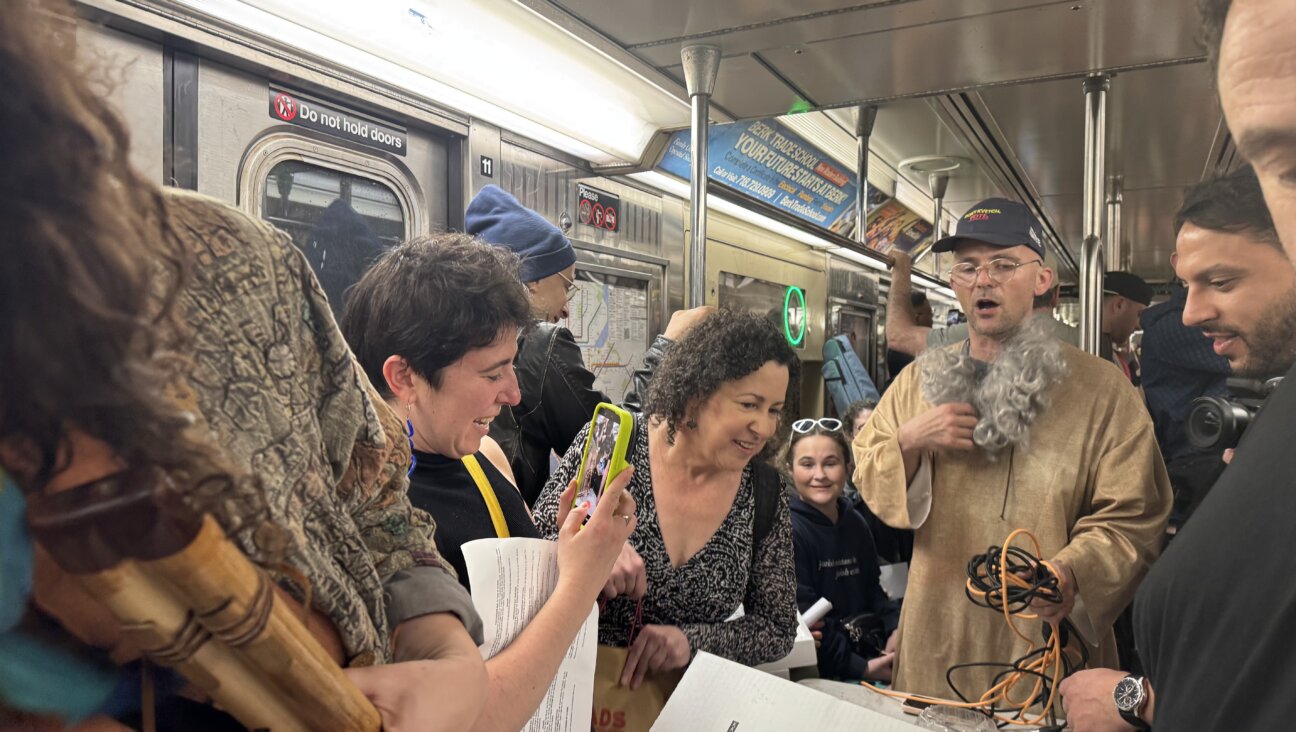
New York City sets a new record for the world’s biggest Shabbat dinner
More than 2,500 Jews — 2,761 to be exact — sat down Nov. 20 at the Javits Convention Center in Manhattan and broke the record for the world’s biggest Shabbat dinner. The previous record had been set by Berlin in 2015 with a dinner of 2,322 people. The Forward’s Hannah Feuer was in attendance to get all the details — and do her best to eat all the food served over the multi-course meal. The event included 811 pounds of kugel, 402 challahs, and 22,500 hors d’oeuvres and, in an AI generated video, Albert Einstein, Ruth Bader Ginsburg, Golda Meir and the Hebrew patriarch Abraham offered commentary on the dinner. For entertainment, a woman in a leotard, suspended by wires from the ceiling, played “If I Were a Rich Man” on the violin and the Jewish a capella group Six13 sang “We Are the Champions” to celebrate the victorious occasion.
Biggest Jewish sports disaster
A bicycle blowup
Canadian-Israeli billionaire Sylvan Adams had a hobby — competitive cycling — and a dream: using the sport to bolster Israel’s image abroad. That dream crashed hard into reality this summer at the Spanish Vuelta, where Adams’ team — called Israel-Premier Tech, and featuring zero Israeli or Jewish riders — turned out thousands of anti-Israel protesters.
Several of the race’s stages were altered or cancelled, including the final, which was halted several miles short of the finish line. By the Vuelta’s conclusion, some of the other riders were openly campaigning for Israel-Premier Tech’s exclusion and the team had removed “Israel” from its jerseys. The team’s demise became official this month when it was announced that retired Spanish footballer Andres Iniesta had bought IPT and, er, rechristened it.
Best Jewish sports performance
Avdija delivers
Deni Avdija was not supposed to be this good. Yet in his sixth season, the Portland Trail Blazers’ forward has been producing like an All-Star — he’s averaging 26 points, 7 rebounds, 6 assists per game as of this writing, with borderline elite efficiency — and with any justice, he’ll soon become one.
Most heartwarming Jewish sports moment
A very Jewish draft
It’s gotta be the back-to-back selections of Jewish Brooklyn Nets rookies Ben Saraf and Danny Wolf at June’s NBA Draft. Some draft prognosticators were expecting Wolf, a dynamic seven-footer who led Michigan to the Sweet 16, to be picked early in the first round — before Saraf, a spindly Israeli point guard. Instead, when Nets took Saraf with the 26th pick, the Wolf ganze mishpoche was still twiddling their thumbs. Moments later, though, Commissioner Adam Silver called Wolf’s name, sending older brother Jake Wolf into full-blown sobs — and into the unofficial sports meme hall of fame.
Menschiest Jewish athlete
Max Fried
The Yankees ace called reigning Cy Young winner Tarik Skubal to tell him he deserved to start the All-Star game in his stead. “It’s a very professional thing to do, and you got a ton of respect for guys that do stuff like that,” Skubal later told reporters. What we were thinking: This kid must have great parents!
This is a moment of great uncertainty. Here’s what you can do about it.
We hope you appreciated this article. Before you go, we’d like to ask you to please support the Forward’s independent Jewish news this Passover. All donations are being matched by the Forward Board - up to $100,000.
This is a moment of great uncertainty for the news media, for the Jewish people, and for our sacred democracy. It is a time of confusion and declining trust in public institutions. An era in which we need humans to report facts, conduct investigations that hold power to account, tell stories that matter and share honest discourse on all that divides us.
With no paywall or subscriptions, the Forward is entirely supported by readers like you. Every dollar you give this Passover is invested in the future of the Forward — and telling the American Jewish story fully and fairly.
The Forward doesn’t rely on funding from institutions like governments or your local Jewish federation. There are thousands of readers like you who give us $18 or $36 or $100 each month or year.
Support our mission to tell the Jewish story fully and fairly.