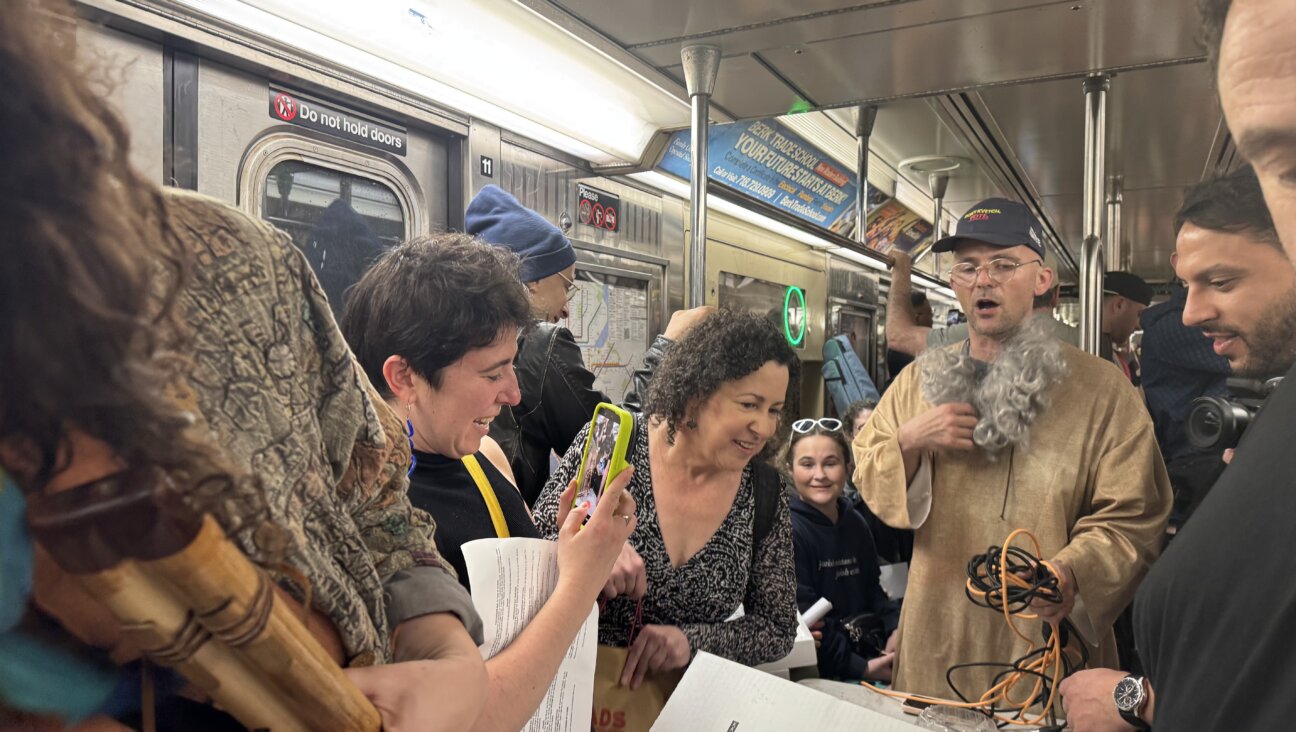
Waiting on line on Christmas is a time-honored New York tradition — was it ever thus?
Once upon a time, lining up for food or some other essential was a sign of deprivation — now it’s a status symbol
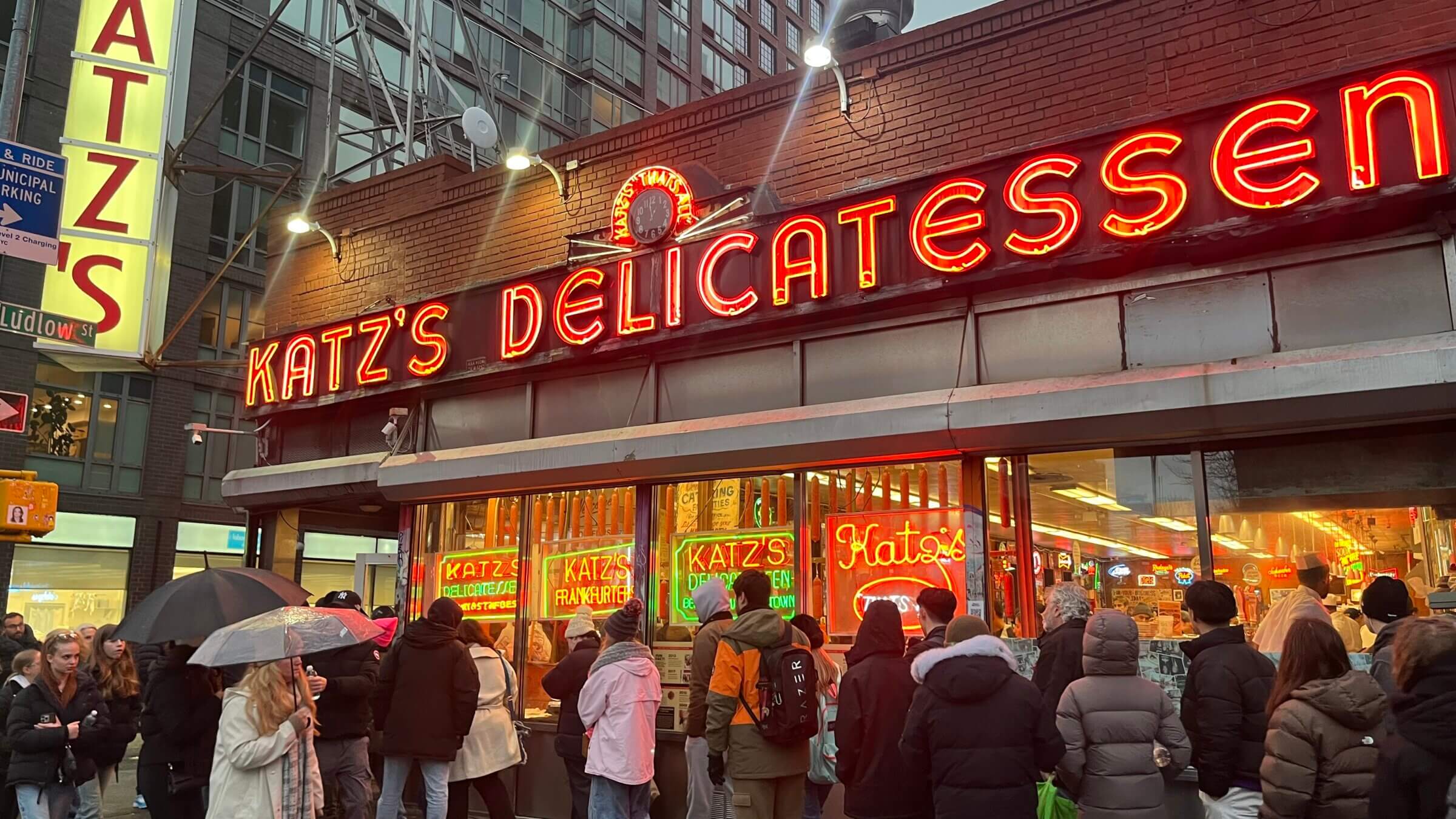
’Twas the day before Christmas — and there was a line outside Katz’s Deli on NYC’s Lower East Side. Photo by Andrew Silverstein

By Andrew Silverstein December 25, 2025
At 6 a.m., the morning before Christmas, Charles Licata was waiting outside the door of Russ & Daughters, two hours before the century-old Manhattan appetizing store opened. Each Christmas Eve for the past 42 years, Licata, joined this time by a family member and a friend, has made the hourlong drive from central New Jersey. “I like to be first in line,” he told me.
Licata, who manufactures granite countertops, told me he was hosting 40 for a traditional Italian feast of seven fishes on Christmas Eve, and on Christmas Day, his family had plans to devour another seven fishes and then some. “We got sable, lox, caviar, the spreads, pickled herring, tuna fish salad, hot and cold smoked salmon,” he started to list, before adding, “we got everything.”
Nikki Russ Federman, the fourth-generation owner of Russ & Daughters, instantly greeted Licata, who she recognized from years past. By 9 a.m., she was hustling off to the shop’s Brooklyn bakery because they were already running out of bagels.
The Christmas Eve crowds rival Erev Yom Kippur, and they grow throughout the day.
“Christmas is a Jewish holiday,” Russ Federman quipped.
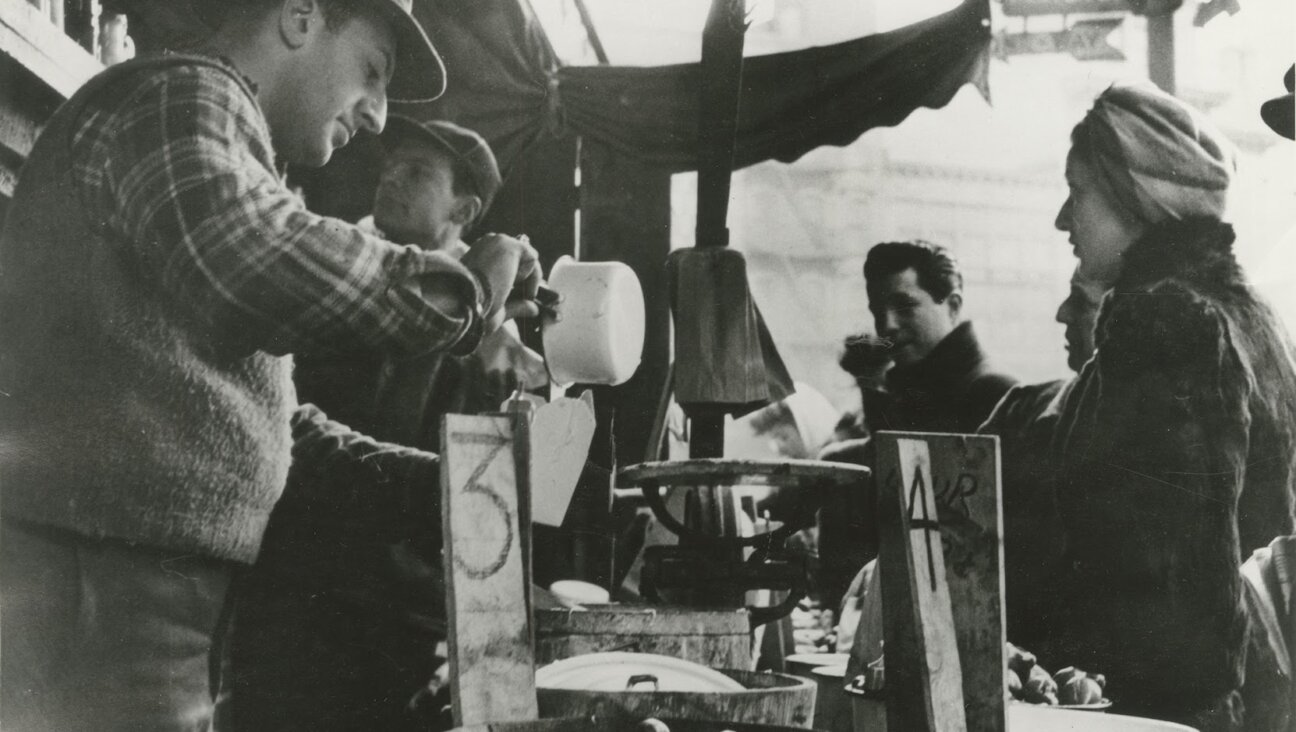
For Licata, the line itself, with its banter and camaraderie, is part of the ritual, except queuing at Russ & Daughters isn’t traditional. Lower East Side Jews didn’t wait in line; they jostled at deli counters and mobbed pushcarts.
“When I arrived on the scene in 1978 to take over the business,” third-generation owner Mark Russ Federman recounted in his 2013 book Russ & Daughters, “I discovered that there had never been a real attempt to implement a method to maintain crowd control and customer flow.”
First, the lox slicers behind the counter would pick out their regulars from the crowd, and then call “Who’s next?” To which, according to Mark Russ Federman, several elderly women would yell in their Yiddish-inflected English, “My next.” Mayhem would ensue.

“Grandpa Russ, my parents, and my uncles and aunts,” wrote Mark Russ Federman, “felt that having customers take a number from a machine and wait their turn was insulting, impersonal, and too ‘uptown.’”
It was during the Yom Kippur rush of 1978 that Russ Federman established a numbered ticketing system, turning the huddled mass of customers into an orderly line — something he saw as both more efficient for business and fairer for the customers. Since then, the appetizing store’s line has only grown, as have lines throughout the city.
Weathering the wait for Russ & Daughters seems more legit than camping out for the latest TikTok trend. Since the pandemic, lines in New York have become ubiquitous — for oversized pastries, for stunt croissants, for hype pizza. This past spring, a Saturday Night Live skit joked that a New Yorker’s favorite pastime is to “wait in a big dumb line.”

Waiting in line for West Village brunch often feels performative, but for Licata at Russ & Daughters, it isn’t about clout; it’s about continuity. It was a Jewish friend who first brought bagels and lox over for Christmas breakfast at Licata’s home decades ago. “I’m just carrying the tradition forward,” he said.
Down the block, most every year, Jeremy Kahn and his family make a pilgrimage from Washington, D.C., to Katz’s Deli. This past week, he was shocked to find that, even at the off-time of 4 p.m., the line still stretched to the corner. He speculated that there were more tourists. “I thought we’d be able to just walk right in,” he said.
After the 30 minute-plus wait at Katz’s, customers hungry for pastrami take a ticket at the door; they must sort into new lines to wait their turn with a cutter at the counter. And before leaving, customers must again wait their turn at the cashier’s line.
For Kahn, the wait is worth it. “This is where my grandfather would come to eat,” he said, and now he was taking his two young children and his father. “It means something that there is a line to get in. People are willing to wait in the cold.”
Katz’s, with its shared cafeteria tables, is known for its hustle and bustle, but things feel orderly compared to how it once was. In 1966, the iconic cheap eats guide, Underground Gourmet, deemed Katz’s “the largest, nosiest, busiest, and sloppiest delicatessen in Manhattan.” The guide’s authors, the illustrators and graphic designers Milton Glaser and Jerome Snyder, described ordering as a “struggle” that involved having to “muscle your way up to the endless serving counter and try to make yourself heard.”
Standing in line was foreign enough to Jewish immigrants that the Forverts mostly referred to queues not by the Yiddish word “rey” (meaning “row”) but with the English “line,” spelled out in Hebrew letters. In 1930, the Forverts reported that boxing fans were waiting in long lines in the cold and rain to watch a Jackie Kid Berg lightweight championship bout at Madison Square Garden, but Jews at the time mostly seemed to be lining up at Depression-era soup kitchens and unemployment lines in the U.S. or, worse, for handouts at refugee centers in Europe.
It’s not just Jews who were late to line up; lines are actually a fairly modern phenomenon. Often cited as containing the first description of a queue in English is Thomas Carlyle’s 1837 book The French Revolution, which described Parisians lining up at bakers’ shops during a famine. By World War II, queuing had become commonplace in rationing-era Britain.

Lines were then associated with shortages and bureaucracy; now they represent wealth and leisure. There are still long waits at the DMV and overburdened food pantries, but today, many lines are fueled by social media. A long line at a bakery signals that their $8.50 pistachio rose croissant is popular; joining the line gives you online bragging rights; not joining risks FOMO.
My friend Miriam Berger, a 91-year-old Manhattanite, said she has no memory of these types of lines in the 20th century. “I have no patience to stand on a line for anything,” she told me, using the regionalism, “probably because such behavior didn’t exist in my growing-up environment.”
We still manage to do much without lines. We squeeze into rush hour subway cars, flag down bartenders at crowded pubs, and hail cabs. At times, it feels cut-throat, but there’s an unspoken etiquette — someone waves you into a lane, a stranger holds the door.
Lines promise efficiency and equity, but the first-come-first-serve system easily breaks down. There are cutters, professional line waiters, and ways to pay your way to the front of the line with priority passes and VIP options for most anything.
And very often, there are ways to avoid lines altogether. At the end of his book, Mark Russ Federman writes that when his daughter Nikki and his nephew Josh entered the business in 2001, they started online ordering. “This wasn’t the way the Russ family did business,” he initially thought before he accepted the idea. “If you wanted to buy our fish, you came to the store. If you wanted to place an order over the phone, we had to recognize your voice or know your family.”
Now, Russ & Daughters ships nationwide, and with delivery apps, lox and herring can be ferried almost instantly to your door on an electric moped.
That’s too uptown for my tastes. I’d rather take a number.
This is a moment of great uncertainty. Here’s what you can do about it.
We hope you appreciated this article. Before you go, we’d like to ask you to please support the Forward’s independent Jewish news this Passover. All donations are being matched by the Forward Board - up to $100,000.
This is a moment of great uncertainty for the news media, for the Jewish people, and for our sacred democracy. It is a time of confusion and declining trust in public institutions. An era in which we need humans to report facts, conduct investigations that hold power to account, tell stories that matter and share honest discourse on all that divides us.
With no paywall or subscriptions, the Forward is entirely supported by readers like you. Every dollar you give this Passover is invested in the future of the Forward — and telling the American Jewish story fully and fairly.
The Forward doesn’t rely on funding from institutions like governments or your local Jewish federation. There are thousands of readers like you who give us $18 or $36 or $100 each month or year.
Support our mission to tell the Jewish story fully and fairly.