He works at a Holocaust museum by day. How’d he end up in ‘Marty Supreme’?
Before he was cast opposite Timothée Chalamet, Isaac Simon had no acting experience. That helped.

Isaac Simon, who plays Roger in Marty Supreme, was originally scouted at a baseball card show. Image by Forward staff; photo by Theo Wargo/Getty Images

By Louis Keene January 14, 2026
Heading into his audition for Marty Supreme, Isaac Simon was nervous. But not for the reasons you’d expect.
“I was taking a long lunch break from the museum,” he said, “and at the time I was three or four months into my job.”
Appearing in a Josh Safdie movie was something Simon, who runs internship programs at the Museum of Jewish Heritage, had genuinely never dreamed of. He wasn’t an actor, or an aspiring one. He’d never taken an acting class or been in front of a camera.
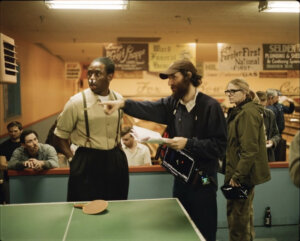
But two years after he was scouted at a baseball card convention, Simon was invited to try out for the role of Roger, a cocksure amateur who gets hustled on the pingpong table by Timothée Chalamet’s Marty Mauser. Standing 6-foot-9 with ice-blue eyes, low eyebrows and flowing brown hair, Simon had the look, the paddle skills and, clearly, the temperament to land a pivotal part in an Oscar-bound — and richly Jewish — cinematic hit.
“I don’t get starstruck,” Simon, 31, said. “I get excited.”

The slew of non-actors who feature in Marty Supreme alongside A-listers like Chalamet, Gwyneth Paltrow and Tyler, The Creator has already become part of the film’s lore. Safdie and veteran casting director Jennifer Venditti have a penchant for casting street regulars; among the first-timers in the movie are basketball legend George Gervin, viral TikTok and YouTube personas and the guy from Shark Tank.
But perhaps none had as personal a connection to the film’s story of postwar Jewish striving as Simon, a native New Yorker whose graduate study at Queens College focused on the development of Holocaust studies in the U.S. In Marty Supreme, which is loosely based on the story of real-life midcentury table tennis star Marty Reisman, one of the protagonist’s best friends is a Holocaust survivor; one of the film’s most arresting scenes is an Auschwitz flashback.
Simon’s day job is, of course, at the largest Holocaust museum in New York. The fateful coincidence of his casting, Simon said, was “like a bizarre lottery ticket I was able to cash in.”
A fateful encounter
The story of Simon’s star turn begins in summer 2022, when Venditti spotted him at a baseball card show in Long Island. Venditti was there with Safdie; Simon — then still in grad school — was there with his dad.
Venditti said they were there to cast extras and non-actors for a baseball-related movie, and asked if she could take a two-minute video of him talking about himself. He obliged, and in the recording told her where he was from (New York City) and what he was doing at the show (chasing the famously rare T206 tobacco card series).
“I thought to myself, ‘Wow, could I really have been at the right place and the right time for something I wasn’t even expecting?’” Simon recalled. Then two years passed, and the run-in faded from memory.
It was not until summer 2024 that he received an email from Venditti: “Isaac Simon audition opportunity – scouted at card show.” No script was provided and nothing about the project was disclosed — just a date and a location.
On his elevator up to the audition, he heard the hollow bouncing of a pingpong ball. Having seen a headline about Chalamet being attached to a Reisman biopic a few days earlier, he realized what the next few minutes might entail.
“The first audition was a total blur,” Simon recalled. “I remember playing pingpong with the assistant casting director and he was like, ‘Oh you’re good!’” At a subsequent callback, he played out a few improv scenarios — some light trash talking, or being cheated in a game. A few weeks later, he got called in for costume fittings.
He hadn’t solicited any acting tips or studied film prior to his audition. But his work at the museum, where he trains educators on how to teach the Holocaust in 90 minutes, had prepared him.
“Because teaching is a performance, there is sort of an inherent performative quality to the work I do,” Simon said. “And so I think that that lent itself well — or at the very least, it didn’t hurt — to the work I was being asked to do for Josh.”
‘Cast for a reason’
Having run through his lines with his dad and his girlfriend, Simon headed upstate that fall to play Roger — and play opposite Chalamet. (This time, he took two days off of work.)
Roger, the reigning hotshot at a humdrum bowling alley, features in two scenes. In the first, he’s goaded into wagering $40 against Marty, who’s feigning amateurism, and loses. He reappears a few minutes later as Marty fills up at a nearby gas station, realizing he was hustled by the reigning American champion; he and his pals want their money back.
Walking into the converted Bowlero where they shot the first scene, Simon was floored by the set. “Each individual looked like they were from the 1950s, and yet their outfit was distinctly their own,” he recalled. Miyako Bellizzi, the costume designer, had fitted him in a striped button-up and faded blue work pants; Simon’s hair was slicked back and to the side.
He hadn’t met Safdie before he got to set, and his cues from the Uncut Gems co-director were limited.
Over the course of his scenes, there were times when he wasn’t sure he was doing what Safdie wanted. Here, it was his inexperience that Simon drew on. “I kept reminding myself that I was cast for a reason, and I was cast as a non-actor for a reason,” he said, “and what I’m bringing to this experience is inherently different than what a trained actor would be. Therefore, if I were a trained actor, I would not be what Josh was looking for in the scenario.”
He didn’t have too much time to banter with the film’s stars during the shoot; most of his time on set was spent with other bit-players. But when the camera was shooting other actors, Safdie wanted to keep the sound of live table tennis in the background, so he had Chalamet and Simon play each other off-camera.
As to who had the upper hand? “We’re probably about even,” Simon said.

Jewish mythmaking
Even after the shoot, Simon couldn’t quite believe it was real. He told almost no one outside his family, superstitious that the scene would get cut. But then the premiere arrived. “It was surreal,” he said.
He’s now seen the film nine times — yes, all the way through — indulging friends who want to see it with him. And his acting has won some praise, with one X post calling it an “incredible underrated performance” liked more than 2,000 times.
Simon likes the movie, if you couldn’t tell, echoing its director and star in calling it a love letter to New York. The film, Simon said, touches on Jewish identity in a way that reminds him of his own family and their experience in this country.
“The way in which it captured intergenerational relationships in Jewish homes in postwar America, in New York specifically, felt very autobiographical for the way that my relatives talked amongst each other,” he said. “There’s a love there that transcends.”
As a Holocaust educator, Simon felt the movie handled that theme appropriately. He found the honey scene — an Auschwitz flashback too intense to explain here — moving, and the Holocaust humor tactfully dispatched. He loved the Yiddish.
Yet Simon still couldn’t wrap his head around his own involvement in such a fitting project. His work passing on the history and memory of the Holocaust to future generations was already meaningful before he got an IMDb page.
“So to be cast in a film and have a speaking line,” he said, “and it just so happens that that film is also this incredibly Jewish film — which has direct references in the scene at Auschwitz — is equally bizarre, but also really beautiful, and oddly perfect.”
This is a moment of great uncertainty. Here’s what you can do about it.
We hope you appreciated this article. Before you go, we’d like to ask you to please support the Forward’s independent Jewish news this Passover. All donations are being matched by the Forward Board - up to $100,000.
This is a moment of great uncertainty for the news media, for the Jewish people, and for our sacred democracy. It is a time of confusion and declining trust in public institutions. An era in which we need humans to report facts, conduct investigations that hold power to account, tell stories that matter and share honest discourse on all that divides us.
With no paywall or subscriptions, the Forward is entirely supported by readers like you. Every dollar you give this Passover is invested in the future of the Forward — and telling the American Jewish story fully and fairly.
The Forward doesn’t rely on funding from institutions like governments or your local Jewish federation. There are thousands of readers like you who give us $18 or $36 or $100 each month or year.
Support our mission to tell the Jewish story fully and fairly.