Could a video game help combat antisemitism on college campuses?
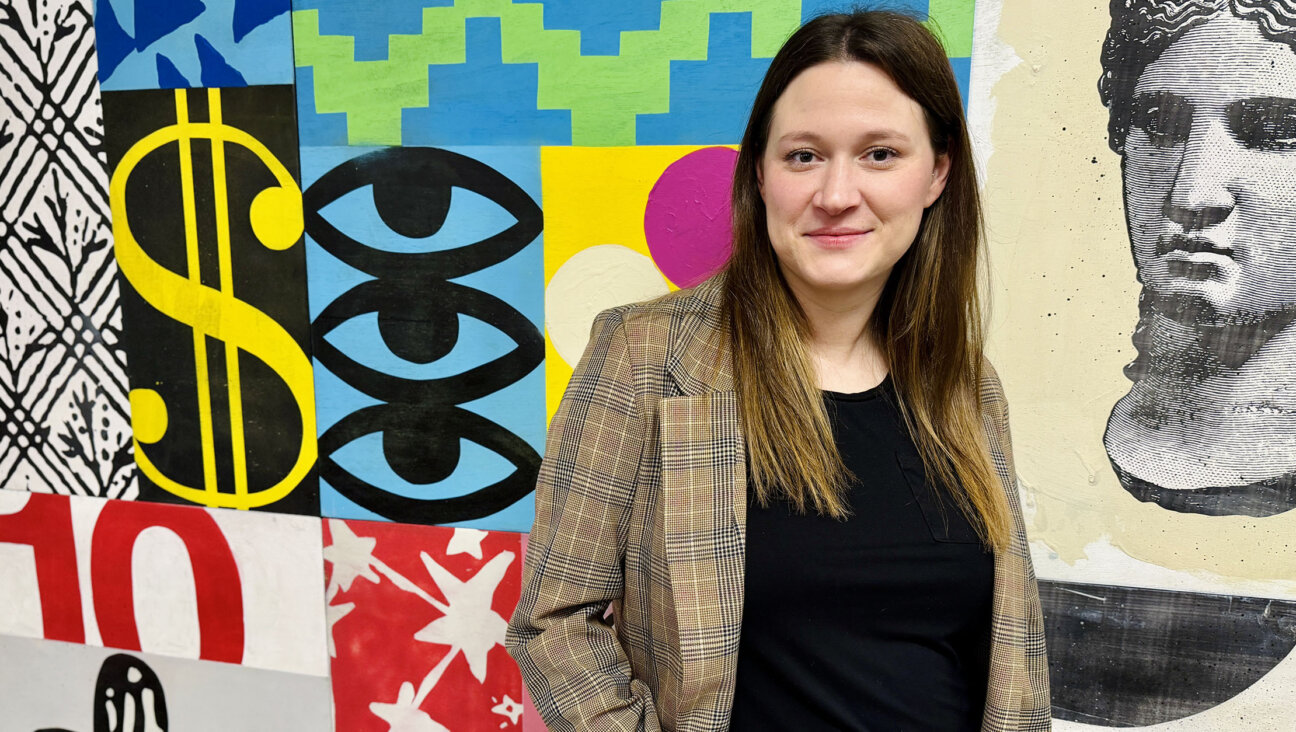
Julia Sebastien wants her PC game, ‘StrangeLand,’ to become a sort of guide to Jewish life on campus

Sebastien’s game is planned to have a retro feel and throwback graphics. Graphic by Noah Hirsch-Rechter
By Noah Hirsch-Rechter January 27, 2026
At a time of escalating antisemitism in the online gaming community, Julia Sebastien’s upcoming PC game, StrangeLand, which explores the difficulties of Jewish life at an Ivy League college, offers an alternative: the digital game not as an agent of antisemitism, but as a bulwark against it.
“What I want players to experience with this game,” Sebastien told me over Zoom, “is the sequence of choices and trade-offs a Jewish student in a really rigorous institution has to make.”
Yet she also has a longer-term, and perhaps loftier, aim for StrangeLand: that college educators and administrators use it as a guide of sorts to Jewish student life in general, and in particular, to “antisemitism on campuses,” she said.
Still, its target audience is one you might expect — current and former Jewish students at North American colleges, who, Sebastien believes, need help communicating “to family and friends when they’re feeling too tired or burnt out by everything that’s been going on.”
Sebastien has made digital games before. Indeed, she’s had a couple, both also academic in tone, published in digital journals. (One explored the effects of burnout in academia.) But thanks to a grant from the nonprofit Maimonides Fund, StrangeLand is her most ambitious, well-funded effort yet.
It’s also a little more personal.

Sebastien grew up in what she described as a “pretty religious Jewish suburb,” a Modern Orthodox community in Toronto. She attended Jewish day school and was fluent in Hebrew. But she never really took to prayer, she told me, and even as a teenager she had begun to see her Jewishness more as an intellectual pursuit than a religious one.
She stayed in Ontario for her undergraduate studies, but then ventured south to Cambridge, Massachusetts, where in 2023 she got a master’s in learning, design, and technology from Harvard, before starting a Ph.D. in media psychology at Cornell (she’s partway through).
StrangeLand is loosely based on her own experiences in the academy, though it also comprises anecdotes from dozens of other Jewish undergraduates, graduates and alumni, whom Sebastien consulted via a survey. Players will “inhabit the life of a Jewish student who has just left home to start graduate school at an Ivy League university, sometime in the 2010s,” she said. There, they’ll be presented with a series of scenarios, organized thematically.
These scenarios will be “evergreen” Jewish student dilemmas: negotiating obligations around Jewish holidays alongside the traditional academic calendar; staying late at a laboratory on a Friday night versus leaving to meet other Jewish students for Shabbat dinner. And some will have a grain of antisemitism, at least according to Sebastien: how to respond to an off-color remark in a social setting, say, or whether or not to wear a Magen David necklace in public.
There’s no winning or losing, per se. Rather, StrangeLand will aim to illustrate the “impossibility of satisfying the demands of these two worlds; that, really, is the crux of the gameplay,” Sebastien said.
Notably absent from StrangeLand, however, are Zionism and Israel, the very topics that have elevated the Jewish collegiate experience to something of a national issue. Their omission is no accident. “I’m not trying to shine a light on what’s happening now,” Sebastien said. “I’m trying to educate people about antisemitism.”
And to include such divisive subjects wouldn’t help Sebastien fulfill this aim, she feels. “As a designer, I need to consider the very real possibility that for some players, StrangeLand might be their first exposure to antisemitism as a distinct concept,” she said. “And I feel that the best way to bring antisemitism awareness to diverse audiences is to use examples that are clear, universal and evergreen.”
These hot-button issues, moreover, would seriously upset the vibe Sebastien is going for. “I actually don’t want characters in the game shouting horrific things,” she said. “I don’t want to jar the player. I want to explore concepts in a safe way that can still be emotionally poignant and meaningful and educational.”
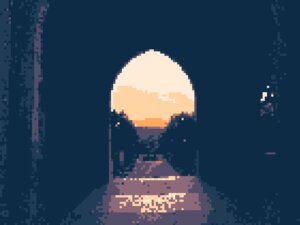
The game will have a retro feel, then, a lo-fi aesthetic — the heavily-pixelated, Game Boy-style gameplay that Sebastien adored as a child — which she’s confident will reinforce these feelings of comfort and safety. (She cited Tomorrow, Tomorrow, and Tomorrow, Gabrielle Zevin’s best-selling 2022 novel about a pair of Jewish, Harvard-educated video game developers in the ’90s, as one of the game’s inspirations.)
In short, Sebastien wants StrangeLand to be a respite from the pressures of campus life, while at the same time illuminating, especially for those non-Jewish players, the complexities of the Jewish student experience.
How it can accomplish this without meaningfully discussing Zionism is an open question. To my mind, StrangeLand seems to be as much a work of history as anything else. The antisemitism Sebastien repeatedly referenced during our conversation was of the classical U.S. variety, the WASP-y strain of the 1960s and 1970s often found in Roth and Bellow novels. Nowadays, of course, discussions about campus antisemitism are typically focused on something else entirely. So it’s a little hard to square Sebastien’s broader goal for StrangeLand, that it eventually be part of DEI curricula, with its lack of contemporary examples.
But Sebastien is confident players will leave StrangeLand with a more complete understanding of Jewish student life. “I want this to speak to and for Jewish students now and in the past,” she said. “That’s what this game is to me.”
This is a moment of great uncertainty. Here’s what you can do about it.
We hope you appreciated this article. Before you go, we’d like to ask you to please support the Forward’s independent Jewish news this Passover.
This is a moment of great uncertainty for the news media, for the Jewish people, and for our sacred democracy. It is a time of confusion and declining trust in public institutions. An era in which we need humans to report facts, conduct investigations that hold power to account, tell stories that matter and share honest discourse on all that divides us.
With no paywall or subscriptions, the Forward is entirely supported by readers like you. Every dollar you give this Passover is invested in the future of the Forward — and telling the American Jewish story fully and fairly.
The Forward doesn’t rely on funding from institutions like governments or your local Jewish federation. There are thousands of readers like you who give us $18 or $36 or $100 each month or year.
Support our mission to tell the Jewish story fully and fairly.