Robert Kraft’s new Super Bowl ad about antisemitism already feels dated
The ‘Sticky Note’ ad may not stick the landing on stopping Jew hate
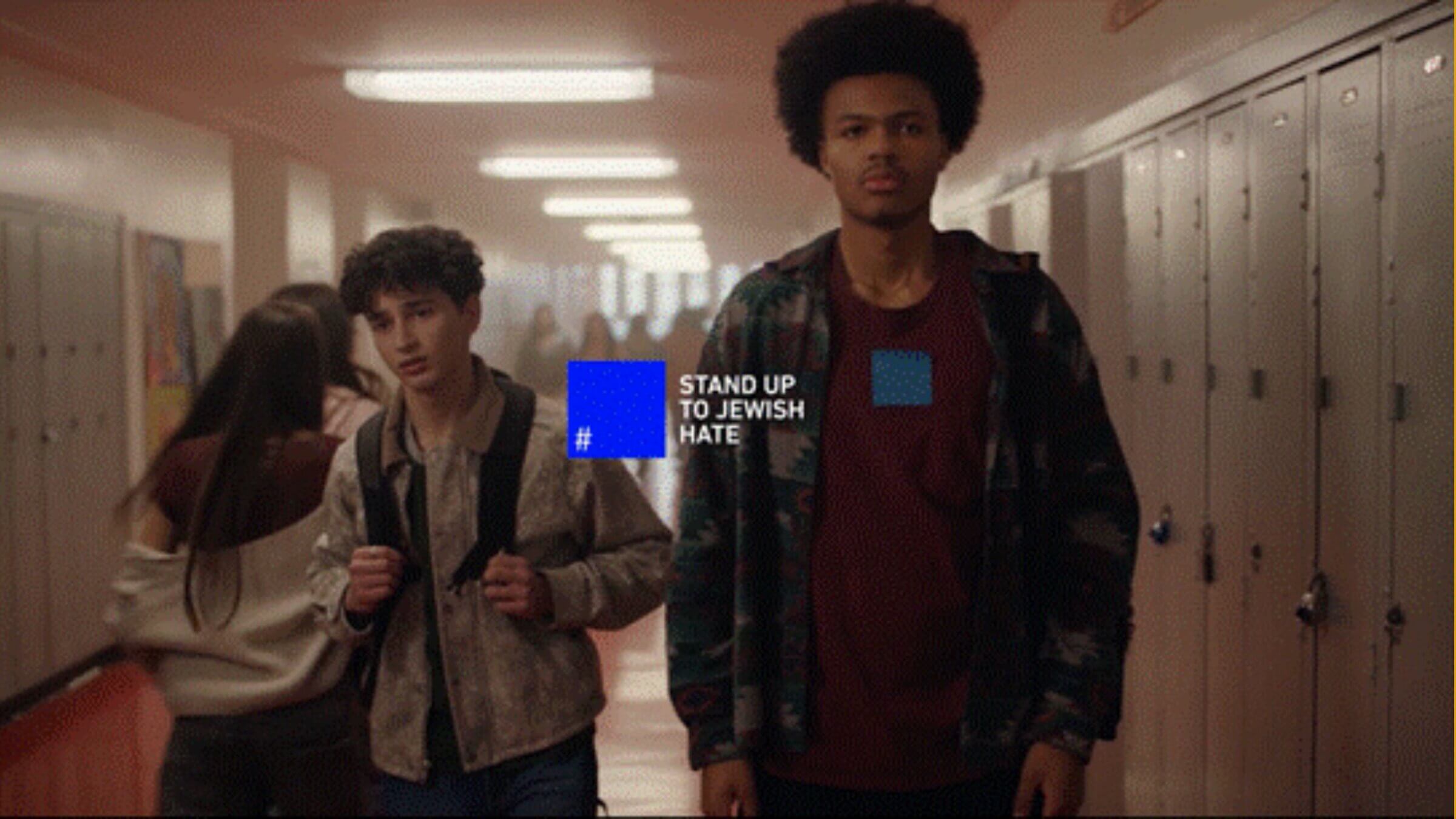
The Blue Square Alliance Against Hate’s new Super Bowl ad. Courtesy of Blue Square Alliance to End Hate

By PJ Grisar February 3, 2026
New England Patriots owner Robert Kraft will be taking on more than just the Seattle Seahawks on Sunday night’s Super Bowl.
A new ad from Kraft’s Blue Square Alliance Against Hate will beam to millions of homes, part of his yearslong, multimillion dollar initiative to combat the Oldest Hatred. The campaign has given us two previous Super Bowl spots: one in which Martin Luther King Jr.’s speechwriter Clarence B. Jones urged us to speak out against silence and, last year, as a nice counterpoint, one where Snoop Dogg and Tom Brady yelled at each other. These commercials, unlike ones that the Alliance aired outside of major sporting events, each had their weaknesses in messaging.
The first ad, which primarily spotlighted other hatreds, was perhaps too generic for an organization that at that point was called the Foundation to Combat Antisemitism, and its slogan, stand up to Jewish hate, left some viewers mystified. The second conveyed essentially nothing, reading as a sort of wan, FCC-vetted homage to a sequence in Do the Right Thing.
Enter the newest campaign, set in an American high school. A boy walks down the hall as classmates — one in a “how do you do, fellow kids”-style backwards cap — knock into him. Others make indistinct comments as he walks by. As the boy pulls up to his locker to put in his knapsack, we see what his peers were snickering at: a Post-it note tagged to his bag that reads “DIRTY JEW.”
Did a wormhole to the 1950s just open up? Was this an outtake from The Fabelmans or that old Frank Sinatra PSA? This just could not feel more disconnected from how antisemitism now operates in school hallways.
High school students, as countless watchdog groups can tell you, are far more creative and subtle now with their Jew hatred. And those more insidious strains are the ones we should be alerting people to.
Kids these days prefer edgelord remarks about cooking 6 million pizzas in five years and slurs like “Zio” and baby killer. They recycle memes about globalist control, the “Austrian painter” and a mythic Aryan civilization called “Agartha.” At their most dunderheaded, they don’t scrawl “Dirty Jew” — though they sometimes say it — they go to that old standby: the swastika. In 2024, the ADL reported 860 incidents in K-12 schools, and though their metrics for antisemitism are at times controversial, 52% of instances involved a swastika. (If you’re a hater of a certain income, like Ye, you can even have swastikas advertised covertly during the Big Game; Kraft’s crew could have stuck it to him by including one on the sticky.)
I get why they did it like this — you want to make your point in 30 seconds. But if you follow instances of antisemitism in schools or online — and it’s kind of an occupational hazard for me — you know this is not how today’s animus is typically expressed. And that can have a kind of unfortunate ripple effect.
If this was meant for the kids, they will laugh at how alien and out of touch it seems. And with that, there’s a risk that antisemitism will seem like a manufactured problem.
What happens next in the commercial holds true to what we teach kids about being an “upstander” rather than a bystander. Another student covers the offensive sticky note with a blue one, and then, like the legendary King of Denmark with his yellow star — or Van Jones with Kraft’s trademark blue square lapel pin — sticks a blue sticky on his own chest.
However noble the intentions of the ad may be, in a world of Groypers, this is bait. I can already anticipate the memes. I also find it doubtful that blue square pins, available on the campaign’s website and the icon behind Kraft’s organization’s rebrand, will become 2026’s hot Gen Z accessory, the new Labubus.
That the message misses the mark is disappointing because Kraft’s organization previously had some quite powerful non-Super Bowl ads, some of which have won awards. The strongest showed a boy and his father in a truck, with the dad confronting his son about a social media post where he said “Hitler was right.”
The dialogue is on-the-nose, but gets at a real phenomenon: Teens, even if raised right, can still be radicalized by the internet and emboldened by its anonymity. (As in the case of the alleged Jackson synagogue arsonist, we know that radicalization can happen fast.) “You got something you want to say? Get out of the truck and say it to their faces,” the dad tells his son, and the camera pulls focus to what’s outside their windshield: Jews leaving synagogue. And then, text, a solid statistic of a real phrase circulating on the internet: “‘Hitler was right’ was posted over 70,000 times last year.”
That ad still hits me in the gut, and serves as a bridge for two audiences: parents and their kids.
The Post-it ad doesn’t do that.
It tells reasonable older people what they already know: Overt, unambiguous antisemitism is bad. It tells kids that adults don’t get what they’re dealing with. It tells people on the cusp, or already fully immersed, in conspiracies of Jewish control that Jews have unlimited resources and a limited understanding of the facts on the ground.
If Kraft is committed to throwing money at a very real problem, he should at least get his money’s worth.
Correction: A previous version of this article misstated the name of Kraft’s organization. It is the Blue Square Alliance Against Hate, not the Blue Square Alliance Against Antisemitism.
This is a moment of great uncertainty. Here’s what you can do about it.
We hope you appreciated this article. Before you go, we’d like to ask you to please support the Forward’s independent Jewish news this Passover. All donations are being matched by the Forward Board - up to $100,000.
This is a moment of great uncertainty for the news media, for the Jewish people, and for our sacred democracy. It is a time of confusion and declining trust in public institutions. An era in which we need humans to report facts, conduct investigations that hold power to account, tell stories that matter and share honest discourse on all that divides us.
With no paywall or subscriptions, the Forward is entirely supported by readers like you. Every dollar you give this Passover is invested in the future of the Forward — and telling the American Jewish story fully and fairly.
The Forward doesn’t rely on funding from institutions like governments or your local Jewish federation. There are thousands of readers like you who give us $18 or $36 or $100 each month or year.
Support our mission to tell the Jewish story fully and fairly.