These two anti-Zionist Jews think the Israeli government is so bad, it’s funny
Matt Lieb and Daniel Maté, co-hosts of comedy podcast ‘Bad Hasbara,’ try to put a humorous spin on a serious subject
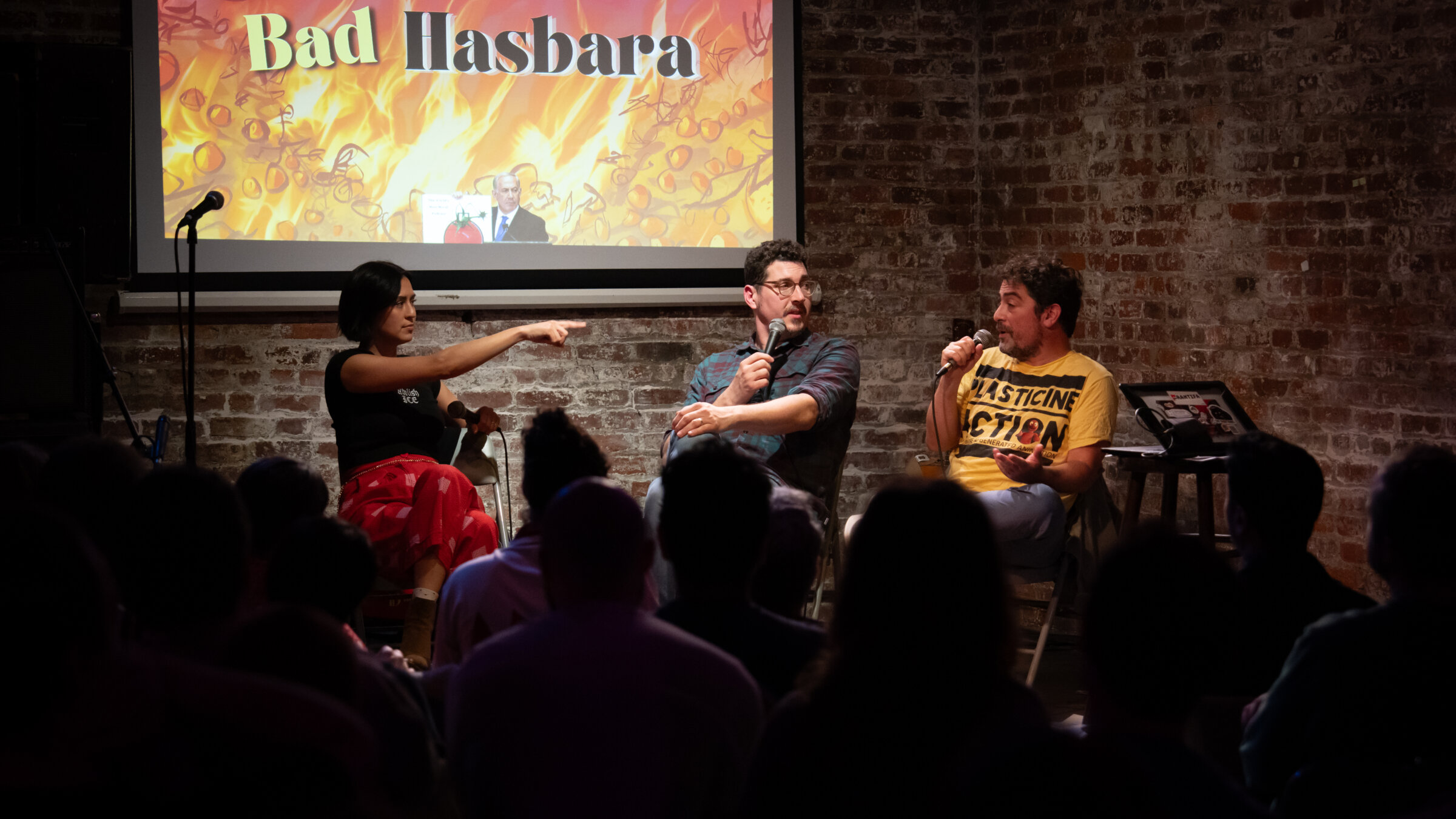
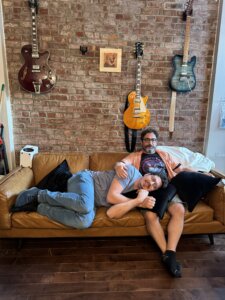
Co-hosts Matt Lieb and Daniel Maté at a ‘Bad Hasbara’ live show Photo by Jake Dietrich
By Noah Hirsch-Rechter February 10, 2026
When Matt Lieb started Bad Hasbara, his comedy podcast about so-called Israeli and US propaganda, he had a specific audience in mind: himself.
“A Jewish anti-Zionist podcast that made jokes at the expense of the Israeli government was not something that, as far as I knew, existed,” said Lieb, 41, who in addition to podcasting is a comedian, writer and actor. “I wanted to listen to something like that.”
Lieb also wanted an outlet for his anguish over Israel’s conduct in Gaza after the Oct. 7 Hamas-led attacks — not least because he felt the comedy industry at large had failed to meet the moment. “By December 2023,” he told me, “I realized the mainstream comedic sphere was going to be completely silent about this, and was going to move on to other subjects, because it was too politically charged.”
So Bad Hasbara, which has just released its 176th episode, began as an experiment to see if there were others like Lieb: those who regarded the Israeli and American governments as deceitful and propagandistic, and who, no less importantly, saw Israeli ‘Hasbara’ — loosely defined as the Israeli government’s myriad efforts to advertise its country — as funny and sinister.
As it turned out, there were plenty of adherents to Lieb’s worldview. (The podcast, whose full title is Bad Hasbara: The World’s Most Moral Podcast, first aired in late 2023, and has just surpassed 50,ooo YouTube subscribers.)
“What shocked me was the amount of people who related to the podcast, and who wanted to laugh at the same things I was laughing at.” Lieb said. “And the number one comment that we get from people, other than saying that they like the jokes, is ‘Thank you for keeping us sane.’”
One admirer was 50-year-old Daniel Maté, a Canadian-born, Brooklyn-based lyricist, composer and playwright for musical theater, whose plays included a reimagining of Kafka’s Metamorphosis, entitled The Trouble With Doug, and a sequel to Hansel & Gretl set in modern-day Chicago. Maté also had a fairly sizable social media following, and a disdain for Zionism that rivaled Lieb’s.
After a brief Instagram courtship (more on that later), Maté appeared as a guest on one of Bad Hasbara’s first episodes. Lieb enjoyed the experience so much that he invited Maté to co-host permanently. “People loved our vibe,” Maté told me. “We’re a rare pair, with our combination of experience, sensibility, and our places of overlap. Not to be too self-fluffing,” he added.
And though Bad Hasbara has certainly broadened its focus since Maté came aboard, at its heart it’s about the ways people interact with Zionism — a show about the rhetoric that has accompanied the Israel-Hamas war, rather than an analysis of the war itself.
Early adopters
The podcast’s popularity partly reflects the demand for anti-Zionist perspectives in the media and elsewhere after Oct. 7. It’s hardly the only podcast geared towards Israel’s critics: Medhi Hasan’s left-leaning news outlet Zeteo, for example, recently launched Beyond Israelism, an anti-Israel podcast hosted by If Not Now founder Simone Zimmerman.
Still, neither Lieb nor Maté is a recent convert to the cause. Lieb grew up in a secular, Jewish home in Los Angeles that saw Israel as “an absolute moral good,” but he began to have doubts about Zionism in the mid-2000s, when he was an undergraduate at UC Santa Cruz. “The Marxists and Islamists indoctrinated me into self-hatred,” he joked.
His embrace of anti-Zionism was sealed on his college Birthright trip, he told me, in part thanks to a guest appearance by Israel’s Prime Minister Benjamin Netanyahu, who spoke at an event for Lieb’s and several other Birthright groups.
“It was a very, very hard sell,” Lieb recalled. “And it felt unfair that as someone with, you know, Jewish ancestry, I was being told I had more of a right to this land than someone who was born there, and whose family was born there, who was ethnically cleansed.” (Lieb discussed his Birthright experience at length on Bad Hasbara’s inaugural episode.)
Maté’s opposition to Zionism, by contrast, was more of an inherited condition. His father, the well-known Canadian psychotherapist Dr. Gabor Maté, is a vocal critic of Israel, and in the mid-1980’s, when the younger Maté was coming of age, had become a “pariah in the Canadian Jewish community,” Maté said. He remembers his father being interviewed on Canadian radio, while on a medical trip to the West Bank, and hearing him say that he’d been crying every day since he had arrived because of what he’d seen in the hospitals.
The younger Maté took after his father, politically. Daniel went every summer to the left-leaning Habonim Dror Jewish summer camp, where he says he argued ferociously with his Israeli counselors, some of whom were just out of the army. “I never could get them to see the contradiction between liberalism and Zionism,” he said.
October 7 and beyond
On the evening of Oct. 8, 2023, Maté — who had not yet joined the podcast — went for a walk around his Brooklyn neighborhood. For about an hour, he went live on Instagram with a kind of stream-of-consciousness of despair and frustration, in which he urged his then-20,000 or so followers to properly contextualize the Hamas-led attacks of the previous day; to sympathize no less with Palestinian suffering than Israeli.
“I’d never done an Instagram Live before,” Maté said. “But I had a sense that I needed to un-crazy myself. And I was in a position to help people orient themselves, because I knew what was coming, right? A lot of lies. So I wanted to provide antioxidants.”
Lieb, for his part, had begun uploading sketch videos to Instagram after Oct. 7, in which he played what he saw as a representative liberal Zionist character: that is, someone increasingly unwilling to accept criticism of Israel post Oct. 7. Maté found the character amusing, and told Lieb as much over Instagram. “The videos would always start off with about 45 seconds of decent-sounding politics,” Maté said, “and then would devolve.” Eventually, they set a date for Maté to appear on Lieb’s new podcast. So were the seeds of Bad Hasbara planted.
Both Maté and Lieb agree that the podcast has been buoyed by the procession of news and people coming out of the Middle East. For its first six months, Maté was amazed they never ran out of characters to lampoon. “Hen Mazzig, Eylon Levy, Rabbi Shmuley: It was like the Wu-Tang Clan of propaganda,” he said.
But its blend of levity, righteous indignation and social media fluency has helped Bad Hasbara stand out in an increasingly crowded left-wing media ecosystem. Episodes can be blunt, funny and sarcastic, often quite crude and sometimes willfully provocative. They’re called things like ‘The Greatest Shoahman’ — an episode about Nick Fuentes’ Holocaust denial, naturally — or, on Nov. 8 last year, after Zohran Mamdani was elected mayor of New York City, ‘The Zionist Freakout over Zohran’s win.’ Either host is liable to, in the same breath, give eloquent expression to some important, overlooked morsel of Palestinian history, and then refer to Birthright as an “11-day handjob.”
“I think the combination of moral earnestness and complete lack of decorum is compelling,” said Maté.
And despite its mostly easygoing vibe, they’ve thought carefully about the podcast’s message. “We’ve worked really hard to diversify our guests,” said Maté. “Not for the sake of diversity, but for the sake of completion and for the sake of insight.” The only through line, then, between the academics and musicians and actors and politicians and comics who’ve been guests on the show — Rashid Khalidi, Debra Winger, Peter Beinart, Miko Peled, to name just a few — is that “they all see what’s happening as an unjustifiable moral abomination, and they’re willing, with us, to take apart all of the various ways that it gets justified,” said Maté.
This specific entry requirement means the podcast has hosted some not-uncontroversial guests. Pink Floyd co-founder Roger Waters, who has frequently compared Israel to Nazi Germany, and in Nov. 2023 suggested the Oct. 7 attacks could have been a “false flag operation”, talked to Lieb and Maté in Feb. 2025. Three months later, so did Mohammed El-Kurd, a Palestinian poet, writer and activist whom several mainstream Jewish groups have accused of demonizing Zionism and Jewish Israelis. (El-Kurd is a regular on the college campus circuit; in March 2025, more than 200 Harvard College affiliates and alumni published an open letter arguing that El-Kurd’s appearance at Harvard violated the university’s policies against antisemitism.)
Yet Maté doubts the podcast has reached those who might find such conversations troubling: more passionate defenders of Israel, say, or anyone especially worried that the line between antisemitism and anti-Zionism can sometimes be blurry. “I don’t know how many Zionists listen to our show long enough to stay pissed off,” he said. “It tends to have a certain kind of repellent to it.” It’s also not entirely clear who Maté means by “Zionists.” When asked, he defined Zionism, a little enigmatically, as “the refusal to heal Jewish trauma.”
Much clearer is the podcast’s particular irritation with the idea that Zionism is compatible with liberal values. After all, it’s the doctrine each was raised on, Lieb at home and Maté in his Jewish community more broadly. So if Bad Hasbara has an overarching aim, beyond ridiculing government officials, it’s probably to emphasize what they see as the impossibility of left-wing Zionism. “You can’t be a liberal and Zionist forever,” Maté told me. “You’re fighting yourself.”
This is a moment of great uncertainty. Here’s what you can do about it.
We hope you appreciated this article. Before you go, we’d like to ask you to please support the Forward’s independent Jewish news this Passover. All donations are being matched by the Forward Board - up to $100,000.
This is a moment of great uncertainty for the news media, for the Jewish people, and for our sacred democracy. It is a time of confusion and declining trust in public institutions. An era in which we need humans to report facts, conduct investigations that hold power to account, tell stories that matter and share honest discourse on all that divides us.
With no paywall or subscriptions, the Forward is entirely supported by readers like you. Every dollar you give this Passover is invested in the future of the Forward — and telling the American Jewish story fully and fairly.
The Forward doesn’t rely on funding from institutions like governments or your local Jewish federation. There are thousands of readers like you who give us $18 or $36 or $100 each month or year.
Support our mission to tell the Jewish story fully and fairly.