Why Bad Bunny’s halftime show delighted New York Jews of a certain age
The Jewish love affair with Latin music and ‘Nueva Yol’ dates back to mambo dancing in the Catskills and stories of a shared diaspora
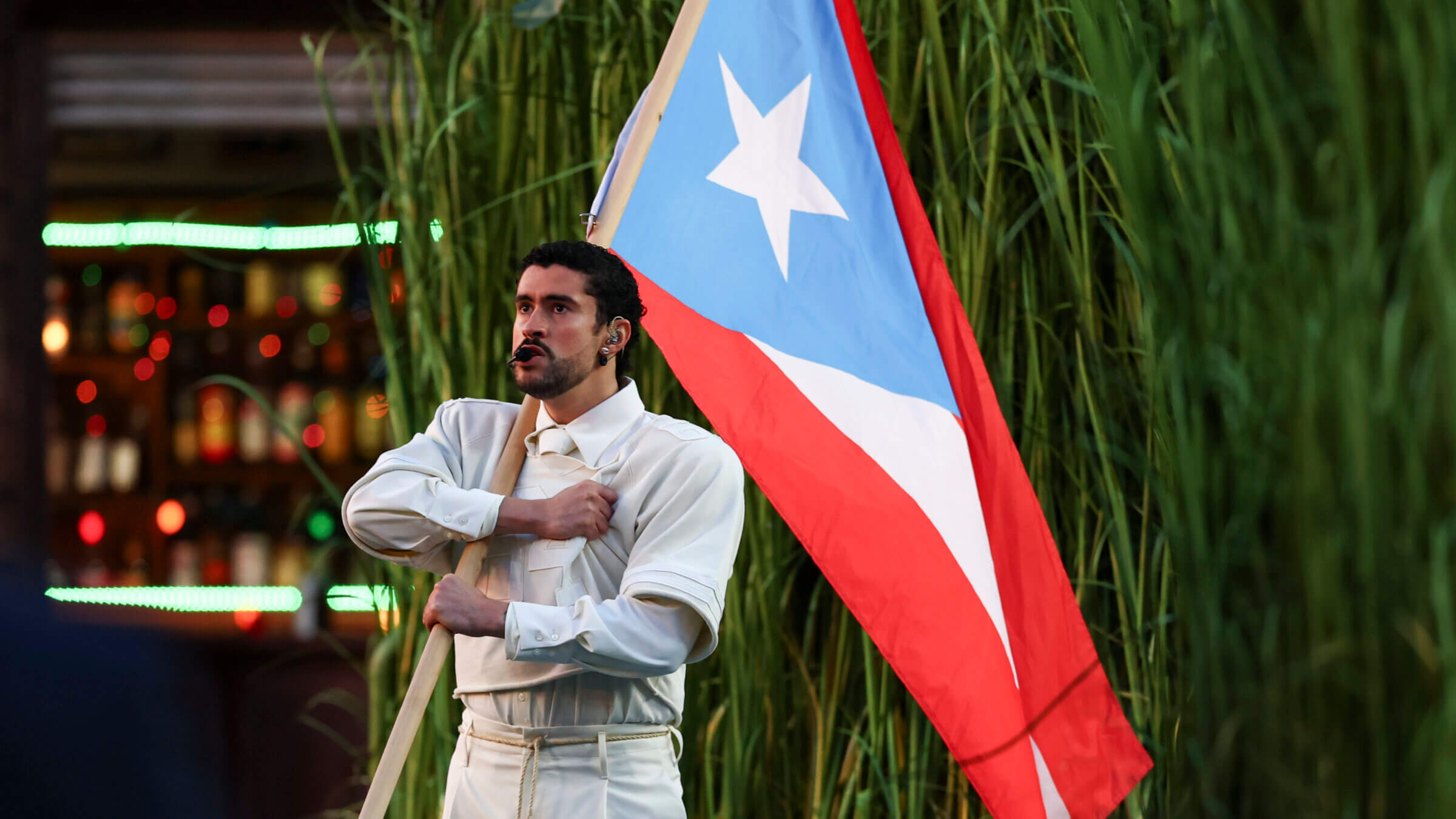
Bad Bunny performs in the Superbowl halftime show Feb. 8. Photo by Getty Images
Since last month, a TikTok has been floating around, showing arthritic Latino grandmas and grandpas hearing Bad Bunny for the first time, courtesy their bemused grandchildren. On the reel, he samples “Un Verano en Nueva York,” a 50-year-old salsa song about New York City — or “Nueva Yol,” as Bad Bunny calls his update in his echt Puerto Rican accent. He sang “Nueva Yol” at the Super Bowl halftime show. The original dates from the 1970s, when the old folks were young and lithe and out on the town. On TikTok, when they listen to the new version, they perk up, and then they dance, as the kids look on, delighted.
I imagine that something similar happened to countless aging Jewish salsa music freaks like myself when they saw the halftime show. I’m 75 now, and I got up and danced, remembering those years during Jimmy Carter’s presidency when I donned high heels and tight skirts to dance away my Saturdays nights at venues like Casino 14 — catorce, it was pronounced — on 14th Street right by Union Square. I’d had a Jewish boyfriend whose mom, a Bell telephone operator, had danced mambo in the 1950s and taught her son the moves. He taught me the cha-cha and rhumba; other friends my age, many of them Jews, loved the music too and knew the steps and clubbed along with me. All this seemed no more remarkable to us than knowing how to say the prayer over the bread on Friday nights.
The Jewish love affair with Latin music began back in the 1950s and, since then, Jews have played it as musicians, produced it as record company owners, and DJed it in clubs and on the radio. Scholars have tried to explain the affinity, and why it has been such a comfortable fit for both ethnic groups. Some speculate that the music of both cultures tends to minor scales. Others point out that, as Jewish neighborhoods such as East Harlem were transitioning in the 1950s to Puerto Rican enclaves, the two groups lived side by side. (Working-class Jews even shared factory spaces with Puerto Rican laborers, especially in the garment industry.)
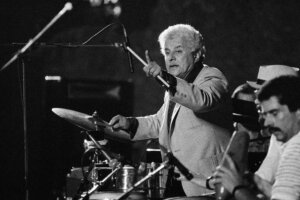
And there was the Borscht Belt. Starting in the 1950s, the big hotels typically maintained two house bands: one for mainstream pop, and the other for all Latin — the tummlers taught mambo lessons around the swimming pool. By the 1930s, Puerto Rico had been thoroughly colonized by the U.S. and was thoroughly poverty stricken. A vast exit began to the mainland: Puerto Ricans, after all, were American citizens. Many moved to the Bronx. By the 1960s, many of the kids had grown up to be musicians. Some had big bands and a big-band sound. They played regular gigs at places like Kutscher’s in the Catskills. You can still hear Tito Puente in 1959 playing “Grossinger’s Cha Cha Cha.”
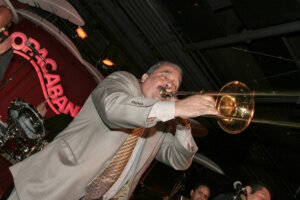
Some of the musicians were Jews — for example, Larry Harlow, a classically trained pianist whose grandfather was a cantor and father a Latin music bandleader in the Catskills. Harlow’s actual family name was Kahn; his nickname among musicians and audiences was “El Judio Maravilloso,” the Marvelous Jew. His friend Lewis Kahn was a salsa violinist and trombonist who’d studied at Julliard; he was “El Segundo Judio Maravilloso.” Once, I gave Lewis a lift back to his hotel post-concert, after I saw him shambling down the street alone. Painfully shy and bespectacled, he seemed more like a member of the Frankfurt School than someone in a band with matching suits and screaming brass.
My foreign language in high school had been Spanish. My conversational skills were good but still stilted. I didn’t get better — didn’t pick up the rhythms and slang and everyday spoken beauty of the language until the 1970s. I began listening then, over and over and over, to my growing collection of LPs from the salsa label Fania, copying the words and learning how they mashed together. Based in New York City, Fania even had a fan magazine. New York also had the annual Puerto Rican parade, and I vividly recall running into impromptu conga circles on street corners, where young people sang not just in Spanish but also in Lucumi, the deeply spiritual language of the Afro-Caribbean Yoruba and Santeria religions. They’d picked up the words from the same records I listened to. Their devotion to the musical aspects of their heritage reminded me of my fascination with cantorial music, which was also available on vintage LPs and even on low-watt radio in Brooklyn.
Twenty-five years ago I went to Columbia one summer to study Yiddish. In class I learned that Molly Picon had sung in Yiddish in the 1940s on the Forward-owned radio station WEVD. Her show was followed by one in Spanish with mambo bands like La Sonora Matancera. How many Jews kept listening after the Picon program signed off? Were Sholem Aleichem and Uriel Weinreich the salseros of their own culture? I got bat mitzvahed at age 71 at a shul in Brooklyn. I had kosher food at the after-party. And we danced to a mambo band, led by Benjamin Lapidus, a fellow synagogue member.
Bad Bunny’s “Nueva Yol” couldn’t be more New York. It talks about going to Bear Mountain in the summer. About the Yankees and the Mets. The 4th of July. About Willie Colon, the beloved salsa trumpeter from the Bronx who ran (unsuccessfully) for Congress in 1994 and for Public Advocate in 2001.
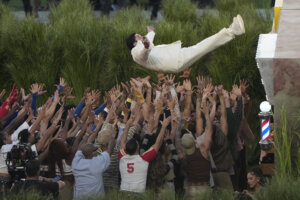
Bad Bunny’s halftime performance of “Nueva Yol” also celebrated a Brooklyn matriarch named Maria Antonia Cay, aka Toñita. She runs an intimate social club for Puerto Ricans in Williamsburg where she cooks traditional food, serves it, and tends bar at age 85. She made a cameo appearance at halftime, as Bad Bunny sang lyrics about conflict and anxiety, featuring his signature tic, the phrase “Uuy, uuy!” Go forward in the mouth just a bit and you’re at Yiddish “Oy oy!” At one point he jumped into a joyful mosh pit of dancers. They hoisted him up and paraded him around. It could have been the reception, in any borough, of any Jewish wedding.
There’s a lot of talk these days about Diaspora Jews versus Israel Jews. It’s a topic that’s been fraught for years and inspires endless discussion. There’s not so much talk about Diaspora Puerto Ricans: the people who settled and struggled here decades ago and whose lives became cultural cross-over when Leonard Bernstein, Jerome Robbins and Leonard Bernstein — all Jews — created West Side Story. Today, the New York boroughs, with about a million Jews, constitute the biggest Jewish city in the world after Tel Aviv. And New York City has more Puerto Ricans than San Juan. Bad Bunny’s halftime show reminded us of our shared diaspora. It did so as our bodies grooved, even if they were geriatric bodies grooving slower than before.
This is a moment of great uncertainty. Here’s what you can do about it.
We hope you appreciated this article. Before you go, we’d like to ask you to please support the Forward’s independent Jewish news this Passover. All donations are being matched by the Forward Board - up to $100,000.
This is a moment of great uncertainty for the news media, for the Jewish people, and for our sacred democracy. It is a time of confusion and declining trust in public institutions. An era in which we need humans to report facts, conduct investigations that hold power to account, tell stories that matter and share honest discourse on all that divides us.
With no paywall or subscriptions, the Forward is entirely supported by readers like you. Every dollar you give this Passover is invested in the future of the Forward — and telling the American Jewish story fully and fairly.
The Forward doesn’t rely on funding from institutions like governments or your local Jewish federation. There are thousands of readers like you who give us $18 or $36 or $100 each month or year.
Support our mission to tell the Jewish story fully and fairly.