Why a forgotten teacher’s grave became a Jewish pilgrimage site
Long after his death, the grave of Rabbi Yechiel Meir Burgeman has become a site of prayer and hope
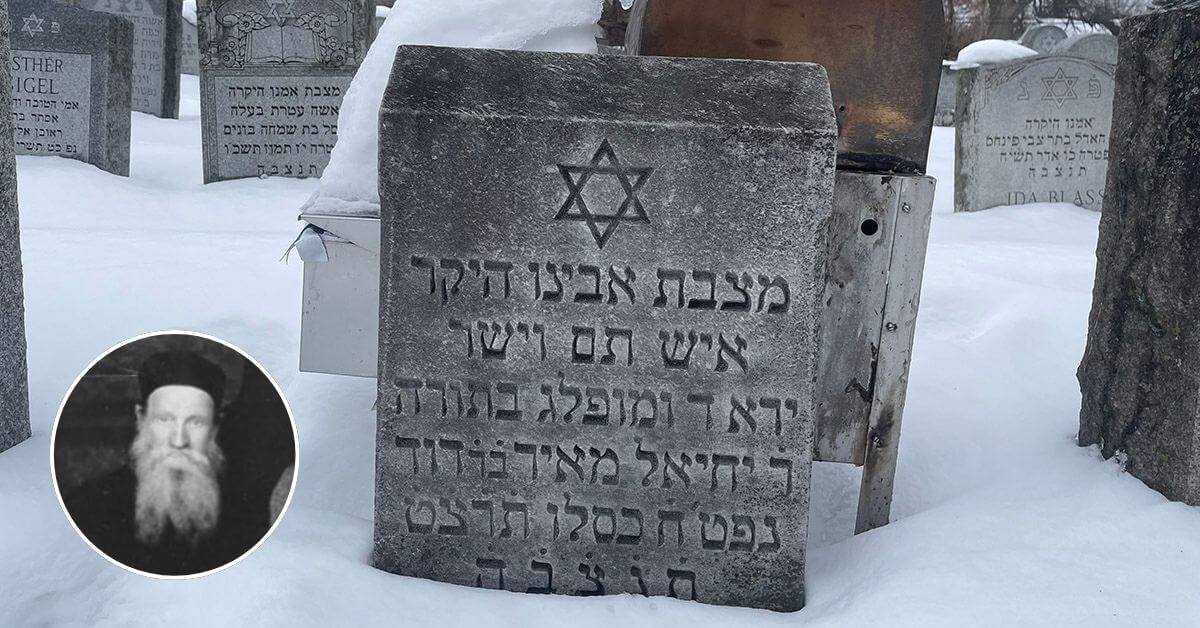
The grave of Rabbi Yechiel Meir Burgeman in Rochester, New York. Photo by Austin Albanese; Inset photo courtesy of Kalman Burgeman and Kevarim of Tzadikim in North America
By Austin Albanese February 15, 2026
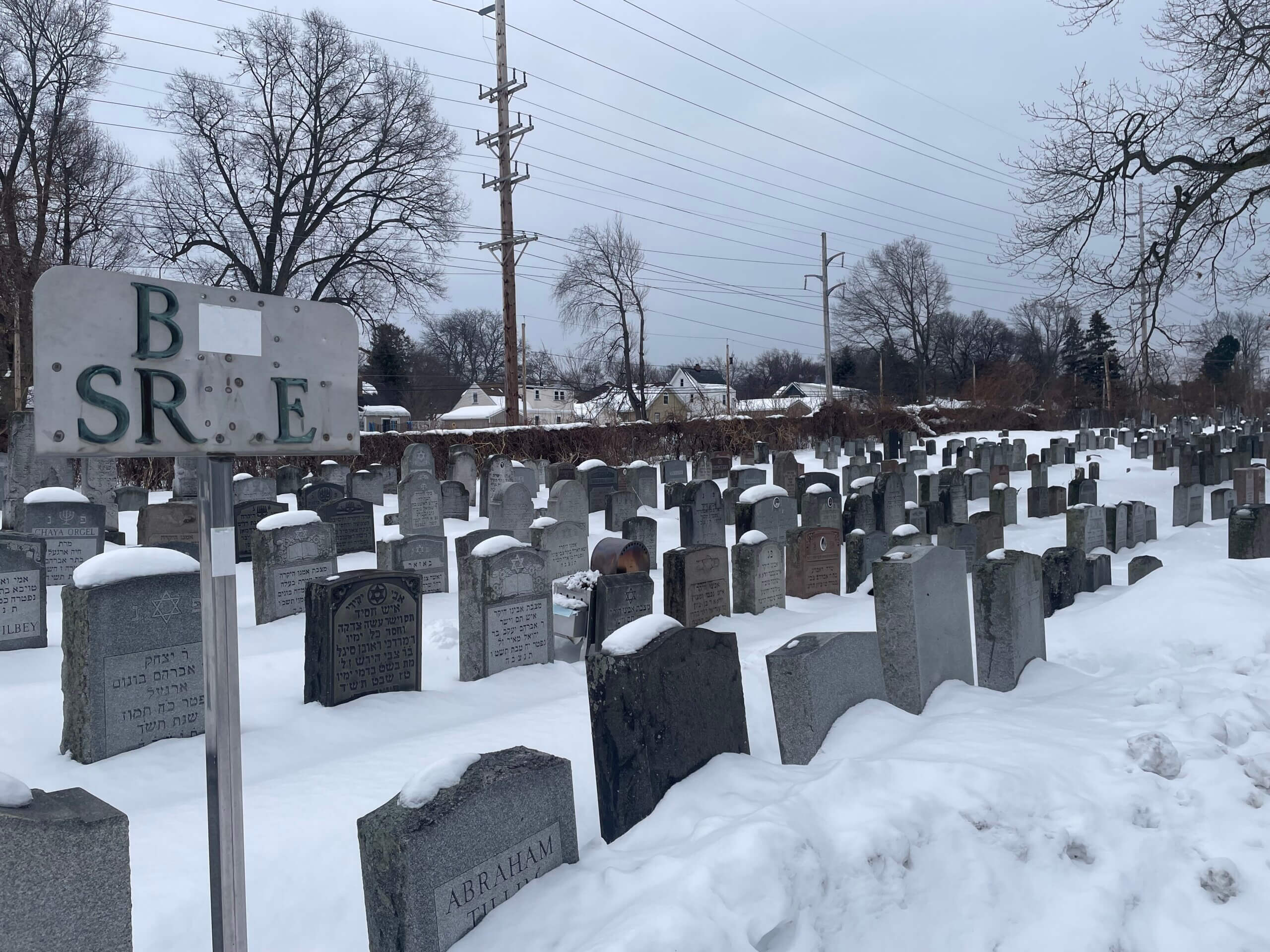
Along Britton Road in Rochester, New York, a brick gatehouse sits across from ordinary homes. Beyond it lies Britton Road Cemetery, its grounds divided into family plots and sections claimed over time by Orthodox congregations and fraternal associations, past and present. Names like Anshe Polen, Beth Hakneses Hachodosh, B’nai Israel, and various Jewish fraternal organizations are found here.
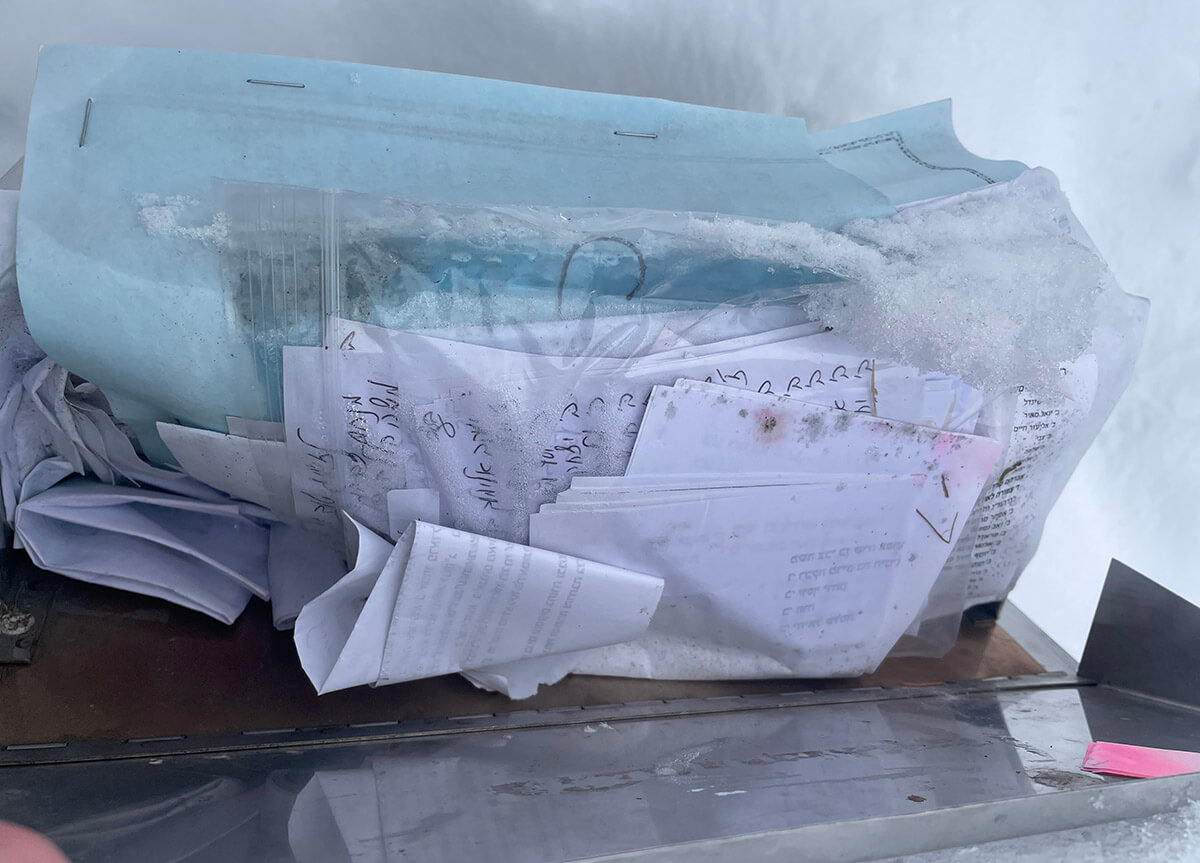
On the east side of the cemetery, a modest gray headstone draws visitors who do not personally know the man buried there, who were never taught his name in school, and who claim no personal connection to his life. Some leave notes. Some light candles in a small metal box set nearby. Others whisper prayers and stand for a moment before going. They come because they believe holiness can be found here.
The grave belongs to Rabbi Yechiel Meir Burgeman, a Polish-born teacher who died in 1938. He did not lead a major congregation or leave behind an institution that bears his name. And yet, nearly a century after his death, people still visit.
Over time, Burgeman has come to be remembered as a tzaddik nistar, a hidden righteous person, whose holiness is known through their teaching and daily life rather than through any title or position. His grave has become a place of intercession. People come to pray for healing, for help in times of uncertainty, and for the hope of marriage. What endures here is not an individual’s biography so much as a practice: the belief that a life lived with integrity can continue to shape devotion, even after the body has been laid to rest.
In life, Burgeman was not known as a miracle worker or a public figure. He was a melamed, a teacher of children, living plainly among other Jewish immigrants in Rochester’s Jewish center in the early decades of the 20th century. At one point, he was dismissed from a teaching post for refusing to soften his instruction. He later opened his own cheder, or schoolroom. There was no congregation to inherit his name, no institution to archive his papers. When he died, he was buried in an ordinary way at Britton Road Cemetery, one grave among many.
What followed was not immediate.
Remembered in return
The meaning attached to Burgeman’s resting place accumulated slowly. Stories began to circulate. People spoke of his kindness, his discipline, his integrity. Over time, visitors came. The grave became a place not of answers, but of belief. For generations, this turning toward the dead has taken this same form. It is not worship. It is proximity. A way of standing near those believed to have lived rightly, and asking that their merit might still matter.
In Jewish tradition, prayer at a grave is a reflection on those believed to have lived with righteousness, asking that their merit accompany the living in moments of need. Psalms are traditionally recited. Words are often spoken quietly.
I have done something similar too. Years ago, before I converted to Judaism and before I had the means to travel, I sent a written prayer through a Chabad service that delivers letters to the grave of the Lubavitcher Rebbe in New York. Someone else carried it. I cannot say with absolute certainty what happened because of it. Only that the practice itself made space for hope that I was seen, and that a prayer was later answered in ways that shaped my life and deepened my understanding of Judaism.
Burgeman’s grave functions in a similar register, though without any institutional frame. People come not because his name is widely known, but because the story has endured. Over time, that story gathered details. The most persistent involves a dog said to have escorted Jewish children to Burgeman’s cheder so they would not be harassed along the way by other youths. The dog then stood watch until they were ready to return home. The versions differ. Some are reverent. Some are playful. Some verge on the miraculous. The story endures because it names something children needed: care, in a world that could be frightening.
In recent decades, Burgeman’s afterlife has taken on a digital form. His name surfaces in comment threads and genealogical forums, passed along by people who never met him and are not always sure how they are connected. Spellings are debated. Dates are corrected. A descendant appears. A former student’s grandchild adds a fragment. Someone asks whether this is the same man their grandmother spoke of. No single account settles the matter. Instead, memory gathers. What once traveled by word of mouth now moves through hyperlinks.
The internet allows fragments to remain visible. Burgeman’s story survives not because it was officially recorded, but because enough people cared to remember it. In this way, his legacy resembles the man himself: quiet, unadorned, sustained by actions rather than declaration.
This story does not offer certainty. It is about remembering a life and asking if we might still learn from it and if, perhaps, it can bring us closer to faith. Burgeman left no grand monument. He left descendants. A grave. A life of Jewish values that continues to teach.
Burgeman did not seek recognition in life. After death, he became something else: a teacher still teaching, not through words, but through the way people continue to act on his memory. That is the lesson. Not any miracle. Not any legend. The quiet insistence that a life lived with integrity does not end when the casket is placed into the earth.
Some graves are instructions.
This one still asks something of us.
This is a moment of great uncertainty. Here’s what you can do about it.
We hope you appreciated this article. Before you go, we’d like to ask you to please support the Forward’s independent Jewish news this Passover. All donations are being matched by the Forward Board - up to $100,000.
This is a moment of great uncertainty for the news media, for the Jewish people, and for our sacred democracy. It is a time of confusion and declining trust in public institutions. An era in which we need humans to report facts, conduct investigations that hold power to account, tell stories that matter and share honest discourse on all that divides us.
With no paywall or subscriptions, the Forward is entirely supported by readers like you. Every dollar you give this Passover is invested in the future of the Forward — and telling the American Jewish story fully and fairly.
The Forward doesn’t rely on funding from institutions like governments or your local Jewish federation. There are thousands of readers like you who give us $18 or $36 or $100 each month or year.
Support our mission to tell the Jewish story fully and fairly.