How a new generation of comics is changing the face of Jewish comedy — and Judaism itself
Comedians are embracing their Jewish identity in a way Borscht Belt stars never needed to
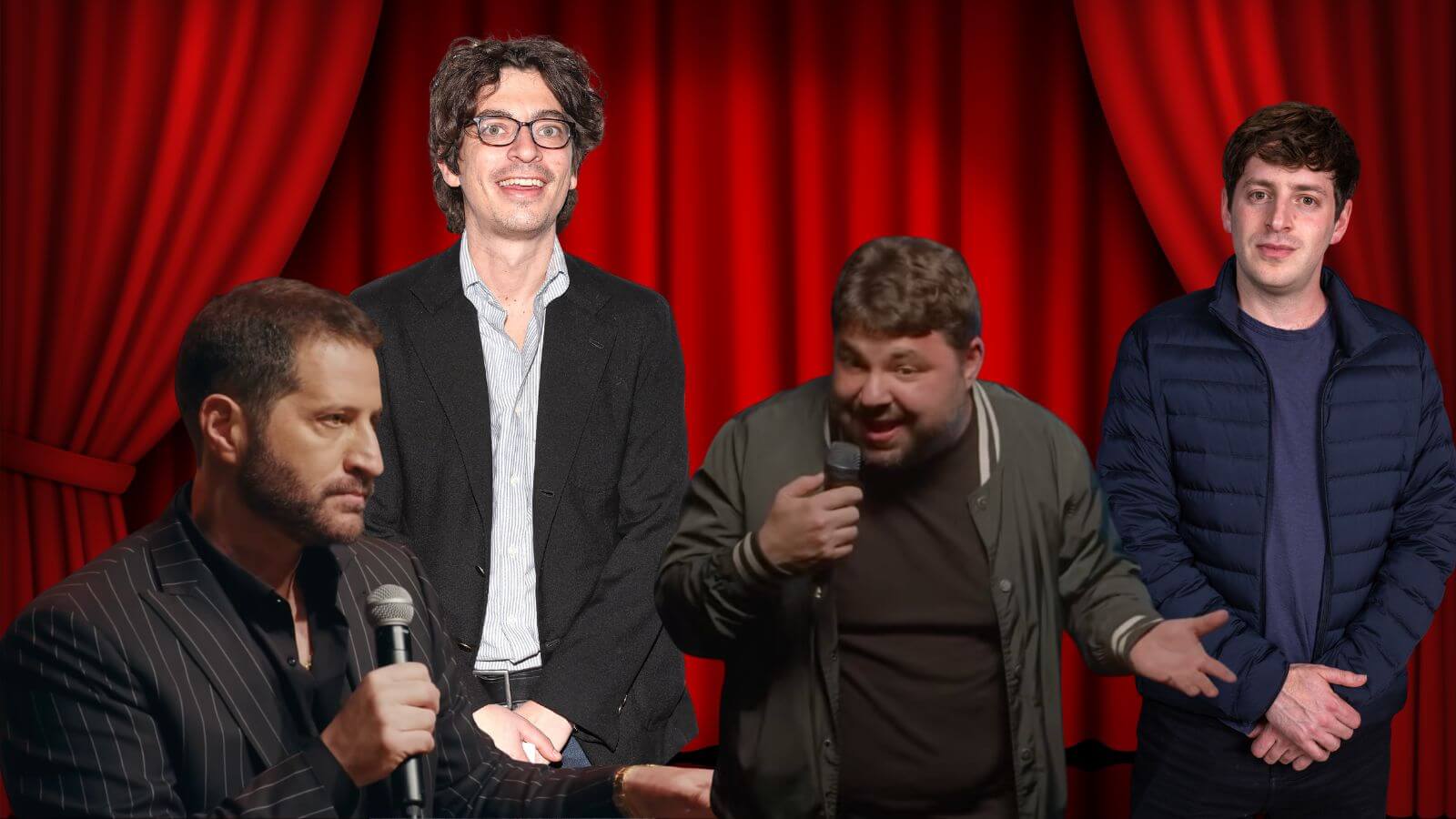
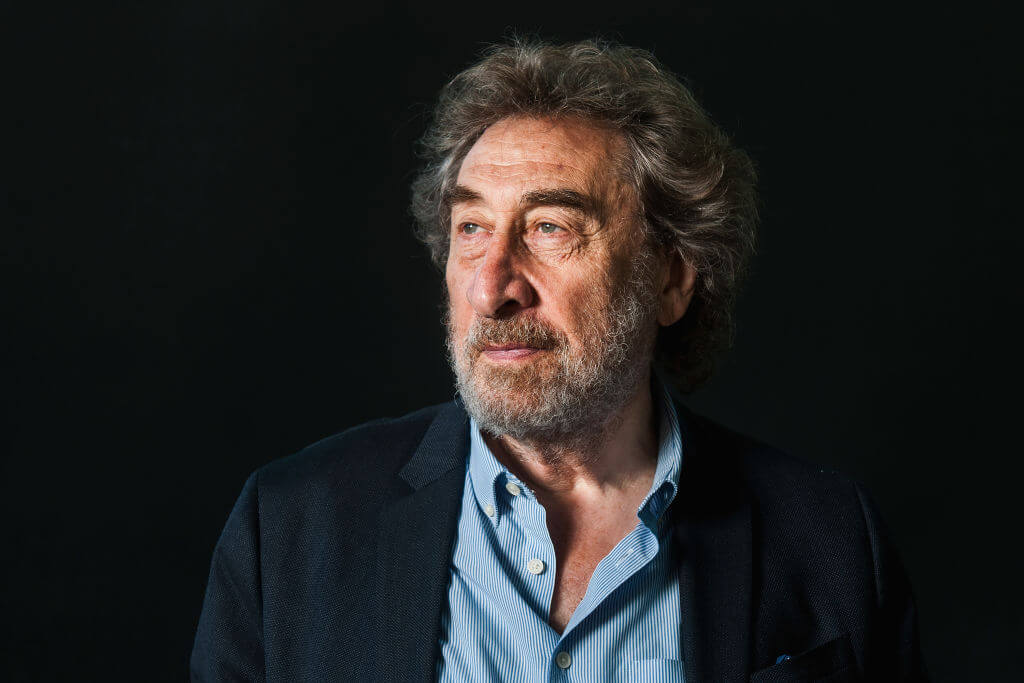
Modi Rosenfeld, Adam Friedland, Raanan Hershberg, and Alex Edelman — just a few of the new faces of Jewish comedy, most of whom made their name on YouTube and TikTok. Photo by Getty Images/screenshot

By Mira Fox February 25, 2026
Jewish comedy is, of course, a long and vaunted tradition: Joan Rivers, Mel Brooks, Woody Allen, Lenny Bruce, Larry David.
No one had to tell audiences that they were Jewish. Sure, there was Jewish content to some of their jokes — Bruce’s most famous bit is about the difference between Jews and non-Jews. But the literal mention of Judaism wasn’t what made their comedy feel so Jewish. It was their affect, their posture, their accents, their discussion of psychoanalysis or overbearing mothers. The self-deprecating, dry, kvetching tone. The test for whether comedy was Jewish was like the test for obscenity: You know it when you see it.
Today, though, everyone is in therapy. Everyone is anxious. Everyone can poke fun at their crazy families. Everyone — or plenty of people, at least — uses at least a few Yiddishisms. Schlep, klutz and mensch are hardly limited to members of the tribe.
Maybe that’s why a new crop of Jewish comics, many of whom have made their name posting their sets and crowdwork clips to YouTube, are so explicit about exactly what kind of comedy they’re doing.
Raanan Hershberg’s sharp new special is called Morbidly Jewish. Ariel Elias titles her YouTube special “A Jewish Star.” Josh Edelman’s latest act is “The Jew Rogaine Show.” “I’m Jewish btw lol,” reads the caption of a viral clip comedian Lucas Zelnick posted, talking about the names of various Jewish day schools. Gianmarco Soresi, an Italian Jew who talks about his Judaism in many of his viral clips, captions them with the hashtag #Jewish.
What it means to be Jewish in the U.S. has changed since the early days of Jewish comics on the Borscht Belt. We’ve assimilated and spread out across the country, and the accent is fading away. You have to tell people you’re Jewish for them to know, most of the time. So, many Jewish comics are doing exactly that.
But beyond the label, what makes their comedy Jewish? For some, it seems like stolen valor, a way of claiming membership in a lauded tradition of comics, when mostly they’re just rehashing old jokes.
Josh Edelman — no relationship to Alex Edelman — spends much of The Jew Rogaine Show riffing about how, for example, his mother would brag about how many people he shot if he were a school shooter. “Thus concludeth the Jewish portion,” he says abruptly halfway through his set, as though Jewish comedy is limited to jokes that literally mention Jews, a switch that can be turned on and off.
But the best of the new, online Jewish comics, however, are birthing a new type of comedy — and with it, a new vision of Jewishness.
A Jewish comedy, divided
There are many comics who include some amount of Jewish comedy in their sets. In Sarah Squirm: Live + in the Flesh, though largely focused on gross-out comedy about bodily fluids, S.N.L. star Sarah Sherman also jokes about Ashkenazi digestion and having a Jewish president. Iliza Shlesinger mostly jokes about being a millennial woman, but also talks about her encounters with Christians as a Jew in Texas.
But there’s a range of comics who lean much more into their Judaism these days, making it central to their comedy, and labeling it Jewish. And among them, there seem to be two genres: comedy explaining Jewishness to non-Jews, and comedy that affirms Jews’ Jewishness.
Raanan Herschberg’s newest special, Morbidly Jewish, is in the first category. Hershberg takes on rising antisemitism with surprising nuance for a set that also includes jokes about masturbation.
In fact, that bit is one of the most complex, in which Hershberg tries to find a porn star to watch whose politics align perfectly with his — after Oct. 7, he said he stopped watching Mia Khalifa, a Lebanese porn star, because she wrote a tweet celebrating the deaths of civilians. But an Israeli performer he turned to instead didn’t believe Palestinians deserved a homeland, which he also found distasteful.
“How could I, in good conscience, continue masturbating to this woman?” he says. “I started looking for a porn star with, you know, a more nuanced view of the Israeli-Palestinian conflict.”
It’s a brilliant bit, skewering the idea — an increasingly common one post-Oct. 7 — that there is political purity to be had at all times, in all moments of consumption, even the most base ones. It allows audiences a window into the internal battle of a certain cadre of progressive American Jews attempting to parse the post-Oct. 7 landscape. And yet, the bit is not remotely preachy; it’s mostly a raunchy, funny joke.
Hershberg’s comedy is quite Jewish in content, sure, but it also has the je ne sais quoi feel of old-school Jewish comedy — the self-deprecation, dry wit and, not for nothing, some creative riffs about his mom — with an ability to bring audiences into the experiences of Jews, whether political purity tests or trying to decide what really counts as antisemitism.
Modi Rosenfeld, a gay Orthodox Jew, is firmly in the other category: Jewish jokes, by Jews and for Jews. In his special, Know Your Audience, he spends much of the time joking about intracommunal things, like the difference between prayer styles at Ashkenazi and Sephardic synagogues. He does explain, and act out, some of these jokes, but they aren’t all that funny if you don’t have the lived experience of, say, sitting through the speed-mumbling that defines so many Orthodox Ashkenazi services, or the lengthy warbling flourishes of Sephardic davening.
So much of the Jewish comedy of yore was pivotal in helping Jews assimilate further into American society. “See, look at us,” it said. “We’re funny and approachable.” Jewish comics became American stars. But Rosenfeld is not shooting for assimilation; he is helping fortify the in-group.
When Rosenfeld asks, at one point, if anyone in the audience is not Jewish, only a few hands go up. And he makes it clear his set is not for them, albeit in a jovial tone: “I don’t know how you got in here,” he says, laughing.
Innovation in Jewish comedy
Then there are Jewish comedians who, while being deeply Jewish, are doing something else altogether. Their comedy feels deeply Jewish, while spending little time talking about it. And, in the style of the previous generation of Jewish comics, they’re also inventing a totally new style.
Adam Friedland gained fame as one of a trio of men who hosted Cum Town, the nihilistic cult podcast of the so-called dirtbag left, and now sometimes does stand-up about his parents, Oct. 7 and Israel. But his real comedic innovation is his shockingly popular YouTube channel, where he interviews politicians and celebrities, ribbing them while also eliciting real revelations. He has interviewed such guests as Zohran Mamdani, Ritchie Torres, Mia Khalifa — yes, that’s the same Lebanese porn star Hershberg joked about — and extremist looksmaxxing streamer Clavicular.
In each interview, Friedland makes himself into a kind of clumsy fall guy who asks such bizarre questions that guests are often stunned into surprising revelations. But then he will pivot into such heartfelt earnestness that it’s disarming. In the episode with Torres, after a contentious exchange over Israel, Friedland turned surprisingly personal in tone, describing the year he spent living in Israel and his family’s connections to Judaism.
“Me saying this to you right now will hurt people in my family,” he says, his voice cracking. “The world is seeing something that is terrible. And it’s being done in my name.”
For all Friedland’s deadpan awkwardness (“Have you seen a movie?” he asks musician and actress FKA Twigs, who responds, in confusion, “A movie? In my life?”), it is clear that he is, in fact, very smart and prepared for his interviews. He emerges as the master in every exchange, despite — or because of — his performance of clumsiness. It makes for a darkly subversive show, each episode poking such sly fun at his guests that they only sometimes notice and even less often know how to roll with any given riff. And it’s catchy enough that Friedland has become a kind of figurehead of a new paradigm in content; in the past year, he has been profiled by GQ and covered in the pages of The New York Times and The New Yorker.
In a way, Friedland fits into a model outlined by Nathan Fielder, whose quasi-reality show The Rehearsal blurs the line between performance and reality, joking and earnestness, into something that is simultaneously funny and deeply unsettling. Even Alex Edelman, whose biographical comedy special Just For Us tells the story of his decision to attend a white supremacist meeting in Queens, toes a strange line of ambivalence over just how bad these racists are; he finds himself hoping they’ll like him.
The throughline of this comedy is a destabilizing ambiguity. The situations can be funny in their absurdity, but they’re undergirded by a deep discomfort because they force the viewers, squirming, to ponder whether the joke or scenario posed by the comedian is, in fact, so outlandish and funny or if it’s actually completely earnest.
This form of comedy manages to touch upon truths that are hard to address directly, ones that are well-suited to our increasingly nihilistic, red-pilled society where earnestness is so often perceived as cringe.
It relies on comedians playing the role of an awkward outsider — willing to be weird or unattractive. It’s an inheritor to the self-deprecation that was so core to earlier Jewish comedy, and to a long Jewish history of outsider status, now remade into a truth-telling device.
This comedy might not be overtly Jewish. But something about this new cadre of comics’ ability to create a new genre, to define new boundaries, and to navigate a tightrope of nuance, feels, to me, almost Talmudic. It feels like these comedians so confidently own their Jewishness that they hardly need to mention it — but nevertheless, it’s foundational to who they are, and how they joke.
A splintered comedy for a splintered community
Jason Zinoman, the comedy critic at The New York Times, wrote a piece asking whether the Golden Age of Jewish comedy had come to an end, crumbling in the face of rising antisemitism.
Zinoman argued that it’s not, pointing out that Jewish comedy has always thrived in the face of fear. Political comedy, too, he points out, is having a moment, and much of today’s politics revolves around Jews, antisemitism and Israel — plenty of creative fuel. Navigating the intense political divides over Israel after Oct. 7, or when a “Free Palestine” comment on social media is antisemitic or not, has certainly fueled many a Jewish comedian’s set.
But in a way, the Golden Age of Jewish comedy is over, in the sense that there is no single sense of what makes comedy Jewish. There are so many kinds that appeal to so many audiences. Some, like Rosenfeld, have turned inwards, while others, like Hershberg, have used comedy to communicate the deep confusion many Jews feel about navigating their identity. And still more, like Friedman, have tried to create something new, a way of being Jewish that still feels completely identifiable as such without many of the obvious markers.
It’s a funhouse mirror of what’s happened to the Jewish community in general in the past few years as it has fractured over Israel and Zionism. Some Jews have become either outspoken Zionists or outspoken anti-Zionists. Others — including some synagogues and minyans — have tried to chart a middle course, navigating stormy waters without tipping either way. And others are trying to invent a new way to understand their identity and beliefs. But none of them have left their identity behind.
The same goes for Jewish comedy — it’s all Jewish, even when it’s not doing it very traditionally. You know it when you see it.
This is a moment of great uncertainty. Here’s what you can do about it.
We hope you appreciated this article. Before you go, we’d like to ask you to please support the Forward’s independent Jewish news this Passover. All donations are being matched by the Forward Board - up to $100,000.
This is a moment of great uncertainty for the news media, for the Jewish people, and for our sacred democracy. It is a time of confusion and declining trust in public institutions. An era in which we need humans to report facts, conduct investigations that hold power to account, tell stories that matter and share honest discourse on all that divides us.
With no paywall or subscriptions, the Forward is entirely supported by readers like you. Every dollar you give this Passover is invested in the future of the Forward — and telling the American Jewish story fully and fairly.
The Forward doesn’t rely on funding from institutions like governments or your local Jewish federation. There are thousands of readers like you who give us $18 or $36 or $100 each month or year.
Support our mission to tell the Jewish story fully and fairly.