Is goy a slur, an antisemitic dogwhistle or a word for non-Jews?
The term goy has been trending, igniting a debate about who can use it, and what it means
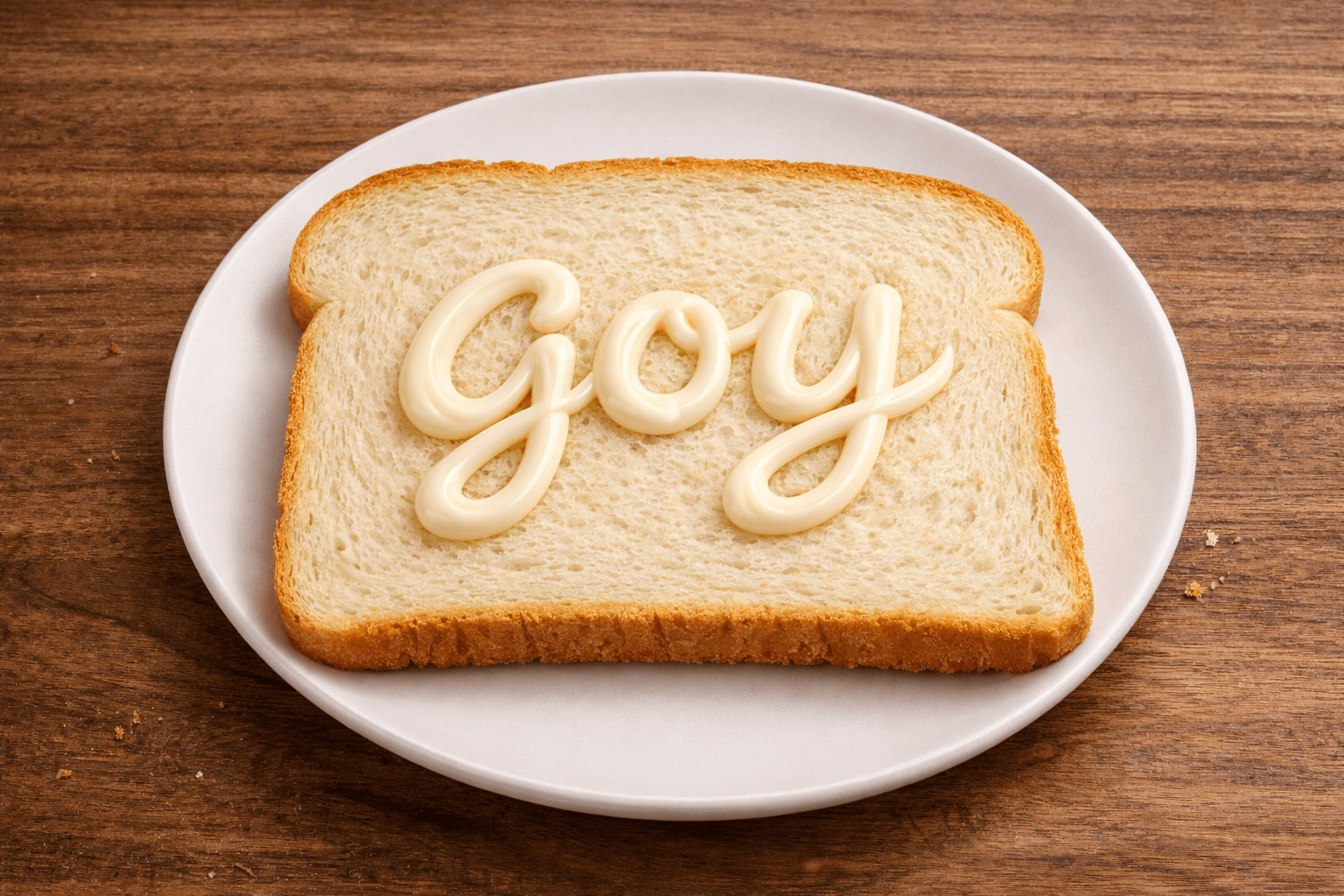
Is goy a slur, an antisemitic dogwhistle or simply a term for non-Jewish things like, as Lenny Bruce famously said, white bread and mayo? Image by Chris Norris-Leblanc

By Mira Fox February 27, 2026
Suddenly the term goy is trending. X is full of memes about “goy pride” and goyim “waking up.” People are debating whether goy is an antisemitic term, or, well, an anti-goyish term. Google Trends shows searches for the term have nearly quadrupled in the last four months.
Why is everyone suddenly obsessed with this bit of Jewish vocabulary?
Well, it’s not so sudden. Antisemites have been obsessed with it for decades. Memes on 4chan and other dark corners of the internet have long passed around quotes from the Talmud discussing goyim as though each use of the term was proof of a nefarious plot against non-Jews. They made up new terms, like “goyslop,” anything unhealthy supposedly created by Jews to weaken the world. White supremacists claim the term as one of pride, creating antisemitic groups like the Goyim Defense League.
Goyim broke into the mainstream discourse thanks to two events. One is the Epstein files, in which Jeffrey Epstein uses the term goy with a pejorative tone. The Epstein files have already birthed a network of conspiracy theories about Jewish cabals and government control, and goy was taken as just another example of Jewish scheming. Candace Owens talked about Epstein’s use of the term at length, incorrectly saying that it means “cattle.”
The other is a viral antisemitic YouTube video about a so-called “Jewish invasion” in New Jersey. The video’s creator, Tyler Oliveira, addressed his video to goyim and claims the label himself, aiming to inform the goyim about the supposedly nefarious threat of Jew moving into a town.
But is goy really such a problematic term? Literally, it just means “nation” — in the Torah, it is used in places to refer to the nation of Israel. In practice, it simply means “non-Jew,” or foreign nation which isn’t inherently insulting; Jews are far from the only group to have a term for outsider — think gringo in Spanish or farang in Thai.
This can, of course, be exclusionary. There is certainly the sense that outsiders cannot understand or participate in certain activities of an in-group — an idea that is not limited to Jews. And sometimes that is used to discriminate or insult.
Goy is used much more commonly among Jews to simply describe something that’s not Jewish. Think of the famous Lenny Bruce bit about pumpernickel being Jewish and white bread being goyish — is it a slur to observe that white bread is not part of Jewish culture? Thanks to a history of poverty and shtetl life, Jewish food is often more humble and less processed. That’s just history. It’s not an insult to white bread, or, for that matter, to pumpernickel.
The use of goy by non-Jews is similarly complicated. Someone can casually describe themself as a goy, simply because they are not Jewish or have little contact with Jewish culture. But the term is also used by neo-Nazi types as a dog whistle that signals familiarity with the world of antisemitic conspiracy theories. The phrase “the goyim are waking up,” which has suddenly entered the mainstream, echoes a much older antisemitic meme — “The goyim know,” which is used to imply there is something sinister to know or wake up to, namely the supposed Jewish control of society. (“Noticing” is another antisemitic meme, referring to the same phenomenon.)
This makes the debate about the term kind of silly. Tone and context is everything, just like with any term. “Jew” can be an insult, too, but it obviously is simply a descriptor as well; I call myself a Jew, because I am religiously and ethnically Jewish. If someone spat “Jew” at me on the street, however, I’d be insulted.
But the supposedly neutral valence of the word goy can make the antisemitism that often accompanies it hard to call out. If Jews use it neutrally, why shouldn’t anyone? Or so goes the defense online.
This is how Tyler Oliveira, the creator behind the “Jewish invasion” YouTube video, spins his use of the term. “Jews are trying to say I’m ‘anti-Semitic’ for using the word ‘goyim’ to describe non-Jews,” he wrote on X. “They can call you ‘goyim’ and it’s fine, but if you call yourself a ‘goy’ you hate Jews…? You can’t make this up.”
But watching Oliveira’s actual use of the term, the antisemitism is clear. He creates false binaries like dismissing antisemitism for the supposedly greater problem of “anti-goyism,” as though Jews, a minority, have outsize power to harm outsiders. He harps on the idea that Jews call themselves God’s chosen people as though it is akin to white supremacy, calling Jews “semite supremacists.”
It’s silly to pretend Oliveira’s use of goy isn’t obviously a loaded one; goy may not inherently be an insult, but when it’s deployed with a conspiratorial wink to antisemites, it’s antisemitic.
That’s really the simple rule for when goy is a slur, or when it’s antisemitic: If the person using it is a bigot, it’s bigoted. Otherwise, it’s just a word.
This is a moment of great uncertainty. Here’s what you can do about it.
We hope you appreciated this article. Before you go, we’d like to ask you to please support the Forward’s independent Jewish news this Passover. All donations are being matched by the Forward Board - up to $100,000.
This is a moment of great uncertainty for the news media, for the Jewish people, and for our sacred democracy. It is a time of confusion and declining trust in public institutions. An era in which we need humans to report facts, conduct investigations that hold power to account, tell stories that matter and share honest discourse on all that divides us.
With no paywall or subscriptions, the Forward is entirely supported by readers like you. Every dollar you give this Passover is invested in the future of the Forward — and telling the American Jewish story fully and fairly.
The Forward doesn’t rely on funding from institutions like governments or your local Jewish federation. There are thousands of readers like you who give us $18 or $36 or $100 each month or year.
Support our mission to tell the Jewish story fully and fairly.