This rabbi reshaped and revitalized Judaism in the 20th century — how have we forgotten him?
Mordecai Kaplan’s vision of ‘maximum Jewishness’ may be just what we need in these fraught times
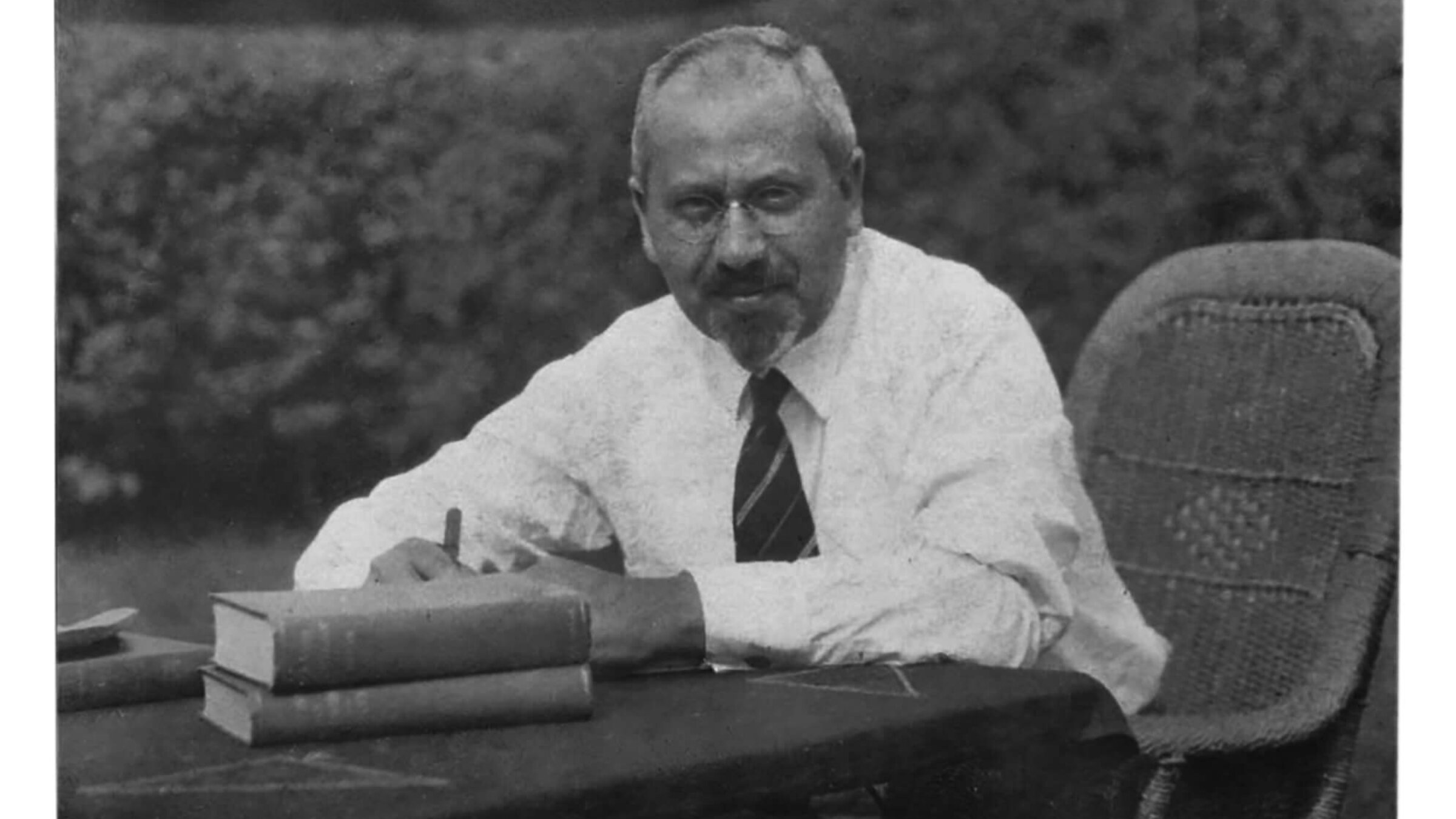
Rabbi Mordecai Kaplan, the subject of Jenna Weissman Joselit’s biography, liked to do his work outdoors when weather allowed. Courtesy of the collection of Hadassah K. Musher, New York
These days, public monuments don’t have an easy time of it. Variously speckled with graffiti, pelted with red paint, rendered headless, melted down and reconfigured into something else entirely, their fate is a fickle one, their future no longer assured.
The same can be said of people who, in their own day, were monumental personalities, household names, whose pronouncements were once heralded and heeded but who, with the passage of time, now go unrecognized, their presence erased from our collective memory.
Then again, monumental personalities have a fighting chance at being rescued from the cruel fate that awaits their physical counterparts. Thanks to the intervention of a biographer, they’re given a second lease on life, their impact on society re-evaluated, their names, activities and ideas put back into circulation.
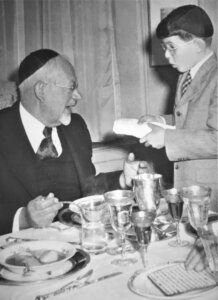
At least, I’d like to think so. As the author of a just-published biography of Mordecai M. Kaplan (1881-1983), a towering figure of the 20th century whose determination to reshape and revitalize American Jewish life set early generations of American Jewry aquiver, I’m heavily invested in obtaining a hearing, or, better yet, a fair shake, for my subject.
It’s not so much a matter of asking “what would Kaplan do?” by literally applying his words and practices to Jewish life today, making of him what so many contemporary American Jews make of A. J. Heschel: the wellspring of our moral conscience, much less a seemingly inexhaustible supply of quotable quotes. That’d be nice, of course, but it’s not what I have in mind when I speak of bringing Kaplan back into circulation.
My objective is more a matter of thinking through the lineaments of his legacy and reckoning with the ways in which his ideas about unity and community, choice, belonging and Israel, as well as his personal experiences with the limits of dissent, shape us. It’s to bring Kaplan into conversation with a generation who knows him not. But should.
Here’s why.
No fan of denominational divisions such as Reform, Conservative and Orthodox which, then, as now, segmented the Jewish community, Kaplan was an advocate, avant la lettre, of what we today call, and embrace, as post-denominationalism. Opening up opportunities for engagement and commitment, his concept of a robust Jewish life pivoted on options and possibilities rather than credentials, obligations and boundaries.
By Kaplan’s lights, all Jewish individuals, no matter their degree of ritual punctiliousness or belief in the divine should feel welcome to study a blatt gemara or observe Shabbat in their own fashion. The big idea, as he put it in 1928, was for Jews to find “joy in being Jews. Their Jewishness should be to them a source of enrichment and a means to the realization of what is best in them.”
Toward that end, Kaplan recalibrated the meaning of being Jewish in modern America, expanding its parameters. Well before “ethnicity” came into play as an omnibus term, one far more capacious and welcoming than “religion” as the locus of identity, he defined Judaism as a “civilization.” In articles, sermons and, in 1934, within the 500-plus pages of Judaism as a Civilization: Toward a Reconstruction of American-Jewish Life, this self-styled theological maverick laid out in great detail his plans for its overhaul. Eschewing “blind habit” and sentimentality in favor of intentionality, he called upon his coreligionists to “rediscover, reinterpret and reconstruct the civilization of his people.”
At the time this whale of a book was published, readers of the Forward would have been familiar with what Kaplan was going on and on about. But they had a simpler, more down-to earth name for the constellation of gesture, movement, humor, foodways, literature, folk sayings, rituals, idioms and beliefs that constitutes a distinctive Jewish culture. They knew it as yidishkayt.
For Kaplan’s audience of alrightniks — rapidly acculturating, upwardly mobile American Jews living the “goods life” — resorting to and promoting a Yiddish term like yidishkayt wouldn’t do. The word didn’t fit with their well-cushioned sense of themselves.
The use of yidishkayt didn’t sit well with Kaplan, either. Having grown up in a litvishe home, himself an immigrant to the United States who, for a spell, lived on the Lower East Side, he was no stranger to Yiddish. But he dismissed it as a “ghetto language,” one that got in the way of modernization.
Kaplan spoke from experience. In 1904, the newly minted, recently hired rabbi at Kehilath Jeshurun, a traditional synagogue on the Upper East Side, was preparing to deliver an English-language sermon, then a novelty, on Rosh Hashanah, when he was stopped in his tracks. Rabbi David Willowski, aka the Slutzker rav, a visitor from the Old World, assumed the pulpit, not Kaplan, and delivered an old-fashioned drush – in Yiddish. Up in arms, Kaplan fired off a letter to his congregants, taking them to task for their belief that Yiddish was the “only means whereby Judaism could be saved.”
In the absence, then, of an acceptable home-grown term by which to express his objectives, it took Kaplan a while to come up with a designation appropriate to the mighty scaffolding that now encased them. Sometimes, he adopted a lyrical turn of phrase, writing in the prestigious Menorah Journal of 1927 that to reduce Judaism to a religion was like “changing a rosebush into a bottle of perfume,” and that to “preserve any of [its] elements without the others is like trying to cultivate roses in a vase.” At other moments, he’d render it more succinctly, almost formulaically: “Before Judaism, Jewishness.” Ultimately, Kaplan put his faith in “civilization” as the antidote to what troubled modern-day Jews: the notion of chosen-ness a vivid case in point.
While recognizing the significance of the “chosen people” concept as well as its hold on the collective Jewish imagination, Kaplan believed the designation to be more of a “spiritual anachronism” than a viable conceit by which to bind contemporary Jews together as one. Its age-old history notwithstanding, chosen-ness, he insisted, was ill-suited to life in a modern democracy, “out of place,” and, in one of his more controversial decisions, retired it from active liturgical and rhetorical duty.
In its stead, Kaplan substituted what he characterized as an “ethically acceptable” and decidedly modern rationale for Jewish collective identity: “peoplehood.” A vague, if emotionally powerful, claim to distinctiveness, it made community and unity the center of gravity of the modern Jewish experience rather than Torah, prayer or even Zionism.
“The old Zionism,” he declared in 1955, “was meant to have the Jewish People rebuild Zion. A New Zionism is now needed to have Zion rebuild the Jewish People.”
In his day, Kaplan worried lest his timing was off, that his ambitious ideas had come too early for the first generation of Eastern European-born American Jews and too late for second generation American Jews. Perhaps he was right to worry. But his vision of a “maximum Jewishness” is neither too early nor too late for us. It’s right on time.
This is a moment of great uncertainty. Here’s what you can do about it.
We hope you appreciated this article. Before you go, we’d like to ask you to please support the Forward’s independent Jewish news this Passover. All donations are being matched by the Forward Board - up to $100,000.
This is a moment of great uncertainty for the news media, for the Jewish people, and for our sacred democracy. It is a time of confusion and declining trust in public institutions. An era in which we need humans to report facts, conduct investigations that hold power to account, tell stories that matter and share honest discourse on all that divides us.
With no paywall or subscriptions, the Forward is entirely supported by readers like you. Every dollar you give this Passover is invested in the future of the Forward — and telling the American Jewish story fully and fairly.
The Forward doesn’t rely on funding from institutions like governments or your local Jewish federation. There are thousands of readers like you who give us $18 or $36 or $100 each month or year.
Support our mission to tell the Jewish story fully and fairly.