As ‘Death of a Salesman’ returns to Broadway, the question remains — how Jewish is Willy Loman?
Arthur Miller’s doomed and delusional protagonist has been seen as both a crypto-Jew and an American everyman

Arthur Miller, circa 1949. Photo by Martin Harris/Underwood Archives/Getty Images

By Benjamin Ivry March 6, 2026
Arthur Miller’s 1949 play Death of a Salesman, currently on Broadway in a new production starring Nathan Lane as Willy Loman, was inspired by an uncle of Miller and a suicidal colleague of his father, both Jewish salesmen.
On the play’s 50th anniversary, Miller told an interviewer that Willy Loman and his family were indeed intended to be Jews. But, he added, they were oblivious to this identity since in postwar America, the Lomans were “light-years away from religion or a community that might have fostered Jewish identity.”
More to the point, in 1947, Miller had lectured at the Committee of Jewish Writers, Artists, and Scientists about a possible new Jewish literary movement in America. After the success of Focus, his 1945 novel about antisemitism, Miller opined: “Jewish artists and writers have it as their duty to address themselves in their works to Jewish themes, Jewish history and contemporary Jewish life.”
Yet despite this belief, Miller proceeded to explain that the Holocaust had temporarily made it impossible for him to write about Jewish life without being “defensive and combative” or to treat Jewish themes “in relation to antisemitism.” A delusional failure, Loman was no role model in his professional or family life, and presenting him as a Jew might have fed already-burgeoning antisemitism among audiences.
Miller would return to Yiddishkeit in his later plays After the Fall (1964), Incident at Vichy (1965), The Price (1968), Playing for Time (1980), and Broken Glass (1994), but Salesman reflected a cagier ethnic identity.
Even so, alert audiences picked up on Yiddishisms or Brooklyn Jewish inflections, such as when Loman’s wife Linda says: “Attention, attention must be finally paid to such a person.”
The literary critic Leslie Fiedler deemed these echoes of Yiddishkeit a symptom of Miller being “devious” in creating “crypto-Jewish characters” who are presented instead as generic Americans, supposedly to appeal to a wider American audience.
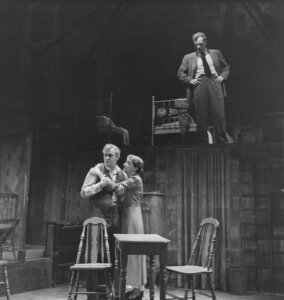
In a 1998 essay, the playwright David Mamet alleged that by not overtly dwelling on the characters’ Judaism in Salesman, Miller had shortchanged Jewish culture; the play is the “story of a Jew told by a Jew,” he wrote, but Loman’s fate is “never avowed as a Jewish story, and so a great contribution to Jewish American history is lost.”
To which Miller politely retorted that Mamet had discerned the Jewish content in the play, “so it couldn’t have been lost. I mean, what more could anyone want?”
What some observers wanted was a literal embrace of Jewish tradition, which they received from the Yiddish stage actor Joseph Buloff, best remembered for his role as a peddler in the Broadway premiere of the musical Oklahoma! and as a Russian agent in the 1957 MGM musical film Silk Stockings. In 1951, Buloff translated and staged Salesman in Yiddish, a version which has since been revived and performed widely.
The plangent tone of the Yiddish “Toyt fun a Salesman” made it an audience pleaser, and the literary critic Harold Bloom, a native Yiddish speaker, considered the Buloff translation the “most satisfactory performance” he ever saw of Salesman.
Less internationally celebrated was a contemporaneous staging by The Habima Theatre, the national theater of Israel. Directed by the Czech Jewish theatrical maestro Julius Gellner, it starred a powerhouse cast led by Aharon Meskin, an acclaimed Othello, Golem, and Shylock. Linda Loman was played by Hanna Rovina, who was known as the First Lady of Hebrew Theater; she had previously appeared with Meskin in the Habima production of S. Ansky’s The Dybbuk, and their exalted, visionary scope suited the epic, oneiric moments in Salesman.
Yet Israeli audiences seemed to prefer Miller’s All My Sons to Salesman, reportedly because Loman was a schmendrick (a small-time loser), and his pathetic demise excluded him as an appropriate hero/martyr for the new Jewish state.
Unlike the tearful Yiddish-language Loman and exalted, mythical Hebrew version, both of which glorified Jewish identity, the original Broadway cast was more ambiguous. Loman was played by Lee J. Cobb (born Leo Jacoby) a bellowing bulvan of a performer whose one-note paroxysm riveted audiences with its grim weight. In a televised interview (see the 51-minute mark), the Jewish performer Zero Mostel later complained that even a failed salesman needed humorous charm, entirely missing from the doom-laden Cobb rendition.
Of course, Mostel had suffered during the House Un-American Activities Committee hearings in Washington, D.C., at which Cobb and the Salesman stage director Elia Kazan were friendly witnesses, naming names of former friends to placate the government witch hunt, just a few years after Salesman premiered.
By contrast, Miller himself courageously confronted the HUAC and refused to yield to threats, winning admiration even from Jewish critics who did not always laud his work. To celebrate Miller’s 87th birthday, the sometimes waspish Robert Brustein proclaimed the playwright a “true public intellectual” who created “powerful plays, but also a shining moral example unmatched in American theater.”
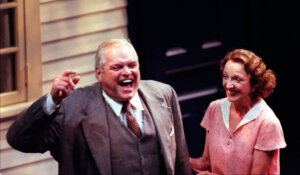
This praise refutes decades of obloquy, often from fellow Jewish writers, some of whom oddly resented Miller for being married for a few years to Marilyn Monroe, who converted to Judaism before their wedding. Such personal attacks, like Loman, Miller and the play itself, now belong to the ages.
Miller’s play has also won applause for productions with Black and international casts, including a celebrated staging in Beijing, which resulted in a book and documentary film on the topic. Miller, who traveled to China for the production, explained that the play’s filial theme was as poignant in Chinese tradition as it is for Jews. Indeed, Salesman in China, a 2024 Canadian play by Leanna Brodie and Jovanni Sy, freshly revisits that historic production.
As the literary historian Leah Garrett has noted, Willy Loman and Salesman can be simultaneously Jewish and universal. Some theatergoers believe that the finest modern interpretation of the role was performed by Warren Mitchell, an English Jewish actor whose Loman at times sounded vaguely like the Jewish comedian George Burns (born Nathan Birnbaum).
The most powerful, yet nuanced, Loman I ever saw onstage was incarnated by a non-Jewish actor, George C. Scott, who had previously played the role of the biblical patriarch Abraham in the 1966 epic film The Bible: In the Beginning… After a Loman tirade just before intermission, the house lights went up and the audience at New York’s Circle in the Square Theater sat in stunned silence, riveted. The impact resembled that of a 1950 Berlin production at which the audience refused to leave the theater after the show was over.
This immense force of Miller’s play is not always conveyed on stage or screen, even when accomplished actors like Dustin Hoffman and Brian Dennehy have played Loman. But the drama’s inherent force shows how the play has survived triumphantly as an American Jewish literary achievement.
This is a moment of great uncertainty. Here’s what you can do about it.
We hope you appreciated this article. Before you go, we’d like to ask you to please support the Forward’s independent Jewish news this Passover. All donations are being matched by the Forward Board - up to $100,000.
This is a moment of great uncertainty for the news media, for the Jewish people, and for our sacred democracy. It is a time of confusion and declining trust in public institutions. An era in which we need humans to report facts, conduct investigations that hold power to account, tell stories that matter and share honest discourse on all that divides us.
With no paywall or subscriptions, the Forward is entirely supported by readers like you. Every dollar you give this Passover is invested in the future of the Forward — and telling the American Jewish story fully and fairly.
The Forward doesn’t rely on funding from institutions like governments or your local Jewish federation. There are thousands of readers like you who give us $18 or $36 or $100 each month or year.
Support our mission to tell the Jewish story fully and fairly.