For the ‘Jazz Rabbi’ of Connecticut, music and Judaism are both about tradition and improvisation
Greg Wall runs ‘Jazz at the Post’ in Westport, but still finds time to pray and study Talmud every day
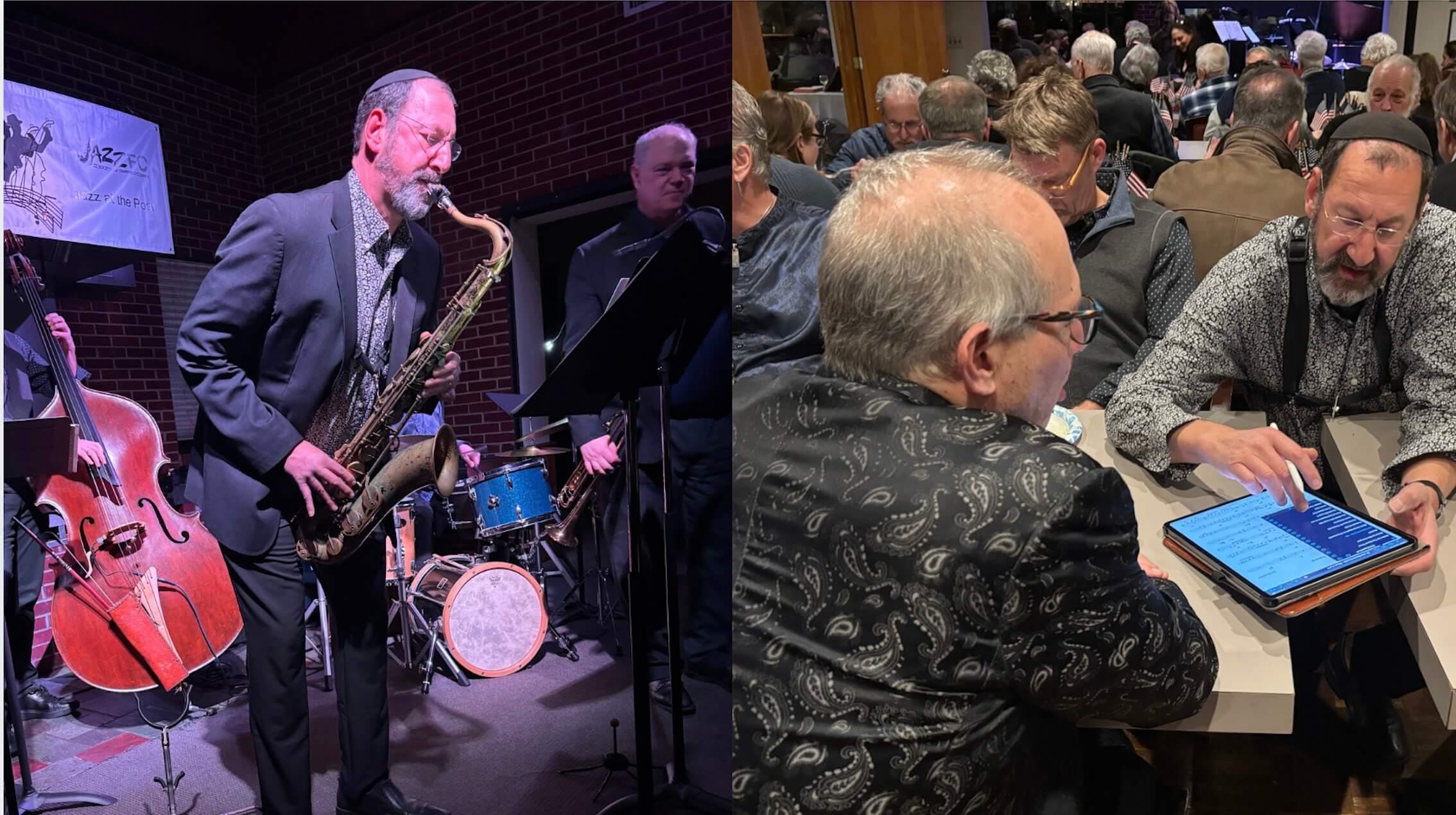
The onstage and offstage life of Greg Wall, the “Jazz Rabbi” of Connecticut. Courtesy of Greg Wall
Greg Wall, who has juggled a career as a professional jazz musician while holding down a day job as a pulpit rabbi, has long been known as The Jazz Rabbi. Though he has retired from his job at the Beit Chaverim Synagogue in Westport, Conn., where he served as full-time rabbi for 11 years, he’s still at the synagogue seven days a week.
“Jazz is really a model of how to put your own spin on an inherited tradition,” Wall told me. “And that’s what the practice of Judaism has been for me. I’m part of the tradition, yet I’m trying to come to my own understanding and make certain connections myself, rather than just dial it in by rote.”
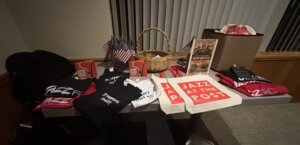
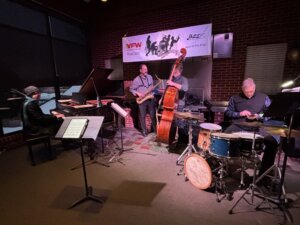
The Jazz Rabbi prays three times a day and studies Talmud daily. But Wall is also devoted to another congregation: Every Thursday night the jazz faithful gathers at a VFW post in Westport. The shows, known as Jazz at the Post, are organized by the Jazz Society of Fairfield County, a non-profit organization Wall co-founded. He’s the organization’s artistic director.
“This is a really nice chapter of my life,” Wall told me just he as he was getting ready to perform at a sold-out show in late February. “I have people calling me all the time to come play here. A lot of them are Grammy Award-winning jazz artists.”
The venue, which has a capacity of about 80, is usually sold out. Admission is $20 and there is no drink minimum, making it much more affordable than the typical night out at a commercial jazz venue, where admission is often $50 with a two-drink minimum. Because the Jazz at the Post shows take place at a VFW hall, veterans are admitted for $15, as are students.
Wall said that the fact that there’s no adversarial relationship with a restaurant trying to sell food and drink makes for a much better listening experience for jazz lovers.
“People come here to listen to the music,” he told me. “The people that I would go out and listen to in New York now come to Westport. I feel a little guilty that this place is two minutes from my house, but so be it.”
Back in 2009 when Wall got his first pulpit, a part-time gig at the Sixth Street Community Synagogue in Manhattan’s East Village, his group Later Prophets was touring regularly. During his time at the Sixth Street shul, Wall created the Center for Jewish Arts and Literacy, which brought klezmer, jazz and big-band music to the synagogue’s basement social hall, along with Yiddish language and Torah classes. The music series lives on at the Hudson Yards Synagogue in Manhattan, thanks to the efforts of the percussionist Aaron Alexander.
Later Prophets has been inactive in recent years but Wall still plays freelance gigs with various artists and occasionally performs with the guitarist Jon Madoff’s horn-heavy Afrobeat ensemble Zion 80, as well as The Elders, a jazz group led by Frank London, Wall’s friend and collaborator of nearly 50 years.
At the VFW hall in Westport, The Jazz Rabbi joins the visiting artists on the bandstand every week. Wall said the experience of playing with different acts, many of whom perform original compositions, has been good for his musical chops. One of the regulars at the Westport shows remarked that when Wall really gets into a groove, he rocks back and forth like he’s davening.
The Jazz at the Post shows have been happening since April 2022 but Wall has been performing locally since 2015. He started playing in the back room of a local eatery known as Restaurant 323. That gig came about after Wall’s impromptu performance at a fundraiser for the Bridgeport community radio station WPKN-FM.
“After he played a couple of bars of music at the WPKN benefit, I was just blown away by his talent,” recalled Richard Epstein, a Westport dentist who serves as vice-president of the Jazz Society. Epstein’s wife Ina Chadwick, a former Forward editor, was running a spoken word performance series at Restaurant 323 and suggested Wall start a jazz night there.
Eric Bibler, a co-founder of the Jazz Society and a board member, said he discovered the Restaurant 323 scene when his wife went to pick up their daughter one night at the Metro-North station in Westport and didn’t come home right away. Their daughter Zina noticed someone playing a stand-up bass and decided they should check it out. They had such a great time that they stayed until the last set.
“And that was it,” Bibler told me. “I went back with them the following week and we’ve been going ever since. We started bringing our friends and everybody that we could think of to try to support this.”
Bibler realized there was a need to start a non-profit after the Westport jazz lovers had collected thousands of dollars by passing around a cigar box at performances to purchase a piano.
One day he asked Wall, “Who owns the piano?’” Bibler recalled. “And we decided maybe we should start a non-profit.”
The newly created Jazz Society paid $11,000 for a Steinway Model M that was built in 1937. It had served as one of the house pianos at the Village Gate, the iconic Greenwich Village nightclub that closed in 1988.
If a piano can be said to have yichus, the Gate’s Steinway would certainly fit the bill. Thelonius Monk and Nina Simone are among several jazz greats who played it on live albums recorded at the Gate. Mose Allison, Count Basie, Bill Evans, Eddie Palmieri, Sun Ra and McCoy Tyner have banged on its keys, too.
Wall had been tipped off to the Model M’s availability by his piano tuner. But all that wear and wear had taken its toll on the instrument, so in 2018 the Jazz Society came up with $15,000 to refurbish it.
Paul Haller, a Stamford-based piano restorer, recalled with a chuckle that Wall brought down a few local pianists to his shop when the repairs were completed. They put the piano through its paces for a couple of hours before declaring they were pleased with the restoration.
Ted Rosenthal, a pianist who teaches at Juilliard and the Manhattan School of Music, performed at the Post with a quintet that included Wall in late February. During the intermission, he reminded me that being a jazz musician means that one night you could be playing at Carnegie Hall and the next night your gig might be at the Carnegie Deli.
“They’ve created a jazz club in a place that wasn’t designed to be a jazz club,” he said. “I think that’s what we need to do because obviously rents in New York are so high that some clubs don’t succeed because of the expenses involved. If you can find a place and build an audience, I think that’s a perfect way to go.”.
“This place is like being in Greenwich Village,” said Alan Phillips, a Westport resident who comes to the Jazz at the Post performances almost every week. “The world-class jazz that we get right here — it’s the best kept secret.”
This is a moment of great uncertainty. Here’s what you can do about it.
We hope you appreciated this article. Before you go, we’d like to ask you to please support the Forward’s independent Jewish news this Passover. All donations are being matched by the Forward Board - up to $100,000.
This is a moment of great uncertainty for the news media, for the Jewish people, and for our sacred democracy. It is a time of confusion and declining trust in public institutions. An era in which we need humans to report facts, conduct investigations that hold power to account, tell stories that matter and share honest discourse on all that divides us.
With no paywall or subscriptions, the Forward is entirely supported by readers like you. Every dollar you give this Passover is invested in the future of the Forward — and telling the American Jewish story fully and fairly.
The Forward doesn’t rely on funding from institutions like governments or your local Jewish federation. There are thousands of readers like you who give us $18 or $36 or $100 each month or year.
Support our mission to tell the Jewish story fully and fairly.