This isn’t Barbra Streisand’s ‘Yentl’ — it isn’t I.B. Singer’s either
In a new production currently playing in London, Isaac Bashevis Singer’s Yeshiva boy makes an awkward transition to the Yiddish stage
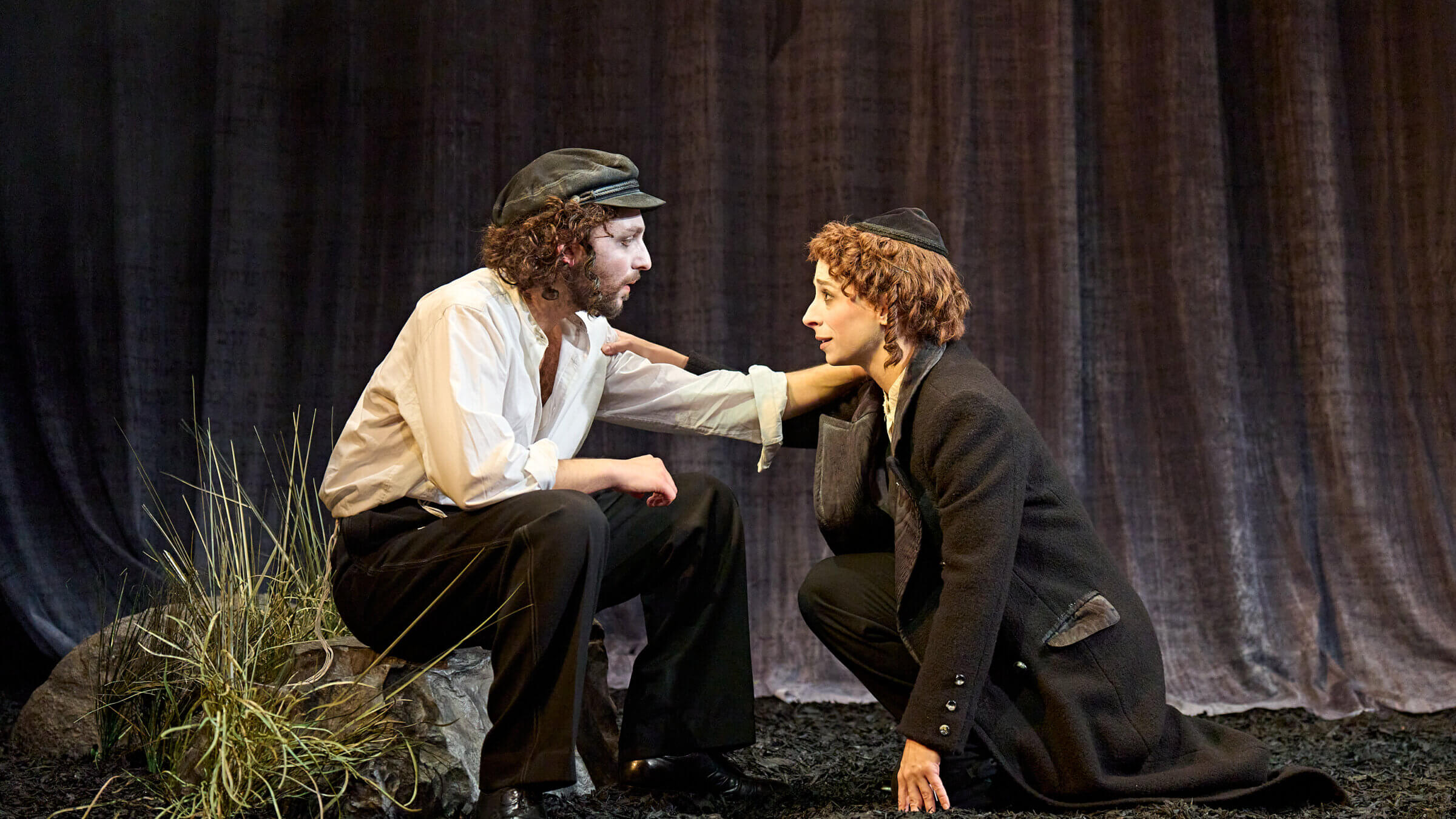
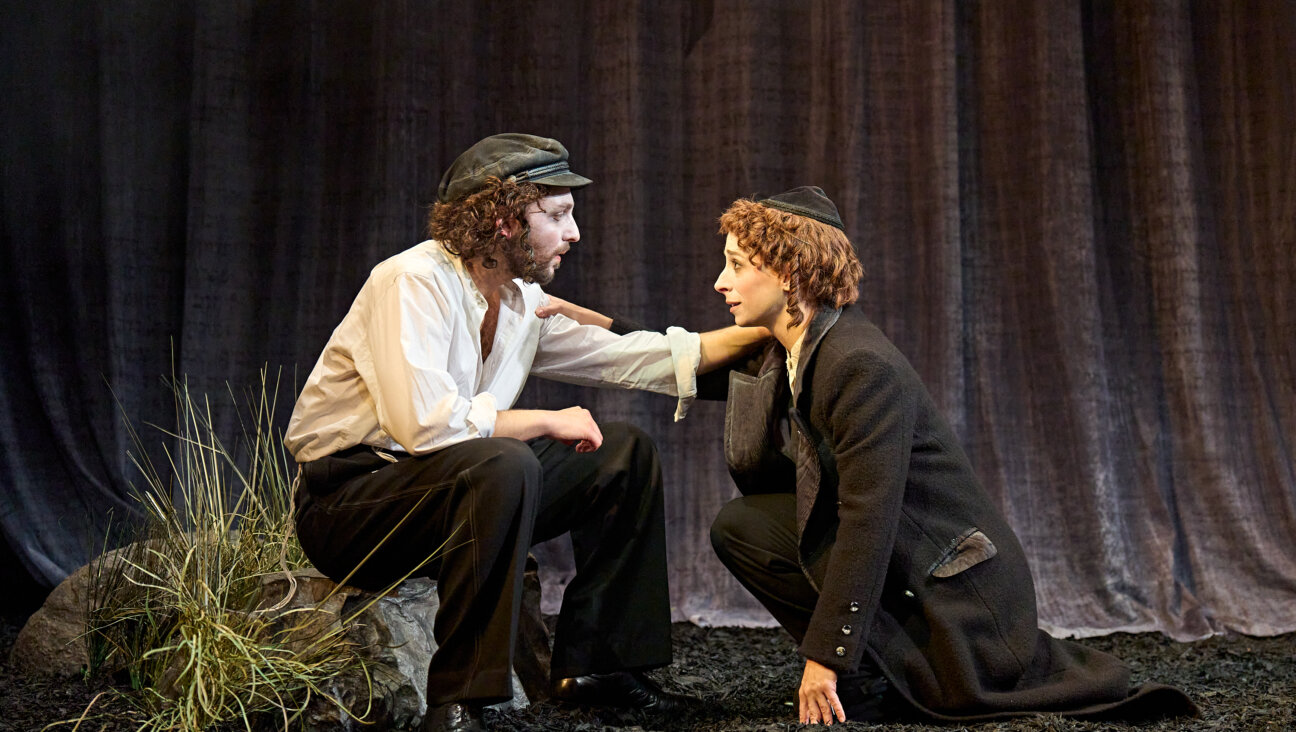
Ashley Margolis as Avigdor and Amy Hack as Yentl in the Kadimah production at London’s Marylebone Theatre. Courtesy of Marylebone Theatre

By A.J. Goldmann April 3, 2026
There’s an FAQ on the website of the London theater where the Kadimah Yiddish Theatre of Melbourne’s production of Yentl is running through April 16. The very first item reads:
Is this a stage version of the 1983 musical film starring Barbara Streisand?
No — the London production of Yentl is a play. It is a new adaptation of Isaac Bashevis Singer’s 1962 short story,“ Yentl the Yeshiva Boy“ — just like the Streisand film was at the time.
This explanation does more than relieve box office staff of the tedious duty of informing Mrs. Lipschitz and Mrs. Rosenblatt from the sisterhood that no, they shouldn’t come expecting to sing along to “Papa, Can You Hear Me.” It argues that this theatrical “reimagining” (to use Kadimah’s own term) of Yentl is no less authentically Singerian than the musical. It also hints at how Kadimah prevailed, against considerable odds, in adapting a story whose rights Streisand still owns and fiercely guards.
As Gary Abrahams, Kadimah’s executive director and the director of the production, recently told the Jewish Telegraph, Singer’s estate gave him their approval on the condition that it be a Yiddish language, non-musical production. The London transplant, which comes on the heels of earlier stagings in Melbourne and Sydney, is enjoying a six-week run at the Marylebone Theatre, which is housed inside of an anthroposophical center. Both the limited duration of the run and the Off West End venue were critical to securing the Singer estate’s approval.
Kadimah’s production, a bilingual Yiddish-English chamber piece that has gained a certain notoriety for featuring male and female nudity, is the latest chapter in the long and unruly afterlife of Singer’s deceptively simple tale.
In “Yentl the Yeshiva Boy,” which first appeared, in English translation, in Commentary in September 1962, a rabbi’s daughter, shut out from the Talmud learning reserved for men, cuts her hair, dons male clothing, changes her name to Anshel, finds a chavrusa, the heartbroken Avigdor, and enters a yeshiva. But Singer’s tale is considerably stranger than both that simple summary and Streisand’s popular version suggest.
Yentl is not simply a tale of female exclusion and feminist defiance. It is also a story of impersonation, erotic confusion, spiritual hunger and metaphysical trespass. Yentl does not cross one line and stop there. Once she begins living as Anshel, all the categories meant to keep life orderly — male and female, study and desire, law and transgression — begin to blur.
That instability may explain why Yentl has proved so durable. Before Streisand made it famous on screen, Singer had already adapted it for the stage in the mid-1970s together with Leah Napolin. The show opened at the Brooklyn Academy of Music in 1974 and transferred to Broadway the next year, with Tovah Feldshuh in the title role.
“As a play it is altogether too anecdotal,” wrote Clive Barnes in the 1974 Times review. “The storyline wanders on and on like a river through a landscape, but the landscape happens to be worth looking at.” Napolin, who died in 2018 (and who claimed that Singer didn’t write a single word of the script) suggested that the second wave feminism of the time made the story and its themes feel relevant to contemporary audiences.
“This dark little gender-bending tale had an impact on many people who identified, as I did, with the heroine’s struggle to reinvent herself, to redefine herself,” Napolin once told an interviewer.
Half a century later, Kadimah’s Yentl leans heavily, and not always successfully, into our contemporary discourse about sex and gender. The story reemerges in a markedly — and overtly — queerer form than in previous versions.
Streisand’s film absorbed the title character so completely into her own star persona that for many people Yentl is now synonymous with Babs, not Singer. Her approach is expansive where Singer is compressed, ardent where he is dry-eyed, and schmaltzy where he is severe. Streisand gave the story glamor, emotional clarity and uplift. It also tilted the material away from Singer’s sharper ambiguities and toward the all-American theme of becoming oneself. The film, which Streisand also directed, produced and co-wrote, even ends with Yentl aboard a ship bound for America! (In Singer, Yentl simply ups and vanishes, an ending that has been interpreted as a reference to the legend of the Wandering Jew).
Yet Streisand’s victory over the material came with at an expense. As Linda Besner notes in an essay on Singer and Streisand and published in the Canadian arts review Arcade, the film’s feminist reclamation of Yentl also trims away some of the story’s deepest instability. Singer’s Yentl tells Avigdor, “I’m neither one nor the other,” and the story allows a degree of erotic and ontological confusion that the film flattens into a drama of self-realization. (Singer, famously, disliked what Streisand did to the story. The Nobel Prize-winning writer laid out his objections in a 1984 New York Times piece where he humorously interviewed himself.)
Kadimah’s production, adapted by Abrahams, Elise Esther Hearst and Galit Klas, starts from dissatisfaction with that inheritance. Hearst has said the team wanted to get back to the story’s darker, more transgressive roots. In an interview with The Times of London, Abrahams said he had been struck by how unlike the movie Singer’s story really was, and described the original as a work about spirituality, identity, gender, sexuality, as well as plain old sex.
Those ambitions are evident from the outset. This is not a shy Yentl. It foregrounds the body, goes hard on the story’s sexual unease and sharpens its queer implications. Amy Hack is alluringly androgynous in the title role, both attracted by and attractive to Avigdor and Hodes (Genevieve Kingsford in a very stiff performance), Avigdor’s erstwhile fiancée, who Yentl marries in bad faith. As in the film, she casts a prurient gaze at the bathing Avigdor (Ashley Margolis bares all onstage, one-upping Mandy Patinkin, whose naked tush is one of the film’s most memorable sights). Singer’s story can accommodate plenty of sexual discomfort and frustration, but Abrahams’ production lays it on too thick. Did he really need to make Avigdor a mikveh peeper?
The production also never settles on a convincing tone and register. The one-set production, with its vaguely Expressionist look, goes for too much shtetl schlock. The acting keeps sliding between modes without enough control to make the shifts meaningful: naturalistic for a few minutes, then suddenly pitched into something like Yiddish melodrama. Additionally, there isn’t any discernible logic to why certain passages are spoken in English while others are in Yiddish (with subtitles projected onto the set). The result is less daring than uncertain. No performance fully steadies the evening, although Evelyn Krape comes the closest. As “The Figure” (a character not in Singer’s original), she narrates and inhabits minor roles, hovering over the proceedings like a comic dybbuk. The device of a spectral conferencier does not entirely cohere, but Krape — hammy in a grotesque-vulgar-goofy way — almost pulls it off (Krape is also Kadimah’s artistic director).
Kadimah’s production was lauded in Melbourne and Sydney but has met with a very different reception in London, which is, of course, a no-nonsense theater town. Despite the tepid and sometimes outright negative reviews (“Even with nude scenes, this is a schlep,” The Times of London’s critic wrote), the Thursday evening performance I attended was nearly full. And, the mostly grey-haired audience members, several of whom I recognized, from a nearby kosher deli where I wolfed down a pastrami sandwich before the show, were enthusiastic. A Yiddish Yentl in London now is enough of an event to draw not only the usual suspects but the theatrically adventurous — and, no doubt, some Streisand fans who should know to check their expectations at the door.
Kadimah Yiddish Theater, which recently passed its centenary, is, by some counts, Australia’s oldest theater company. This Yentl might well be the biggest hit they’ve had in their long history. Despite its shortcomings — and there any many, both in concept and execution — the production shows that the company understands the need to strive for more than nostalgia and sentimentality, à la Streisand, and to be a little impious and even impish.
Today’s most interesting Yiddish theater (and also film, to an extent) inscribes itself within tradition while treating that heritage as unstable, literate and vulgar. That is what makes the Yiddish work of another Australian director, Barrie Kosky, so refreshing and bracingly alive.
Earlier this season, Kosky directed K., a “Talmudic vaudeville” inspired by Kafka’s “The Trial” at the Berliner Ensemble. In interviews, Kosky has spoke of the polyglot, code-switching, cross-dressing Yiddish theater that formed part of Kafka’s world. His haunting and unsettling production moves between German, Hebrew and Yiddish (including a gorgeous translation of Schumann’s Dicherliebe into mamaloschen) and injects intellectual seriousness with showbiz energy.
There’s another reason I bring up Kosky, a prolific, influential, and deeply Jewish theater and opera director. In summer 2027, he will present a fresh musical version of Yentl at the Fisher Center for the Arts at Bard College, created together with Lisa Kron (the Tony-winning writer and lyricist of Broadway’s Fun Home) and Adam Benzwi, one of the director’s regular musical collaborators in Berlin. According to Bard’s announcement, Benzwi’s score will draw on American and European Yiddish theater, music hall and Hasidic choral traditions. That sounds less like an attempt to strip Yentl back to some pristine original than like an effort to push through the whole layered history of the piece and make something gloriously heterodox.
By this point Yentl exists not as a single work. Singer gave it severity, mischief and danger. Streisand gave it melody and yearning. Kadimah has tried, admirably if unsuccessful, to restore taboo, Yiddish abrasion and folkloric unease, sometimes vividly, sometimes crudely. Kosky may prove better placed than most to let those elements collide without trying to reconcile them too neatly.
This is a moment of great uncertainty. Here’s what you can do about it.
We hope you appreciated this article. Before you go, we’d like to ask you to please support the Forward’s independent Jewish news this Passover. All donations are being matched by the Forward Board - up to $100,000.
This is a moment of great uncertainty for the news media, for the Jewish people, and for our sacred democracy. It is a time of confusion and declining trust in public institutions. An era in which we need humans to report facts, conduct investigations that hold power to account, tell stories that matter and share honest discourse on all that divides us.
With no paywall or subscriptions, the Forward is entirely supported by readers like you. Every dollar you give this Passover is invested in the future of the Forward — and telling the American Jewish story fully and fairly.
The Forward doesn’t rely on funding from institutions like governments or your local Jewish federation. There are thousands of readers like you who give us $18 or $36 or $100 each month or year.
Support our mission to tell the Jewish story fully and fairly.