In 1989, Harold Pinter and Jerry Schatzberg made the perfect Holocaust movie for 2026
Almost four decades after its premiere, ‘Reunion’ is a masterful look at how civil society disintegrates
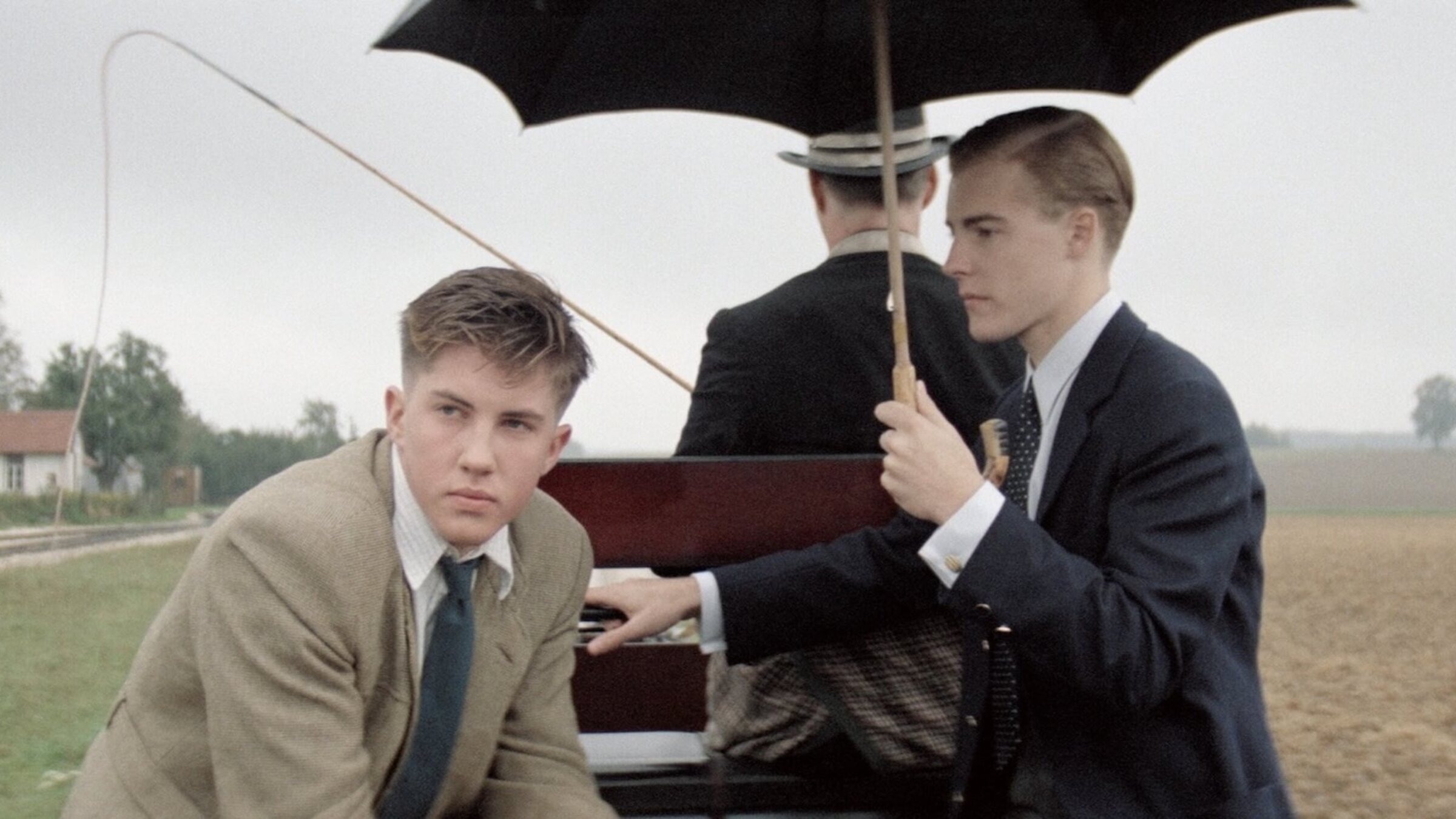
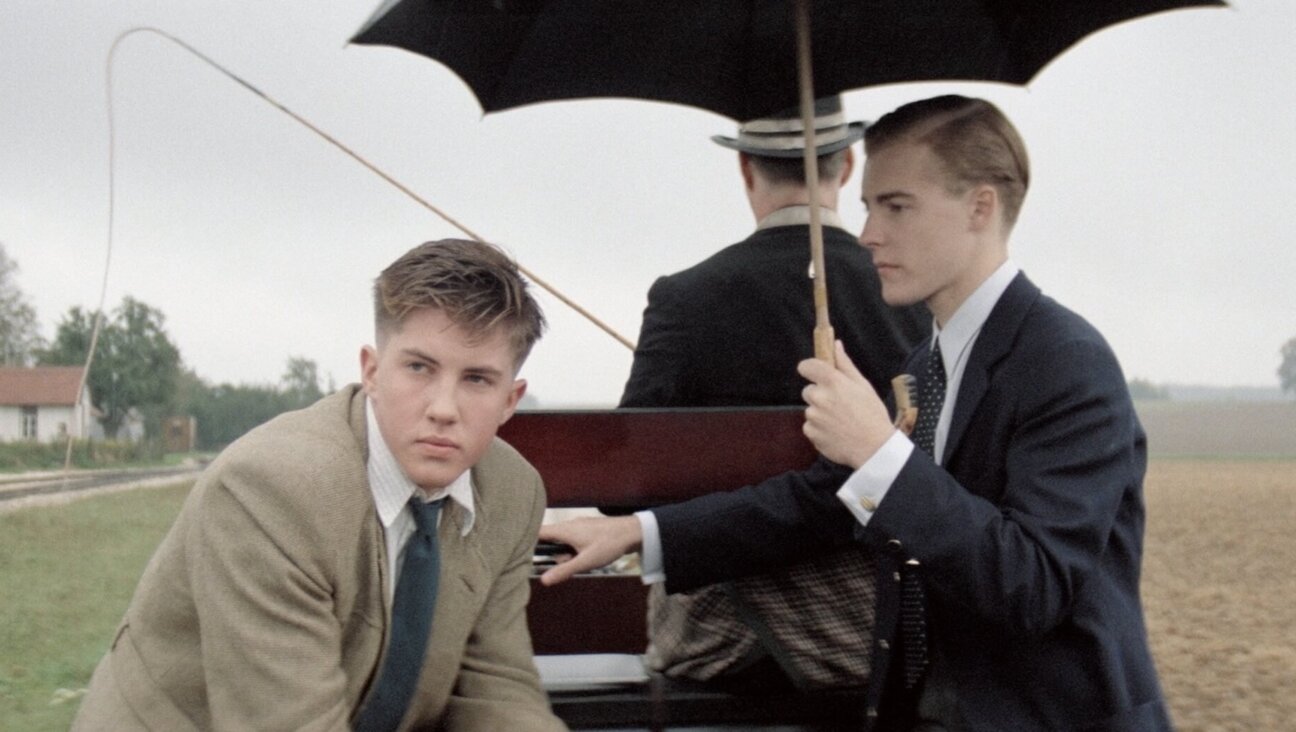
Hans Strauss (Christien Anholt) and Count Konradin von Lohenburg (Samuel West) in ‘Reunion’. Courtesy of Rialto Pictures Media

By Talya Zax April 2, 2026
The first hint that Reunion is an unusual kind of Holocaust film comes from a music cue.
An older man has traveled from New York City to Stuttgart, a trip that has clearly brought him immense psychological pain. His flashbacks to Nazi marches lead us to assume he lived in the German city during Adolf Hitler’s rise — but he doesn’t seem to know any German, opening every conversation by asking if the other party speaks English. Then he arrives at a warehouse, presumably to filter through belongings left to fester for decades after World War II, and begins a journey down a hallway that seems almost infinitely long.
As he walks the path back toward his past, the music marking his steps, composed by Philippe Sarde, is buoyant and lilting. The tune comes as a surprise. What’s this tripping sense of joy doing, following this man toward what we have every reason to assume is a museum of miseries?
Reunion, a 1989 film by director Jerry Schatzberg, with a screenplay by Harold Pinter based on a novel by Fred Uhlman, barely made a splash when it premiered in the United States, despite a largely positive European reception. Now, it’s being re-released, beginning with a two-week run at Manhattan’s Film Forum that opens this weekend. It’s almost a perfect Holocaust movie for our times — because it chronicles a moment much like our own, in which the gradual dissolution of society began to make itself known through the gradual dissolution of personal relationships. (Spoilers follow.)
The old man is Henry Strauss (Jason Robards) — who was once Hans (Christien Anholt), a lonely Jewish teenager at an elite all-boys Stuttgart school. The trip to Germany is his first since before the Holocaust. And the music, we quickly learn, is the soundtrack of what seems to have been the one great friendship of his life: it recurs at moments of particular meaning or joy during his brief, almost romantic engagement with an aristocratic boy called Count Konradin von Lohenburg (Samuel West).
The story of that adolescent friendship is the core of the film, an extended flashback to a time of great happiness as well as great peril, threaded through with that same uplifting melody.
Konradin is a bright, brave boy — ready to defend Hans to an antisemitic relative, or join his friend in striking back at Nazi youth who bully those without swastika armbands. But it’s also clear that he’s destined to get sucked into the Nazi machine: everything about his heritage, not to mention his prototypically Aryan looks, foreshadows that future. So from the first moment of his friendship with Hans, when the two connect over a shared love of collecting — with Konradin’s choice of companion clearly shocking a school in which Hans, as a Jew, resides somewhere far below the bottom of the social ladder — there’s a dominating sense of an invisible clock, counting down.
But oh, the halcyon days of this doomed duo.
They walk one another home from school, giggling in the age-old manner of teenagers for whom political upheavals are not yet real. They practice archery. They bicycle through the Black Forest, staying overnight at inns without the oppressive presence of their parents, whom both boys find embarrassing. (Konradin’s mother hates Jews, and Hans’ father is painfully enamored of Konradin’s elevated status.) When Konradin confesses that Hans is his first true friend, and Hans grins with quiet glee, it’s impossible not to hope that, somehow, they’ll stay this way — lovely, young and unchanged by the times in which they live.
For months, the Nazi threat only hovers around the edges of their relationship. Then it overtakes them. Rapid ruptures follow. And then it’s the 1980s, and Hans is back in Germany, seeking to figure out what happened to his old friend.
What prompts him to make the trip? There’s never a clear explanation. But it’s hinted that Hans has come to feel that he needs, at long last, some resolution to this passionate, formative relationship. He’s willing to risk his sense of self — the identity of the man who escaped to the U.S., and refused to ever speak a word of German again — to close that loop.
The sense that Hans’ whole life has turned on the events that marked his friendship with Konradin makes Reunion a profound watch, one that I suspect will be more effective for audiences in 2026 than it proved in 1989. Many of us have had once-close relationships begin to crack under the pressure of extreme polarization, and the insidious tensions of a political environment characterized by conspiratorial suspicion. Many of us love people we can no longer talk to, at least not freely.
It’s tempting to write these rifts off as personal. Reunion‘s terse message: don’t. A society doesn’t collapse all at once. It succumbs to hairline fractures; provoking a critical number of them is a strategy.
A Holocaust movie that spends so much of its runtime on a period of real contentment is an odd object. The break between its heroes comes late, meaning much of Reunion is a pleasure to watch. That is the point: under authoritarianism, life is still good until it’s not. Citizens have freedom, until they don’t. Friendship is trustworthy, until human weakness interferes. Liberal values are easy to hold onto, until you shake the demagogue’s hand.
But what makes Reunion most timely isn’t its somber portrayal of the connection between the minor tragedy of Hans and Konradin and the major one of World War II and the Holocaust. It’s that the film is hopeful.
To spoil the ending would be a shame. It is enough to know that Hans’ searching leads him to unexpected places, and while some are miserable and vicious, others are not. To let things stay broken, or assume that humans can’t change for good as well as for ill, is a choice. So is hearing and following the better music — the call to connect, and to resist being persuaded of something you know is wrong.
This is a moment of great uncertainty. Here’s what you can do about it.
We hope you appreciated this article. Before you go, we’d like to ask you to please support the Forward’s independent Jewish news this Passover. All donations are being matched by the Forward Board - up to $100,000.
This is a moment of great uncertainty for the news media, for the Jewish people, and for our sacred democracy. It is a time of confusion and declining trust in public institutions. An era in which we need humans to report facts, conduct investigations that hold power to account, tell stories that matter and share honest discourse on all that divides us.
With no paywall or subscriptions, the Forward is entirely supported by readers like you. Every dollar you give this Passover is invested in the future of the Forward — and telling the American Jewish story fully and fairly.
The Forward doesn’t rely on funding from institutions like governments or your local Jewish federation. There are thousands of readers like you who give us $18 or $36 or $100 each month or year.
Support our mission to tell the Jewish story fully and fairly.