In the work of 21 artists, 49 different ways to be Jewish
The Derfner Museum of Judaica’s ‘Envisioning the Sacred’ exhibit encompasses paintings, printings, drawings and linoleum cuts
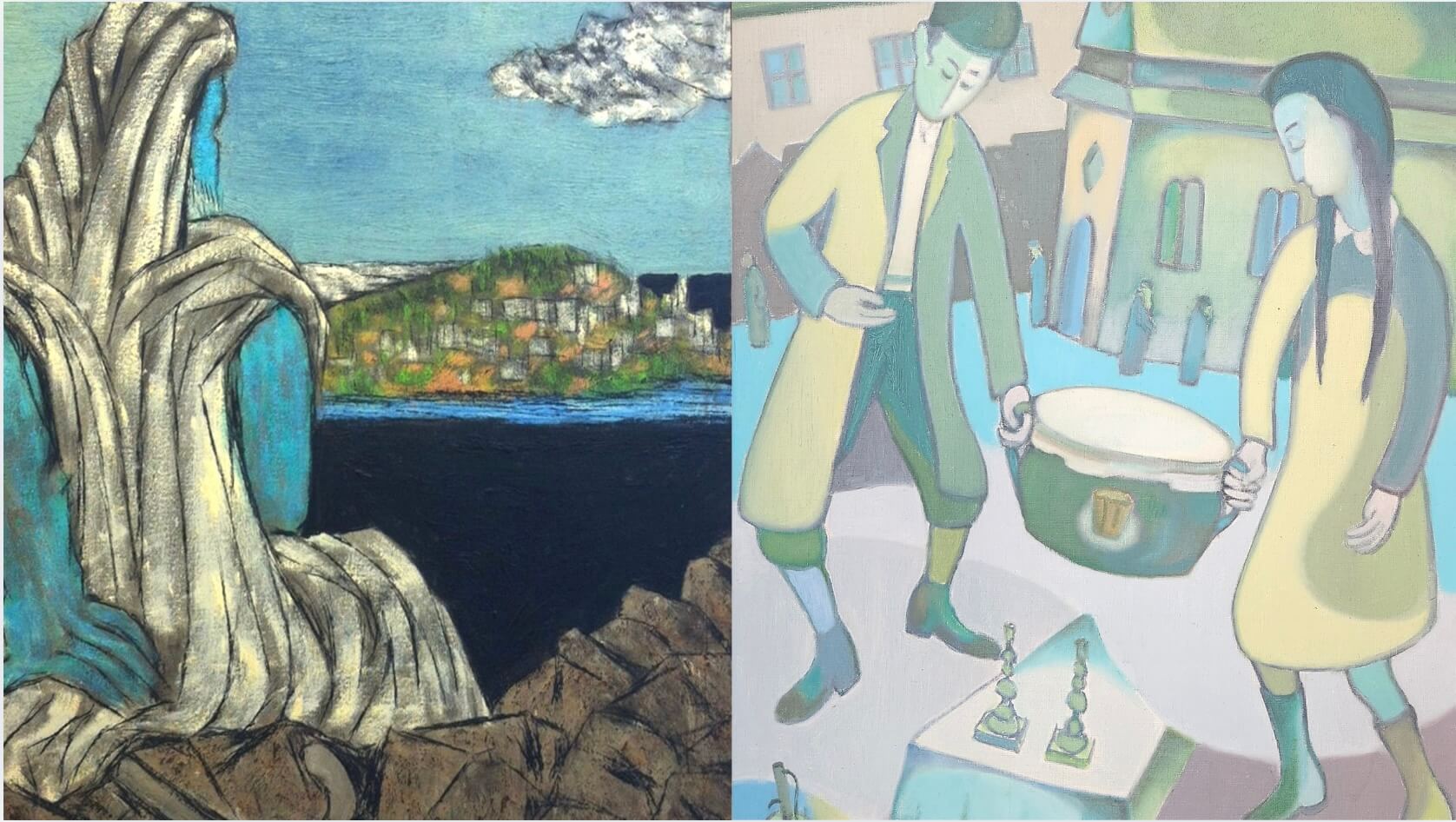
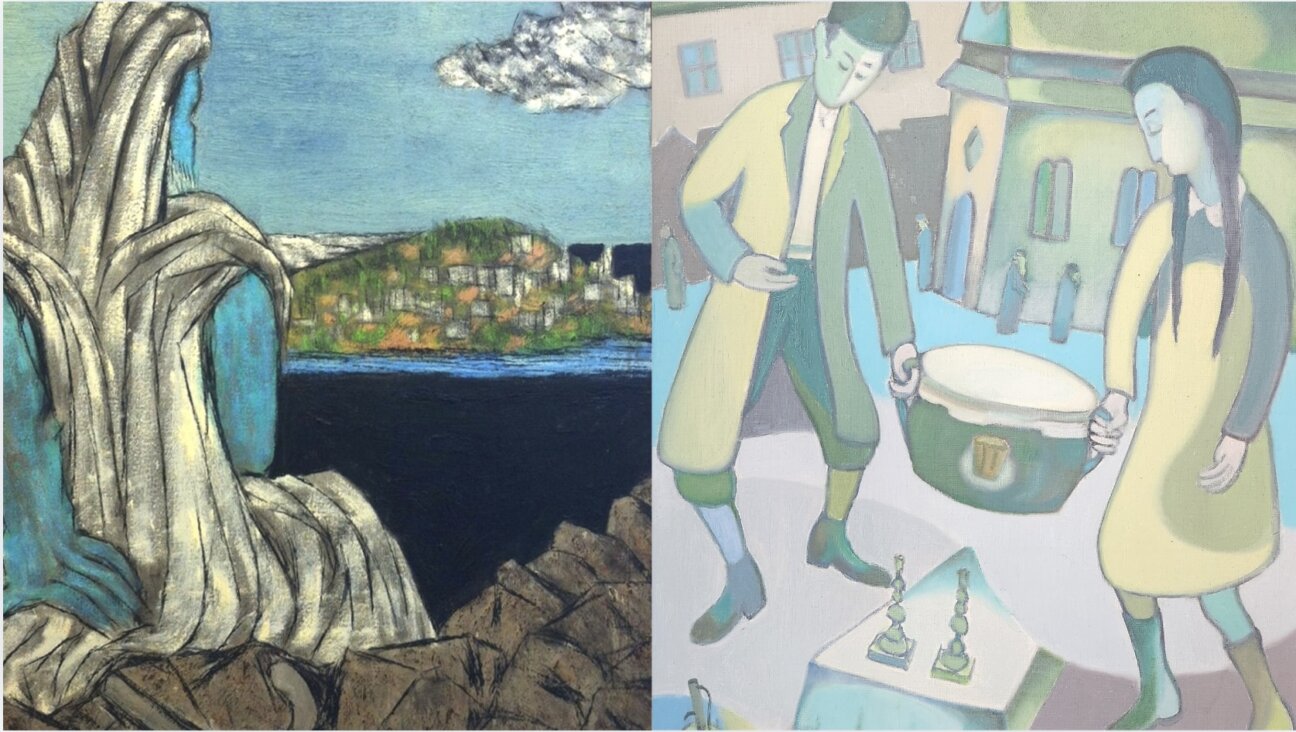
From left: Ben-Zion’s ‘Moses Looking Down to the Promised Land’ and Adam Muszka’s ‘Sabbath Meal.’ Both are on display at the Derfner Judaica Museum’s ‘Envisioning the Sacred’ exhibit. Courtesy of Derfner Judaica Museum + Art CDerfner Judaica Museum + Art Collection. Gift of Noah L. Butkin; Gift of Geraldine Lipschutz
As I walked through the exhibit, Envisioning the Sacred: Modern Art from the Collection, at the Derfner Judaica Museum and Art Collection, I wondered aloud which was the more defining element in these 20th and 21st century paintings, drawings, prints and linoleum cuts. Was it the modernist sensibility, which encompassed figurative, abstract, symbolic and metaphorical approaches? Or was it the Jewish-themed content?
In the 49 pieces by 21 artists (including two etchings by Marc Chagall), there were illustrated Biblical characters and stories; depictions of traditions and rituals; and a fair number of the works employed the Hebrew alphabet to evoke emotion and inspire the composition.
“The exhibit shows how artists use a modern visual language to express their Jewish identities,” said Susan Chevlowe, chief curator and museum director who guided me through the light-filled gallery, which is part of the Hebrew Home at Riverdale and set on a shallow hill that slopes down to the Hudson River.
“It’s hard to separate the two elements or say which is more defining,” Chevlowe said. “The majority of these artists were artists early on in their lives, drawing and sketching as children. Some grew up steeped in a Jewish tradition and others came to their Jewish identity later in life, especially in the post-Holocaust years. Percival Goodman is an example. An agnostic, he was best known as a modernist architect. But in the post-Holocaust years he became interested in Biblical figures.”
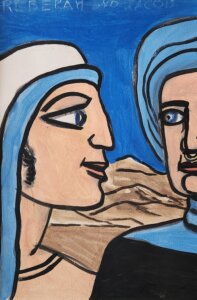
Chevlowe pointed to Goodman’s painting “Rebekah and Jacob,” presenting two large, sharply drawn flat heads. The bold colors outlined in stark black stripes summon forth figures that border on the cartoonish, yet are also strikingly beautiful. Here, the matriarch Rebekah beams at her younger son Jacob with whom she is scheming to steal her older son Esau’s birthright.
A number of the works reflect, in subtle and layered ways, Jewish traumas coupled with homage and pride and in some instances a touch of the elegiac.
Adam Muszka’s “Sabbath Meal,” painted in the 1960’s is a nostalgic look back at the lively Polish shtetl that he grew up in and that no longer exists. With its sentimental tone, the painting evinces distortion. Two figures in the foreground are over-sized, while the homes in the background are shrunken and lopsided — an indication, perhaps, that this is a falsely rosy memory.
In the seemingly more realistic 2003 painting, “Choral Synagogue, St. Petersburg, Russia,” one of the more recent works on display, Joyce Ellen Weinstein brings to life the massive temple entrance and the decorative gate in front of it, “which is slightly off kilter,” Chevlowe pointed out. “Notice the barbed wire on top of the gate. The painting suggests the dignity of the synagogue and its people and also the difficult position of Russian Jews throughout history.”
Chevlowe was hard pressed to pick a favorite, though she admitted a special fondness for Jane Logemann’s 1996 “Alphabet,” a series of pale blue and purple ink wash panels adorned with repeated pairs of Hebrew letters, in pen and ink, which create a vertical pattern from the top of the page to the bottom. The series is poetic, lyrical.
“Logemann is interested in patterns and structures of nature,” said Chevlowe. “Some letters are large, others small. There’s a randomness here. Her choices are intuitive. For many artists the abstract is spiritual. For some mysticism and spiritual quest are essential in their work.”
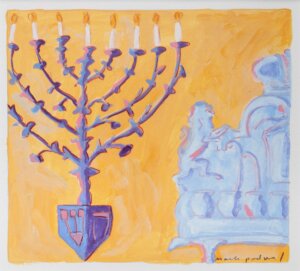
One of the better known artists in the group is Mark Podwal. In his 2002 “Dreidel Hanukkia,” an acrylic painting, we see a menorah balanced on a dreidel and on the opposite side of the page there’s a less readily definable bench lamp.
“It’s modern and old and very playful,” said Chevlowe. “And each Hanukkah light, the menorah and the bench lamp, is cut off by the frame, cut off by the rest of the world. It’s a fragment. We often see that in Degas too.”
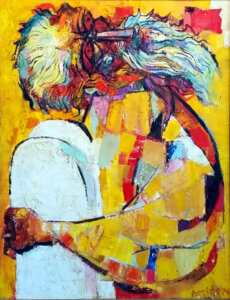
Some of the painters are more deeply embedded in or influenced by particular schools of art than others. In Jacques Yankel’s joyful and expressionistic “Torah,” one can see the Marc Chagall and Chaim Soutine lineage. Yankel’s emigre artist father lived in Paris and was very much part of the Paris school of art, which included Chagall and Soutine.
In New York, Ben-Zion, a Russian-born painter who arrived in the United States in 1920, was a recognized member of “The Ten,” abstract painters that consisted of, among others, Mark Rothko and Adolph Gottlieb, though curiously enough Ben-Zion was never really an abstract painter.
Moses was a frequent subject of his. In his 1962 “Moses Looking Down to the Promised Land,” our title character is viewed from the back, an imposing, heavily draped figure perched on a rocky terrain. He is staring out at Jericho, at once so close to and yet so far away from The Promised Land.
Abraham Rattner also employed Moses as the central figure and theme in his vibrant Picassoesque “Moses,” which features the Prophet clutching two blank tablets, devoid of the commandments or, indeed, any writings. His head twisted to the side and an integral element in a wild abstract design is as unsettling as it is thrilling. It is perhaps my favorite in the collection.
“I would like viewers to appreciate the richness in stylistic range and to be aware that these are highly trained, skilled and knowledgeable artists who come from a rich cultural tradition that includes all of art history,” Chevlowe told me. “At the same time they create something that’s original, authentic and beautiful.”