For the first time since Hitler, a Hebrew publisher sets up shop in Germany
Altneuland Press aims to assert Hebrew as a global language once more
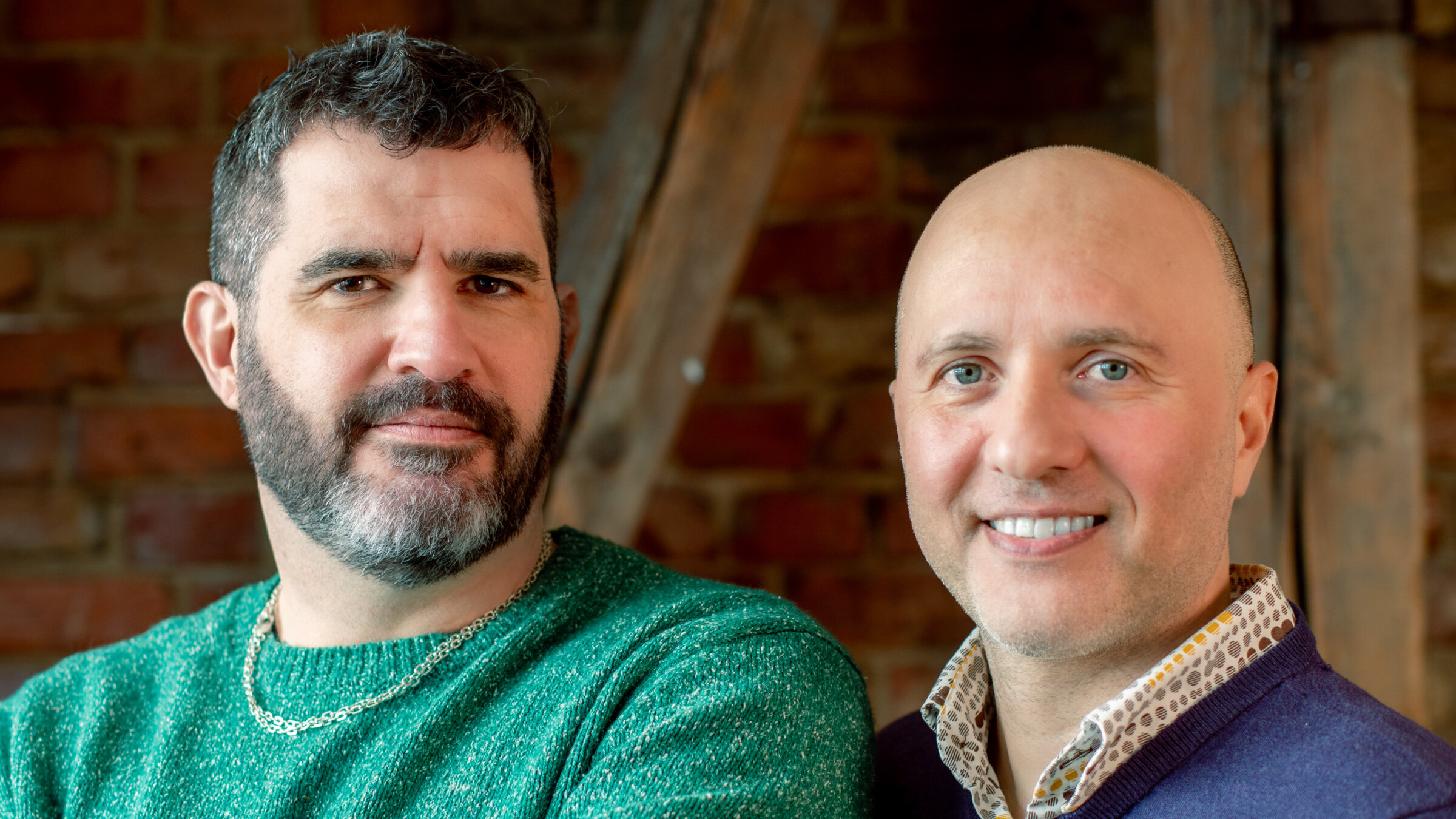
Altneuland Press’ editor-in-chief Dory Manor (L) and publisher Moshe Sakal (R) Photo by Dalia Castel
By PJ Grisar January 26, 2026
In his job as a publisher, Moshe Sakal often needs to communicate with Israel about his books’ bar codes. Sometimes these phone calls sound like an Abbott and Costello routine.
Encountering an error, Sakal will tell the agent for the International Standard Book Number — used to identify a title in global book sales — the system won’t let him enter his address, as he’s based in Berlin. The guy on the other line will tell Sakal to enter his business’s Israeli address (it doesn’t have one, he’ll respond). The agent will then ask him what language his book is in. When Sakal answers “Hebrew,” the man responds, “So put your address in Israel,” not understanding how a press outside Israel could publish a Hebrew book.
The back and forth needs some explanation: Since the founding of Israel in 1948 — and until 2024 — there hadn’t been a major non-religious Hebrew publishing house outside of the country. (There are thriving Hebrew presses for the Haredi community in the U.S. and in Europe, publishing everything from biblical and Talmudic commentaries to children’s books.)
This wasn’t always the case.
Modern Hebrew has roots in 19th-century Europe, where Russian-born lexicographer Eliezer Ben-Yehuda lived and worked before joining the First Aliyah in 1881.
There were flourishing presses in the language, including the original Schocken Books, founded in Berlin in 1931 and boasting authors like future Nobel Laureate S. Y. Agnon. Hitler’s rise and the Holocaust, underscored by book burnings on the streets, put an end to the industry on the continent. Israel became the national home for Hebrew, and for Hebrew books on its founding in 1948, with many of the early, European-born luminaries of the revived language based there. By 2021, when author Sally Rooney cut ties with her Hebrew publisher but left open an opportunity for translation by a non Israel-based Hebrew press, none existed.
Sakal, a novelist, and Dory Manor, a poet and editor of the literary journal Oh!, are partners in life and business. They were born in Israel but have lived abroad for much of their adult lives, settling in Berlin in 2019. The couple are part of a vibrant Israeli expat community in the city. (When they arrived in 2019, NPR published an article estimating 10,000 Israelis had moved to Berlin in the last decade — the trend shows no sign of slowing.)
Over the years, as they mixed with journalists, writers and artists, they would occasionally mention how the Sapir Prize, the Hebrew language’s answer to the Booker, has since 2014, when New York-based novelist Reuven Namdar won, been closed to authors living outside of Israel.
“Everybody who heard that said, ‘So you should start an ecosystem of global diasporic Hebrew and have your own prize,’” Sakal recalled.
Sakal and Manor at first demurred, but the idea wouldn’t die. In 2023, they started developing Altneuland Press, based in Berlin and printing work in Hebrew, German and English. They established the company early in October 2023 — right before Oct. 7 — and began operations in June of 2024.
To date, Altneuland has published six books in Hebrew and two in German with two more titles on the way. Their authors include Hillel Cohen, author or Between the River and the Sea: My Travels in Israel and Palestine, which they published in Hebrew and German; Maya Arad, with the German translation of her novel Lady of Kazan; and journalist Ruth Margalit, whose forthcoming book will be their first in English.
The company prints books in Tel Aviv and their home base in Berlin for the Israeli and European markets.
“Berlin represents the possibility of Hebrew literature,” Manor said. “Hebrew culture that’s open to the world, rather than closed off or isolated or nationalistic, as is the case more and more in the current political climate in Israel, where democratic spaces are shrinking. We have here the possibility and the freedom to publish voices that might be silenced or marginalized back in Israel.”
The name “Altneuland,” taken from Zionist leader Theodor Herzl’s 1902 speculative novel about a future Jewish state in what is now Israel, is ironic, given the press’ desire to serve as a hub for the Israeli diaspora. But Manor says it speaks to an ideal in the spirit of Herzl’s book — really a utopian novel that imagined Jews and Arabs living together peacefully in a kind of Vienna of the Middle East.
“We think of Altneuland, old-new land, not as a territory,” Manor said, but a language and culture. He likened his vision of their work to Heinrich Heine’s description of the Torah as a “portable homeland.”
In a time of cultural boycotts, Sakal and Manor say being based outside of Israel helps to bypass some of the political minefields. Their books, like Gish Amit’s Cedrick, about the author’s investigation into the life of his former student, a Filipino-Israeli who died serving in the IDF in the Gaza War, have been well-received in Europe and Israel, though Sakal and Manor say they’ve had trouble finding a U.S. partner for the title.
Being outside of the Israeli system offers other freedoms.
In Israel, it is customary for authors to pay publishers to take on their first book — Manor and Sakal don’t take money from their writers. Selling their books in Europe, they also aren’t bound by the infrastructure of Israel’s bookstores, which, apart from a handful of independent shops, is a duopoly of Steimatzky and Tzomet Sfarim, who dictate the terms of the market. As for the titles they can take on, they noted some publishers in Israel may choose not to pursue books that are too anti-government for fear of losing help from public institutions.
It also opens the door for new stories to be told — ones that can center experiences had by Hebrew speakers outside of Israel. Sakal mentions the works of early modern Hebrew poet and novelist David Vogel, whose prose he says was different from the Hebrew he grew up with. Sakal, who is Sephardic, is also hoping to promote more writers with his background.
Some in the Israeli press have been skeptical of Altneuland, with publisher and editor Oded Carmeli writing in Haaretz that, “there aren’t enough Hebrew readers outside of Israel to support a publishing house – not even a bookstore, not even a shelf in a bookstore – and even if there were enough readers, no store in Berlin or Madrid would maintain such a shelf, for fear of repercussions.”
Manor responded, in his own Haaretz article, that Carmeli mischaracterized their operations and the vitality of the Israeli diaspora.
Maya Arad, who publishes with the Israeli press Xargol and went to Altneuland for the German translation of Lady of Kazan, wrote in an email that Hebrew literature still depends on Israel as a center.
“I would agree to admit that it is unlikely that a generation born outside Israel will arise in the Diaspora and begin writing in Hebrew, as Hebrew writers did at the end of the nineteenth century and the beginning of the twentieth,” Arad, who was born in Israel but who has lived abroad since 1994 and is based in the U.S., wrote in an email.
But, at the same time, she said it’s undeniable more Hebrew literature is coming from beyond the Jewish State and the subject of Israelis abroad has been attracting growing interest in Hebrew letters.
“The fact that about ten years ago it was decided to restrict the Sapir Prize to writers living in Israel paradoxically attests to the Israeli literary establishment’s recognition of a literary community outside Israel,” she said.
Altneuland, navigating the differing tastes of their global, trilingual markets, have a full slate for 2026, and are now exploring translating Yiddish literature into English, German and Hebrew.
For Manor, the thrill of seeing their Hebrew books on German shelves, for perhaps the first time since the 1930s, can’t be overstated. He recalled a story about an IDF delegation that visited Auschwitz in 1995. On that occasion, then-chief of general staff Ehud Barak said “We’ve arrived 50 years too late.”
“I found that remark chilling,” Manor said. “That idea that Jewish victory should be imagined as an Army arriving at Auschwitz. For me, the true victory lies elsewhere: in Hebrew books being printed in Germany again. That is a victory of culture over violence and over destruction. Victory, joined by hope, not by death.”
This article has been updated to include mentions of Hebrew publishers in Haredi communities.
This is a moment of great uncertainty. Here’s what you can do about it.
We hope you appreciated this article. Before you go, we’d like to ask you to please support the Forward’s independent Jewish news this Passover. All donations are being matched by the Forward Board - up to $100,000.
This is a moment of great uncertainty for the news media, for the Jewish people, and for our sacred democracy. It is a time of confusion and declining trust in public institutions. An era in which we need humans to report facts, conduct investigations that hold power to account, tell stories that matter and share honest discourse on all that divides us.
With no paywall or subscriptions, the Forward is entirely supported by readers like you. Every dollar you give this Passover is invested in the future of the Forward — and telling the American Jewish story fully and fairly.
The Forward doesn’t rely on funding from institutions like governments or your local Jewish federation. There are thousands of readers like you who give us $18 or $36 or $100 each month or year.
Support our mission to tell the Jewish story fully and fairly.