Why Walter Benjamin was all things to all people
Peter E. Gordon’s illuminating biography considers a philosopher who couldn’t be boxed in
Courtesy of Yale University Press

By PJ Grisar February 23, 2026
Walter Benjamin’s life, to use the kind of metaphor he was so fond of, was not unlike the Parisian arcades, those covered retail passages that he loved so much.
He was born into a world with the finer things on display. He marveled at his mother’s jewelry, the cut-glass champagne glasses and carafe stoppers in the shape of animals and gnomes in their Berlin home. But his passage through life as an adult was seldom easy, and existed in tension with those glittering objects in their vitrines.
An omnivore par excellence, as a young man Benjamin announced his intent to be the “foremost critic of German literature,” but ended up spending much time translating works from French to German, musing on Marxist concepts and generally resisting any easy classification in ideology or literary genre.
“Adhering to any doctrine awakened in him some kind of allergy,” said Peter E. Gordon, the Amabel B. James Professor of History at Harvard. “I think it’s at those moments that his real originality shines through.”
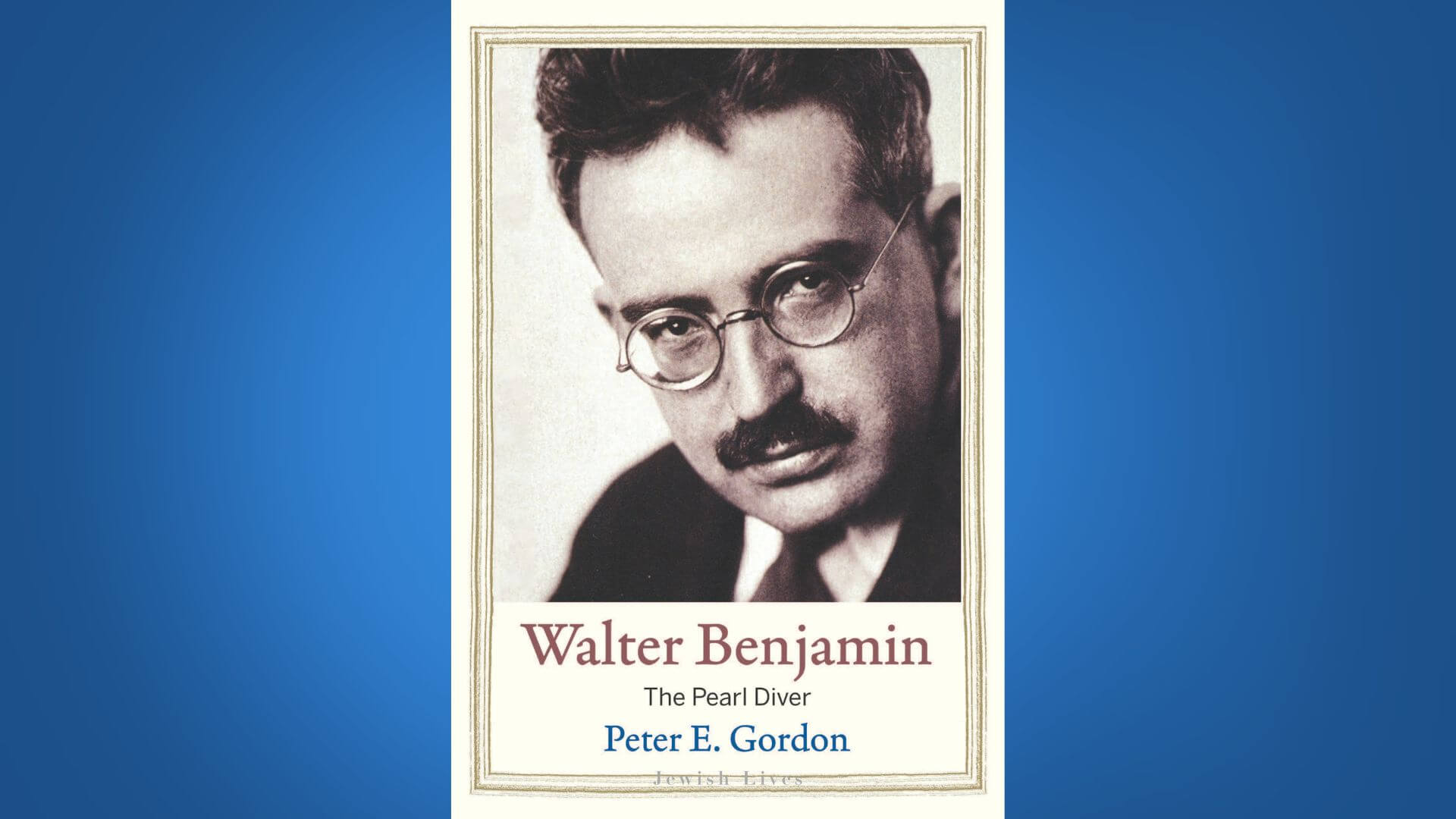
Gordon’s illuminating new book for the Jewish Lives series, Walter Benjamin: The Pearl Diver, is a portrait of a thinker who couldn’t conform. In keeping with his subject’s unconventional spirit, and his unique sense of cyclical time in which tragedies repeat, Gordon begins at the end.
As Benjamin navigated the Pyrenees, escaping from Vichy France and into Spain, he took a lethal dose of morphine. Gordon winds back the clock from that moment, and ends the narrative right on the cusp of his journey through the mountains.
“I thought on Benjamin’s idea that history should not be written by the victors,” Gordon said in a phone interview. “And that means not permitting the fascists to have the last word, as if his death were the end of his influence.”
Indeed, one could say Benjamin’s death was only the beginning of the legacy.
I spoke with Gordon about Benjamin’s life, work and why he may not be an entirely appropriate fit for the Jewish Lives series. The following conversation has been edited for length and clarity.
You have a little uncertainty about whether Benjamin fits comfortably into a series like this. How does he fit the bill and in what ways do you think he might fall short of it?
He escapes almost any traditional categories that are available to us. People have trouble figuring out, was he a critic primarily? Was he a philosopher? Was he a Marxist? Was he an historian? Moving away from academic disciplines, he exhibits the same resistance to being placed within any distinctive tradition. That’s one of the reasons why it’s so difficult to directly answer the question of whether he belongs to some kind of canon of Jewish thought or Jewish philosophy.
He’s always operating at the margins or just outside the boundaries of any settled doctrine or tradition. Bertolt Brecht couldn’t figure out if Benjamin was really a Marxist and had some suspicions that Benjamin’s Judaism was distorting his Marxist insights. And then on the other hand, people like [Benjamin’s close friend, Kabbalist scholar] Gershom Scholem vigorously argued that Benjamin’s best insights were, in fact, ones that belong to Jewish tradition, but he warned Benjamin that he was distorting those Jewish insights because of his Marxism.
So Benjamin was being pulled and pushed in various directions by the people who were closest to him intellectually. But they all saw, I think, that he couldn’t easily be corralled fully within their fold.
It does seem like he did have a tendency, depending on who he’s associating with, to adopt some of those ideas. As you said, he buys into them to a point before making it his own. What do you think of that impulse?
There might be a temptation to see him almost as a chameleon who adapted to the interests of the friends who were near him, but he also frustrated those friends because of his own instincts, and some of those instincts he once described as nihilistic. There was a fierce debate over Benjamin’s legacy, going back to the first edition of his correspondence and writing, published cooperatively by Adorno and Scholem after Benjamin’s death. The more militant Marxists at the time were furious and felt that Scholem and Adorno had falsified Benjamin’s legacy and weren’t honoring its true Marxist credentials. I rather doubt it had true Marxist credentials.
One of the things I say at the end of the book is that there’s a key principle in Marxism that Benjamin’s own Jewish themes seem to contradict. Benjamin describes an intrusion into history from a place that comes from the outside, and he calls that the Messianic. Any moment in history could be the gateway through which the Messiah might enter. And Marxism has a commitment that whatever changes might occur in history, those changes emerge from the immanent contradictions in history itself, not from a place outside history.
So Benjamin’s allusion to a Messiah who enters into history through some kind of gate, as if from the outside, is very hard to square with Marxism. And so there you find him operating with what you could call a syncretism of Judaism and Marxism. But even those two might not be really sufficient to capture everything that’s going on. He was really fascinated by Christian theology as well.
I didn’t know that he struggled so much in his lifetime that he didn’t have a professorship. He had to scrape by to make a living. Because the way the book is structured, we leave him in the Pyrenees so we don’t really see his afterlife. How did he become a well-known thinker? Was it the efforts of Adorno and Arendt after he died?
The peripatetic quality of his thinking, that it crossed so many boundaries has made him available for a great many people with different sorts of commitments, and also for the great community of humanists who share with him a sense of boundary-crossing in their disciplines. The rise of cultural studies in the Anglophone world since 1945 owes a great deal to Benjamin, and perhaps to Benjamin more than anyone else.
That practice of cultural studies is all about drawing the unlikely connection, say, between literature and economics, between history and theology and so forth. And that’s a risky but very original practice. Benjamin’s one of the great avatars for people who wish to pursue that practice. His study of the Parisian arcades is maybe the best example of that, because he’s trying to figure out, how does 19th century Paris contain all of these conflicting energies that are evident in architecture, like the passage itself, but also in its social movements, and in its poetry and he tries to bring all these together in what he called constellations of culture and society.
I saw your recent piece in the New York Review of Books, writing about historical analogies and how it’s an imperative to invoke the memory of Jewish persecution when discussing ICE raids or Gaza. Because Benjamin was a refugee, and he insisted that historical crises recurred as a rule, I’m wondering if he was on your mind when you were writing that?
I’ve been very close to immigrants in my life. My own family were immigrants and refugees to the United States from Nazi Germany on one side and from pogroms on the other side. That experience is always very much on my mind. I would hope it would be on everybody’s mind, regardless of identity or history.
Benjamin says “the amazement that things like this are still happening is not philosophical.” And I very much agree with that. I know no polity is blessed with immunity from the worst things. Benjamin himself was a victim of fascism. He died in a moment of despair, thinking that there was no way for him to survive, and taking his own life which he thought was better than the alternative. Tragically, he was mistaken, but it was an entirely plausible inference, given the situation that he saw around him.
And the U.S. at the time beckoned as a refuge for many people fleeing fascism, whether on account of their ethno-religious origins or their politics. Unfortunately, it doesn’t look like we’re that country anymore.
This is a moment of great uncertainty. Here’s what you can do about it.
We hope you appreciated this article. Before you go, we’d like to ask you to please support the Forward’s independent Jewish news this Passover. All donations are being matched by the Forward Board - up to $100,000.
This is a moment of great uncertainty for the news media, for the Jewish people, and for our sacred democracy. It is a time of confusion and declining trust in public institutions. An era in which we need humans to report facts, conduct investigations that hold power to account, tell stories that matter and share honest discourse on all that divides us.
With no paywall or subscriptions, the Forward is entirely supported by readers like you. Every dollar you give this Passover is invested in the future of the Forward — and telling the American Jewish story fully and fairly.
The Forward doesn’t rely on funding from institutions like governments or your local Jewish federation. There are thousands of readers like you who give us $18 or $36 or $100 each month or year.
Support our mission to tell the Jewish story fully and fairly.