Decades after her ancestor was blacklisted from Hollywood, this teenager is bringing her family’s history to light
Simone Elias’ book teaches the history of Golden Age cinema — including its antisemitism — to Gen Z.
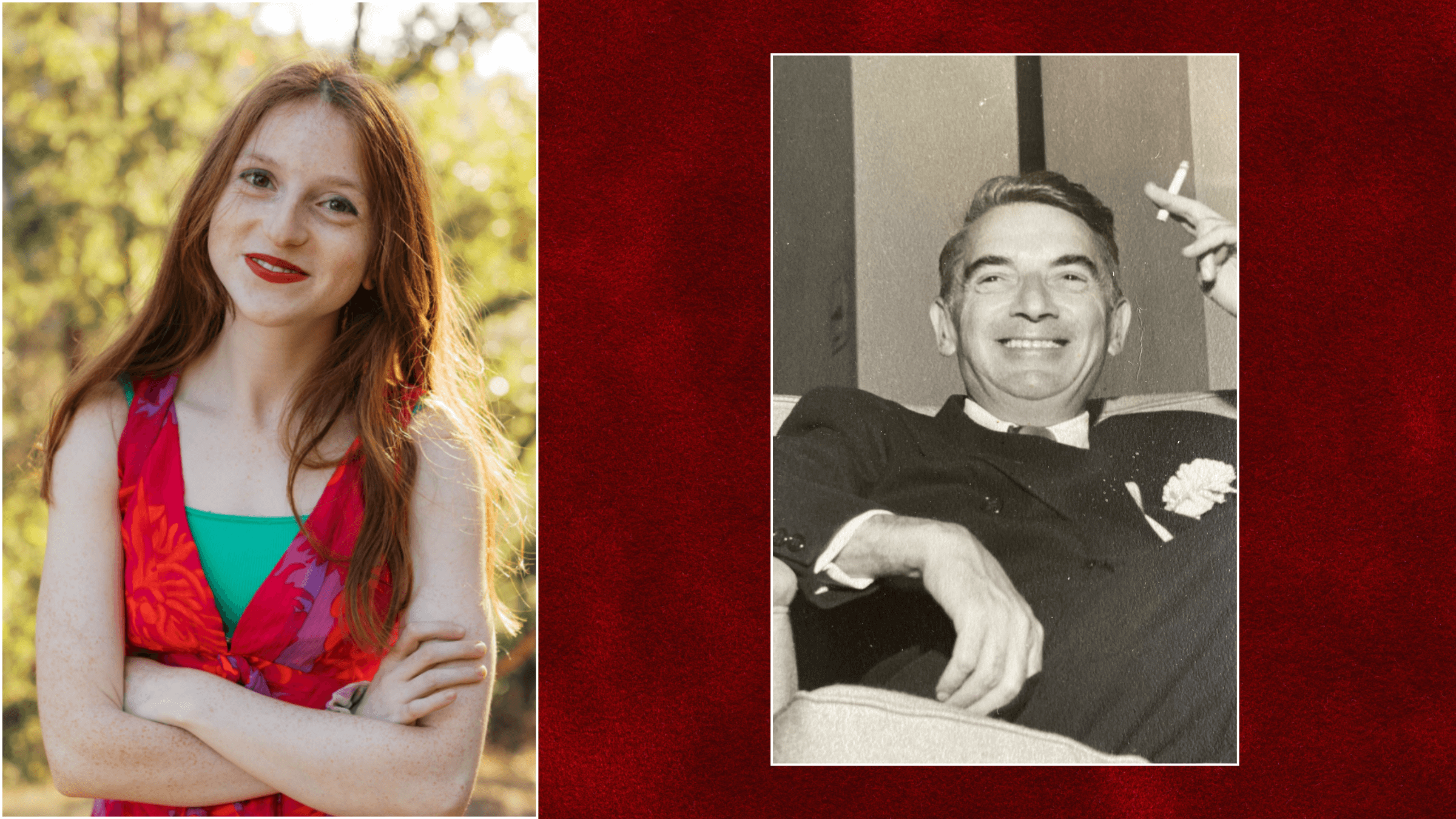
Simone Elias’ interest in classic Hollywood reached new levels when she learned her great-great-grand uncle was blacklisted screenwriter H.S. Kraft. Courtesy of Simone Elias

By Olivia Haynie December 17, 2025
During the pandemic, teenager Simone Elias found solace in movies from the Golden Age of Hollywood. The glamorous sets, the romantic storylines, the studio-styled movie stars all held a nostalgic appeal.
“There’s something so magical about going back in a time machine,” Elias, 16, said. “Like, wow, I can go back and see the 1930s on my computer randomly at 9 p.m.”
A friend suggested starting a podcast together about old Hollywood in hopes of bolstering their college applications. As Elias began to do research, she discovered that her attachment to the Golden Age of Hollywood was more than just a fun interest — her great-great-grand uncle was the blacklisted Jewish screenwriter H. S. Kraft.
Born Hyman Solomon Kraft, he was known professionally as Hy or H.S. Kraft to avoid antisemitism. Among his best-known credits are the comic musical Top Banana, starring Phil Silvers, and the Lena Horne film Stormy Weather. In the early 1950s, bandleader and author Artie Shaw (born Arthur Jacob Arshawsky) connected Kraft to the Communist Party in comments to the House Un-American Activities Committee. Like many other artists at the time, Kraft found himself blacklisted despite lack of evidence. In order to continue writing, Kraft began working under the pseudonym Harold Kent.
After learning about her family history, Elias threw herself deeper into Hollywood history.
“I reached out to all my family. I looked in all the archives,” Elias said. “It was really kind of another window into the real life working world of Hollywood at the time.”
At 15 years old, Elias’ marshaled her research into a book. The resulting tome, A Teenage Take on Hollywood’s Golden Age, explores the history of classic films and the lessons contemporary audiences can take from them. For Gen Z viewers especially, Elias presents movies that may seem outdated in a way that is more accessible and relatable. She dedicated an entire chapter exploring the prominent role Jews played in creating Hollywood.
Despite the fact that Jews were integral to the Hollywood studio system, their stories were often not shown on television. Elias writes in her book that antisemitism dissuaded writers and directors from having Jewish elements in their movies. Joseph Breen, a censor in charge of making sure films followed the Motion Picture Production Code — a set of rules also known as the Hays Code that forced movies to follow certain moral guidelines — accused Jews of putting “sex, violence, and moral depravity” into films. Some government officials also believed Jewish media moguls were secret Communist agents. Elias said that having her ancestor’s story as an example of the persecution in Hollywood gave her a new perspective on the risks writers had to consider in their work.
Soon after being blacklisted, Kent moved to London, but found much fewer opportunities for film work. “I don’t think his career ever really recovered,” Elias said.
In her research, Elias found that its Jews weren’t the only ones pushed off screen by McCarthyism and the Hays Code era of Hollywood. All sorts of stories were written out of Hollywood at the time, as studios attempted to push wholesome, Christian narratives. that Elias is interested in uncovering, but also feminist perspectives that have been erased from discussions of classic Hollywood.
“Culture has always gone in waves and so non-monogamy was actually really popular in the early 1930s in film and so were working women,” Elias explained. “When the Hays Code actually outlawed all that in movies, we sort of forgot that even happened.”
Elias continues to do film analysis on her Instagram page in a series called “Girlhood on Film” and hopes to write more books about Hollywood. She’s presenting this month on the Turner Classic Moves channel as part of their Kid Fans series. But it hasn’t been easy for Elias to be taken seriously in an industry primarily dominated by men — and people much older than her.
“There’s a certain amount of time that I’ve been alive so I can’t have seen every movie like Leonard Maltin has,” Elias said. “That doesn’t mean that I don’t have something to say about the movies I have seen.”
Correction: The original version of this article incorrectly stated the name of Simone Elias’ Instagram series. It is called “Girlhood on Film,” not “Girls on Film.”
This is a moment of great uncertainty. Here’s what you can do about it.
We hope you appreciated this article. Before you go, we’d like to ask you to please support the Forward’s independent Jewish news this Passover. All donations are being matched by the Forward Board - up to $100,000.
This is a moment of great uncertainty for the news media, for the Jewish people, and for our sacred democracy. It is a time of confusion and declining trust in public institutions. An era in which we need humans to report facts, conduct investigations that hold power to account, tell stories that matter and share honest discourse on all that divides us.
With no paywall or subscriptions, the Forward is entirely supported by readers like you. Every dollar you give this Passover is invested in the future of the Forward — and telling the American Jewish story fully and fairly.
The Forward doesn’t rely on funding from institutions like governments or your local Jewish federation. There are thousands of readers like you who give us $18 or $36 or $100 each month or year.
Support our mission to tell the Jewish story fully and fairly.