How the Israeli police’s first trans volunteer fought bigotry on the force
In the documentary ‘The First Lady,’ Efrat Tilma shows that resilience is key to fighting prejudice

‘The First Lady’ documents the life of Efrat Tilma, the first trans volunteer with Israel’s police department. Photo by Daniel Binsted

By Olivia Haynie January 18, 2026
From the beginning of the biographical documentary The First Lady, Efrat Tilma makes it clear she has mixed feelings about the film, which details how she became the first trans woman to volunteer in Israel’s police department. When asked why she wanted to make the movie, she tells one of the directors, “I didn’t want to. You asked me.” This prickly demeanor persists throughout the film, although she later acknowledges that she wants “to show people that a trans woman is just like any other woman, like any other person.”
Tilma starts her story in 1964, the year she first tried living as a woman. Using archival footage, animation, and present-day interviews, directors Udi Nir and Sagi Bornstein present a moving portrait of Tilma’s life, unveiling how the burdens of her past have followed her into the present.
When Tilma was 14, she often wandered the streets of Tel Aviv to escape her abusive father. There she met another trans woman, Gila Goldstein, who introduced her to a whole network of trans women who taught Tilma about hormones and gender reassignment surgery. That same year, a man held her hostage in his apartment for a day and a half and sexually assaulted her. Not long afterwards, she says, an Israeli police officer threatened to kill her for dressing as a woman.
These experiences made her determined to carve her own path in spite of obstacles or the opinions of others, including the film directors. In one scene, as the team records her coming out of her apartment building, she strikes several poses.
“Natural, Efrat. We said natural!” a director reminds her.
“Kiss my ass!” Tilma responds, before strutting away.
But behind all the bravado is a vulnerable human being, who spends her first moment in the film nervously rehearsing the speech she is going to give at a 2023 Pride celebration in Israel. Tilma acknowledges that she’s not sure she’s been able to process her trauma and still carries it with her.
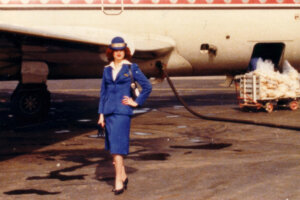
After leaving Israel in 1967, Tilma spent nearly four decades living in Europe, where she created a new life for herself as a woman. She performed in nightclubs, worked as an airline stewardess, got sex reassignment surgery in Morocco, married a man, and, nearly two decades later, divorced him. In 2005, she finally moved back to Israel and, on a whim, began volunteering with the Israel Police.
She wasn’t open about her gender identity at first, given the negative way she saw her colleagues treat trans women on the street. But when the police captain eventually discovered she was trans, the result ended up being positive: She began leading workshops on approaching the trans community with empathy and respect.
The film jumps between Tilma’s past and the present, as she reacts to Netanyahu’s 2022 re-election and the creation of a far-right coalition in Israel. Convinced that the world is reverting to the hateful days of her youth, Tilma leaves the police force and plans how she’ll kill herself if the government attempts to round up trans people. As protests start to sweep the country, however, she decides to channel her fear into activism. Shots of her among the protesters are mixed with recollections of her 1971 sex reassignment surgery and abuse she faced from a doctor in 1973.
Respecting Tilma’s boundaries while encouraging her to share her life story, the filmmakers capture both Tilma’s toughness and sensitivity, giving the film the honesty and heart that make The First Lady feel so intimate. They get Tilma to open doors into her life — literally.
Several times, the directors try to convince Tilma to bring the film crew into her apartment, where she says that no one else has been for a decade. When she finally lets them inside, they encounter piles of clothing, discarded plastic bottles, and other hoarded objects. The filmmakers tell her that the film crew will help her reorganize the apartment bit by bit, in much the same way they piece together her story: bit by bit.
Even if she approaches the whole process with a bit of attitude, Tilma remains determined to never give up fighting for a better life — or a better apartment.
The First Lady will screen at the New York Jewish Film Festival on Jan. 20.
This is a moment of great uncertainty. Here’s what you can do about it.
We hope you appreciated this article. Before you go, we’d like to ask you to please support the Forward’s independent Jewish news this Passover. All donations are being matched by the Forward Board - up to $100,000.
This is a moment of great uncertainty for the news media, for the Jewish people, and for our sacred democracy. It is a time of confusion and declining trust in public institutions. An era in which we need humans to report facts, conduct investigations that hold power to account, tell stories that matter and share honest discourse on all that divides us.
With no paywall or subscriptions, the Forward is entirely supported by readers like you. Every dollar you give this Passover is invested in the future of the Forward — and telling the American Jewish story fully and fairly.
The Forward doesn’t rely on funding from institutions like governments or your local Jewish federation. There are thousands of readers like you who give us $18 or $36 or $100 each month or year.
Support our mission to tell the Jewish story fully and fairly.