At Sundance, the AIDS crisis through the eyes of a bar mitzvah boy
Israeli director Moshe Rosenthal’s ‘Tell Me Everything’ is a memory piece that may jog your memory of a different film
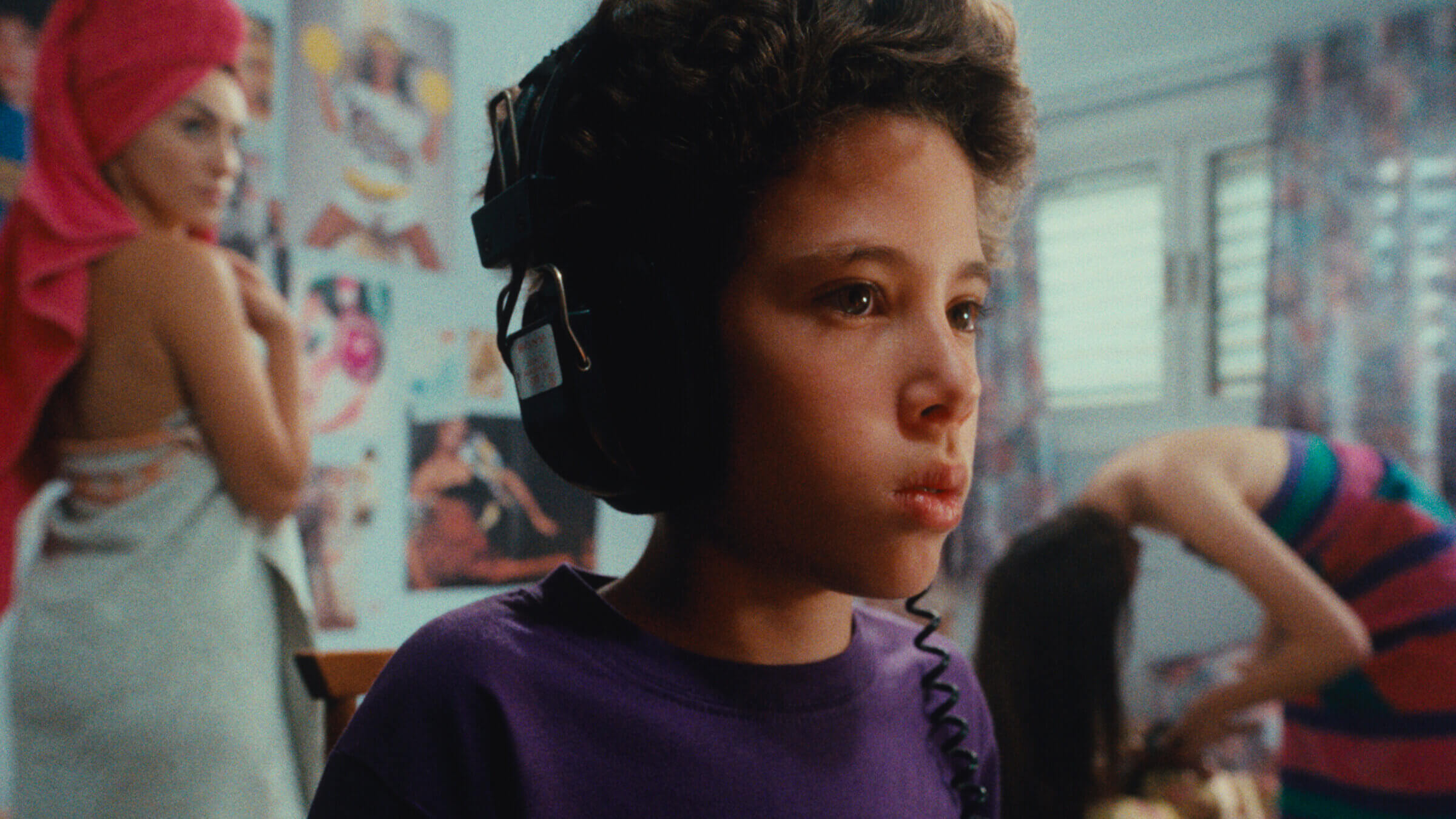
Yair Mazor in Moshe Rosenthal’s Tell Me Everything. Courtesy of Sundance Institute | photo by Ziv Berkovich

By PJ Grisar January 25, 2026
If you were swept up by Aftersun when it debuted on the festival circuit three years ago, Israeli director Moshe Rosenthal’s new film Tell Me Everything may hit you immediately with a sense of deja vu.
It opens on thrashing bodies moving in slow motion in a dark club. Slowly, the strobe lights reveal a figure: a vision of a lost father, just out of reach to his adult child. The scene recalls, and could even be read as a quotation of Charlotte Wells’ semi-autobiographical portrait of a daughter and her tortured father on vacation at a Turkish resort in the 1990s.
While that sequence is very after Aftersun, Rosenthal’s film, in competition at Sundance, has its own merits and its own unwelcome glut of cliches. Tell Me Everything concerns the relationship of a son and a father, and where the source of the anguish of the father in Wells’ is never stated outright, here it’s made explicit.
A memory film split between the 1980s and 1990s, Rosenthal’s drama is told almost exclusively through the perspective of Boaz (Yair Mazor), introduced in the 1980s as a self-conscious soon-to-be bar mitzvah boy. One day, amid the confusion of the early AIDS crisis, Boaz sees his father Meir (Assi Cohen) with another man behind a stall at the pool showers.
Keeping the secret, Boaz grows paranoid about illness and insecure about his own masculinity. Where before he danced to Ilana Avital, voguing with the encouragement of his older sisters, he soon pivots to the edgier pop-rock of the Israeli band Mashina, punching the air with his sister’s mini weights. (He wraps the weights in black tape, he tells Meir, pointedly, using a slur for gay men, because they were pink.)
Teased in school for being small and coddled by the women in his family, not least his beautician mother Bella (Karen Tzur), when Boaz learns of Meir’s sexuality it awakens him to the ways he may fall short of the stereotypical Israeli swagger.
Rosenthal, who broke out four years ago with his debut feature Karaoke, has a deft touch for the period. Shooting in soft focus and working with a pastel palette, he evokes the haziness of the remembered past, half-understood even in the moment.
Tell Me Everything captures how kids process — in overheard snippets, glimpsed scenes — the adult world and the tactics of older siblings shielding a younger one from parental fights. (This family plays Scattergories when voices are raised in the hall.) It also gets at, a bit too strongly, the surrogate husband role often forced on a son by an unsatisfied and possessive mother.
Rosenthal sometimes overdoes it. He shows Boaz in bed, reading sensationalist newspaper headlines about AIDS by flashlight. His growing awareness of his father’s sexuality — and predicament — are shot like a horror film, a sarcoma lensed like a zombie bite. A later montage, showing the redesign of the home after Meir’s exit, is so on-the-nose it belongs in a different kind of ‘80s movie (one from the actual 1980s).
A cut to the late ‘90s, where Boaz (now played by Ido Tako) works at a gas station and nurses an ill-defined homophobia, brings a contrived closure that leaves an earlier plot point dangling.
But when the film works, as in a notable sequence set to Air Supply’s “Making Love Out of Nothing At All” — Boaz and his sisters scramble to tape it off the car radio — it can be moving.
It won’t do for that song what Aftersun, a far quieter film, did for “Under Pressure” in the one moment it got loud, but the drama works as a time capsule. While today Israel is heralded as a gay mecca in the Middle East, the stigma the film hints at still exists with its own strain of toxic masculinity and machismo. (That Boaz’s army service doesn’t feature is notable, and could have made the film a richer text.)
Rosenthal has made a sensitive, if at times excessive, portrait of family life grounded in an uncertain past. That its story speaks to today is to be expected; that it might, at times, seem quaint or nostalgic is a sad truth of history.
Moshe Rosenthal’s Tell Me Everything debuts Jan. 25 at the Sundance Film Festival. More information can be found here.
This is a moment of great uncertainty. Here’s what you can do about it.
We hope you appreciated this article. Before you go, we’d like to ask you to please support the Forward’s independent Jewish news this Passover. All donations are being matched by the Forward Board - up to $100,000.
This is a moment of great uncertainty for the news media, for the Jewish people, and for our sacred democracy. It is a time of confusion and declining trust in public institutions. An era in which we need humans to report facts, conduct investigations that hold power to account, tell stories that matter and share honest discourse on all that divides us.
With no paywall or subscriptions, the Forward is entirely supported by readers like you. Every dollar you give this Passover is invested in the future of the Forward — and telling the American Jewish story fully and fairly.
The Forward doesn’t rely on funding from institutions like governments or your local Jewish federation. There are thousands of readers like you who give us $18 or $36 or $100 each month or year.
Support our mission to tell the Jewish story fully and fairly.