Netflix’s ‘Queen of Chess’ tracks the rise of Judit Polgar — but leaves her Jewishness out of it
The documentary covers the grandmaster’s barrier-breaking career and sidelines a key piece of where she came from
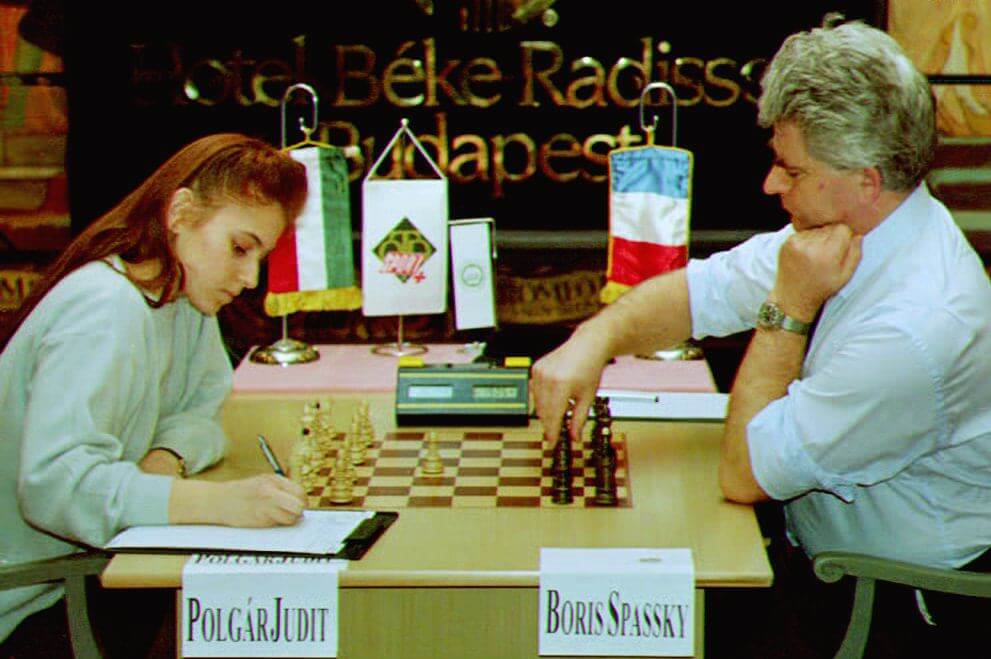
Judit Polgar plays Boris Spassky in 1993. Photo by ATTILA KISBENEDEK/AFP via Getty Images

By PJ Grisar January 30, 2026
Watching Queen of Chess, Rory Kennedy’s Netflix documentary about the top-ranked woman chess player and her long contest with world champion Garry Kasparov, I was reminded — of all things — of Spider-Man: Into the Spider-Verse.
It comes down to one moment. In a montage in the 2018 superhero cartoon, we briefly see Peter Parker’s wedding, where he steps on a glass. This one second of film inspired an avalanche of speculation that Spider-Man (or at least a version of him) was Jewish.
In Kennedy’s film, we see footage from Polgar’s wedding, where her husband breaks a glass. This is the only clue I saw in the entire film that she is Jewish. We need not speculate if this is the case, as we might with fictional characters with arachnid physiology — it’s a matter of public record. And it’s a pretty big part of her story to leave out.
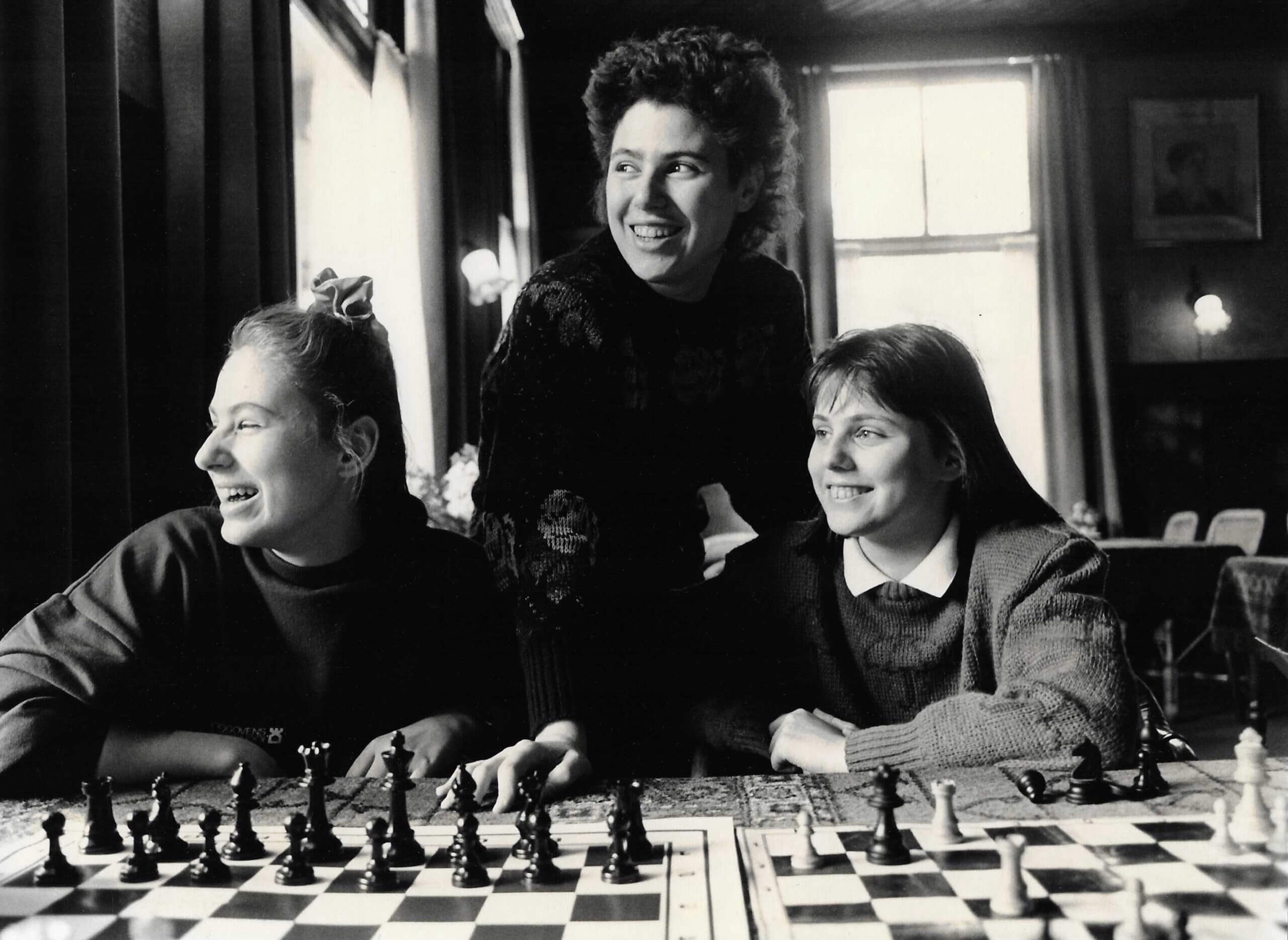
As the film’s early moments make clear, Polgar, now 49, and her older sisters, Grandmaster Susan and International Master Sofia, were not instant prodigies, but the result of a social experiment. The Polgars lived in a ramshackle house with wet walls in the workers’ district of Budapest. The country was poor and, in the Soviet era, topped Europe in suicides.
Their father, László, an educational psychologist, was desperate to make a better life for his children, and so he studied the lives of geniuses and alit on the idea to homeschool his daughters — unheard of in a collectivist country — and from the age of 5 drill them in chess.
Why chess? Their mother, Klára, explains in an interview for the film: “Very simple. The chess board, it’s easy to have it and very cheap.”
When his daughters started drawing attention for their early victories, and for decades after as they rose to international acclaim, the press would frame Polgar’s regimen as child abuse; one headline called him a “Hungarian Daddy Dearest.” Interviews conducted for the film with László give the impression that he’s a demanding eccentric, but skip over some crucial context: He was born in 1946 to parents who survived Auschwitz.
László’s father, Armin, lost his first wife, six children and his own parents in the death camp. For someone with this background, family, and survival, couldn’t be taken for granted.
As László told the Jerusalem Post in 2017, “being a Jew gave me extra motivation to succeed.”
Sofia Polgar wrote in her autobiography that the “fighting spirit that is running through my veins,” came from her survivor grandparents.
“My grandparents were the ‘lucky ones,’ with the numbers tattooed on their arms and nightmares for the rest of their lives,” but who had the strength to rebuild, Sofia wrote, adding that she still has “a bad feeling when seeing train tracks.”
In her 2025 memoir, Rebel Queen, Susan Polgar, Judit’s eldest sister, recalls her father returning home from work and finding a letter with no return address.
“Inside was a photo of him with his eyes cut out,” she writes. “There was also a one-page handwritten letter, which he refused to let me read. He only said that it was dripping with antisemitic remarks and violent threats.”
Within the country Susan sensed that the Polgars were not regarded as “real” Hungarians. The government denied them travel permits and Klára recalls being woken up by armed police. There were threats to take their children away.
Things changed when, after criticism from the international press, the Polgars were allowed to leave the Eastern Bloc for the 1988 Olympiad in Thessaloniki, Greece. The three sisters and their teammate Ildikó Mádl triumphed over the Soviets women’s team and returned as heroes.
Judit, then 12, soon emerged as the top female chess player and sought out men to compete against. After becoming the youngest grandmaster at 15 and 4 months, beating Bobby Fischer’s record, she faced world champion Garry Kasparov for the first time in Linares in 1994. She was 17, he was 30. Their contests and (spoiler), Polgar’s ultimate victory over Kasparov in 2001, form the arc of the film.
Buoyed by a soundtrack of women-led rock and punk bands like Tilly and the Wall and Delta 5, Queen of Chess is primarily about the first woman to smash the chess world’s glass ceiling, cracking into the top 10 overall world ranking — still the only woman to do so — and defeating the number one-ranked player.
Interviews with younger women chess players speak of her as an inspiration. Kasparov, while he now respects Judit, still comes off as sexist in contemporary interviews with remarks like “one of the typical weaknesses of many female players is that they are panicking if there’s a threat.”
This by itself, is enough material for a film, and Kennedy does an admirable job building suspense using archival video from tournaments and a digital chess board tracking the moves of the match.
What’s fascinating about the omission of the girls’ Jewishness is that Kennedy, a director of a couple dozen documentaries about social issues and historical injustices, and the daughter of Robert F. Kennedy and sister of RFK Jr., rightly, acknowledges it as an obstacle in an interview for the press notes.
“The odds were staggering,” Kennedy said. “They were poor. They were Jewish. They were girls.”
The last factor may well trump the others (Kasparov was born Garik Kimovich Weinstein).
Still, Jewishness continues to play a large role in the sisters’ lives. In 2024, Judit and Sofia played matches in Berlin’s parliament in honor of Israeli hostages. Sofia made aliyah in 1999 and is married to Israeli grandmaster Yona Kosashvili. Her parents followed her there.
In the film’s bittersweet final moments, Kennedy asks Judit how she felt being part of an experiment, and missing out on a normal childhood. She takes a while to respond, and does so with a bit of ambivalence.
“I never felt myself being a genius,” Judit says. “I know that the things I could reach, that was definitely like 95% of my work and dedication. And this came from my parents.”
The impetus behind the experiment, to do whatever they could to help their children rise above their circumstances, may be best explained by all that came before them.
In a phone call Thursday, Susan Polgar confirmed that their Jewish history came up in interviews, and acknowledged that a lot was left on the cutting room floor. Within the family, she said, Judit spoke about how this would just be one interpretation of their family’s history.
“What people tell me is actually that probably ideal would be to have a miniseries,” Polgar said.
We may need to wait for that, but for those who want the Jewish story, there’s a 2014 Israeli documentary called The Polgar Variant.
“Obviously that has a lot more of that angle, naturally,” Susan Polgar said.
Rory Kennedy’s Queen of Chess is now playing at the Sundance Film Festival. It debuts on Netflix Feb. 6.