Erich Wolfgang Korngold’s Broadway opus debuts in the U.S. — nearly 80 years late
‘Silent Serenade,’ an undersung operetta, is premiering at Mannes Opera
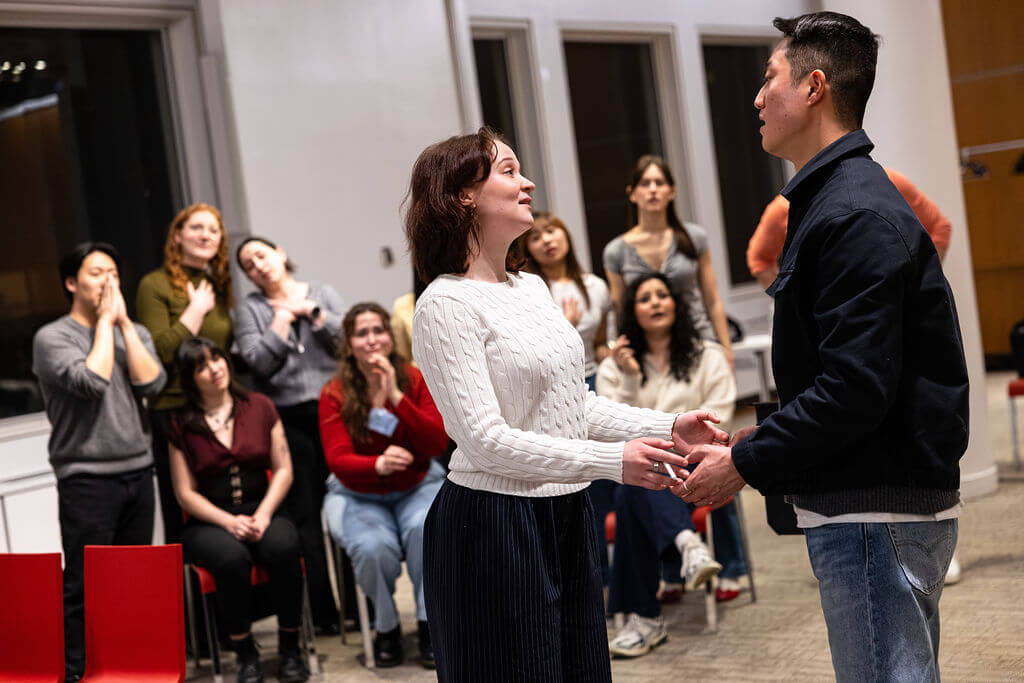
Student performers in Mannes Opera’s Silent Serenade. Photo by Shawn Inglima

By PJ Grisar March 5, 2026
In 1954, the Oscar-winning composer Erich Wolfgang Korngold staged a European homecoming with a new operetta. How this came to pass — and how his planned comeback failed to materialize — is even more convoluted than the piece’s farcical plot.
Korngold, a wunderkind and Jewish refugee from Vienna, first came to Hollywood to adapt Felix Mendelssohn’s music for Max Reinhardt’s 1935 film of A Midsummer Night’s Dream. Until then Korngold, a piano prodigy who began writing music at age 7 and had his first hit with a ballet he wrote at 11, had mostly composed for concert halls and opera houses. His ensuing career in Hollywood transformed film music by treating motion pictures as if they were “operas without singing.”
Korngold’s work on the swashbuckler Captain Blood, The Adventures of Robin Hood and later King’s Row (whose fanfare John Williams lifted for Star Wars) created a template for symphonic scores. But by the late 1940s, chafing under the Hollywood system, he set to work writing an original operetta, The Silent Serenade, that he hoped would premiere on Broadway.
The show collapsed. It’s never had a full staging in the United States or even in English.
As chronicled by the Korngold Society, the composer went through a litany of librettists to refine this tale of a love triangle and its improbable political fallout. After passing through a number of hands in English, Korngold returned it to Raoul Auernheimer, Theodor Herzl’s nephew and the original writer of the story on which the operetta was based, to translate it back to German. Korngold disagreed with the excessive demands of the producers, the Schubert Brothers, and left the project, leading the Broadway impresarios to fruitlessly search for a new composer.
Korngold, who with Reinhardt had previous success on Broadway with arrangements of other composers’ work, decided to resume a career in Europe with the piece. After delays owing to his health — a 1947 heart attack — a German version debuted on radio in 1951 and was followed by a staging in Dortmund in 1954. It bombed.
“We’re not exactly sure who it was for,” said Cris Frisco, music director at the Mannes School of Music at the New School, who is conducting the U.S. debut of The Silent Serenade at Mannes Opera. “It seems like it was given to the wrong public.”
That Germans in the post-war weren’t attuned to the piece’s sensibilities speaks poignantly to Korngold’s journey, which began at the center of Austrian high culture, orbiting names like Mahler and Artur Schnabel. “We thought of ourselves as Viennese,”said Korngold, the son of a music critic father. “Hitler made us Jewish.”
His exile in Hollywood realigned his sonic universe. As much as he changed film music, it — and America — left an impression on him.
“It is obviously influenced by Hollywood. It’s obviously coming out of those ’30s and ’40s musicals,” said director Emma Griffin, Mannes Opera’s managing artistic director. “It is a piece that is living between film and theater and opera and musical theater and operetta. It’s so emblematic of Korngold’s life, of how many different pieces of the 20th century he influenced, and this particular show is a crazy quilt of all of those influences.”
The plot of the show is, in Griffin’s words “daffy,” focusing on a Neapolitan actress, her would-be dress designer lover and her fiancé, the prime minister. Singing shopgirls, a tabloid journalist and a media circus round out the cast who perform tuneful numbers imbued with an MGM je ne sais quoi, while remaining rooted in Korngold’s post-romantic, classical mode. While Korngold’s symphonic stylings beefed up adventure films, the orchestration here is sparer, hinting at the Broadway pit for which the piece was devised.
The Mannes staging is part of a resurgence of interest in Korngold in the classical world, following decades of dismissal for his contributions to Hollywood.
It’s ironic that Korngold, who died at the age of 60 in 1957, had in Silent Serenade a profound professional frustration, given how buoyant and frothy the work is.
“It’s heartbreaking to think that he did not fully perceive the massive impact of his artistry,” said Griffin. Though he lived through hard times, Griffin says, his music has been a balm for the performers.
“The students have talked about it several times,” Griffin said, “how happy they are to be working on something where the source is joy.”
Mannes Opera’s production of The Silent Serenade debuts March 13 and 14 with an on-demand recording to follow. Tickets and information can be found here.
This is a moment of great uncertainty. Here’s what you can do about it.
We hope you appreciated this article. Before you go, we’d like to ask you to please support the Forward’s independent Jewish news this Passover. All donations are being matched by the Forward Board - up to $100,000.
This is a moment of great uncertainty for the news media, for the Jewish people, and for our sacred democracy. It is a time of confusion and declining trust in public institutions. An era in which we need humans to report facts, conduct investigations that hold power to account, tell stories that matter and share honest discourse on all that divides us.
With no paywall or subscriptions, the Forward is entirely supported by readers like you. Every dollar you give this Passover is invested in the future of the Forward — and telling the American Jewish story fully and fairly.
The Forward doesn’t rely on funding from institutions like governments or your local Jewish federation. There are thousands of readers like you who give us $18 or $36 or $100 each month or year.
Support our mission to tell the Jewish story fully and fairly.