Roald Dahl’s monstrous views have a seat at the table today
The play ‘Giant,’ about Dahl’s antisemitism, is chilling for how close it matches contemporary talking points on Israel and Jews
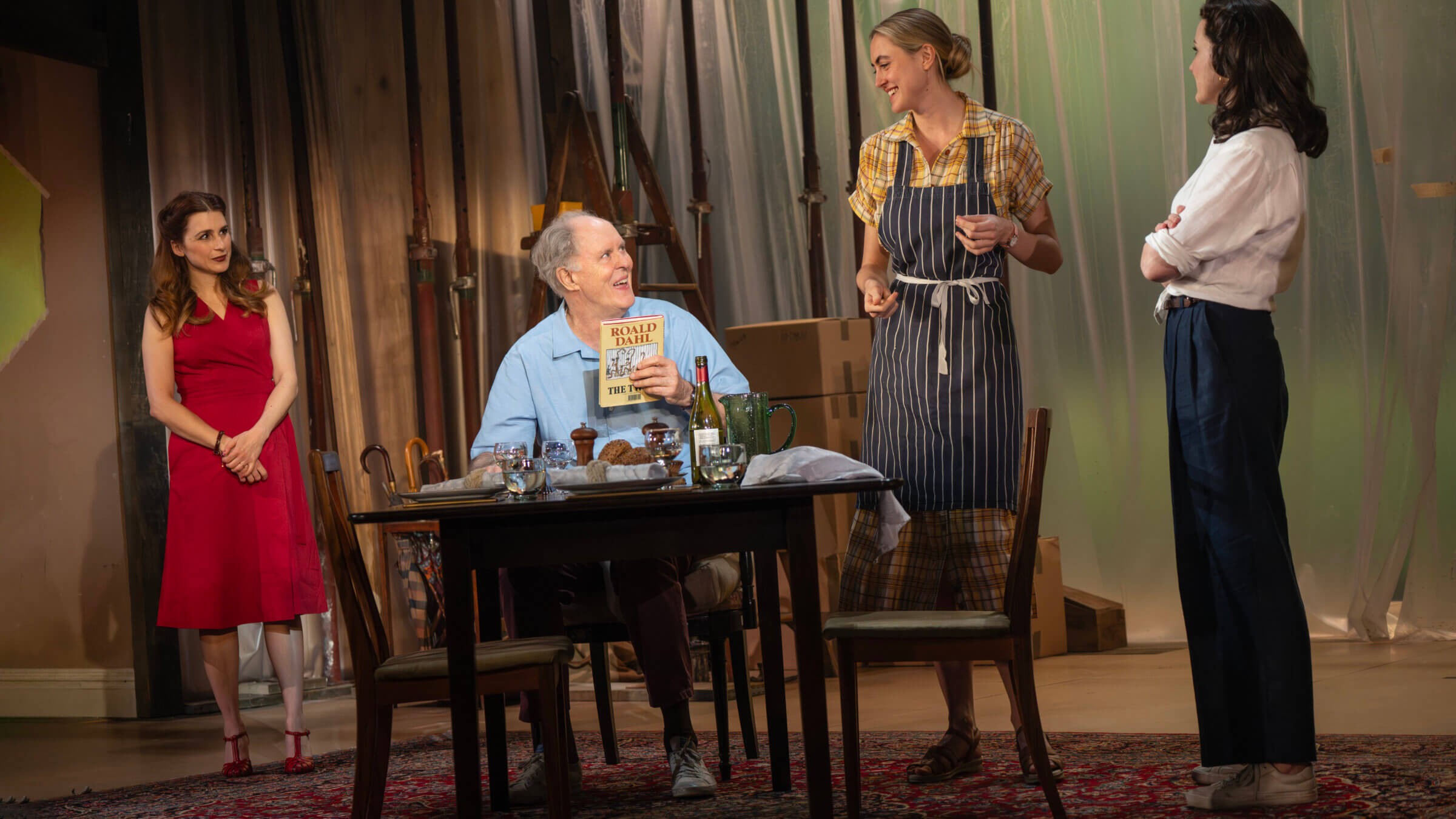
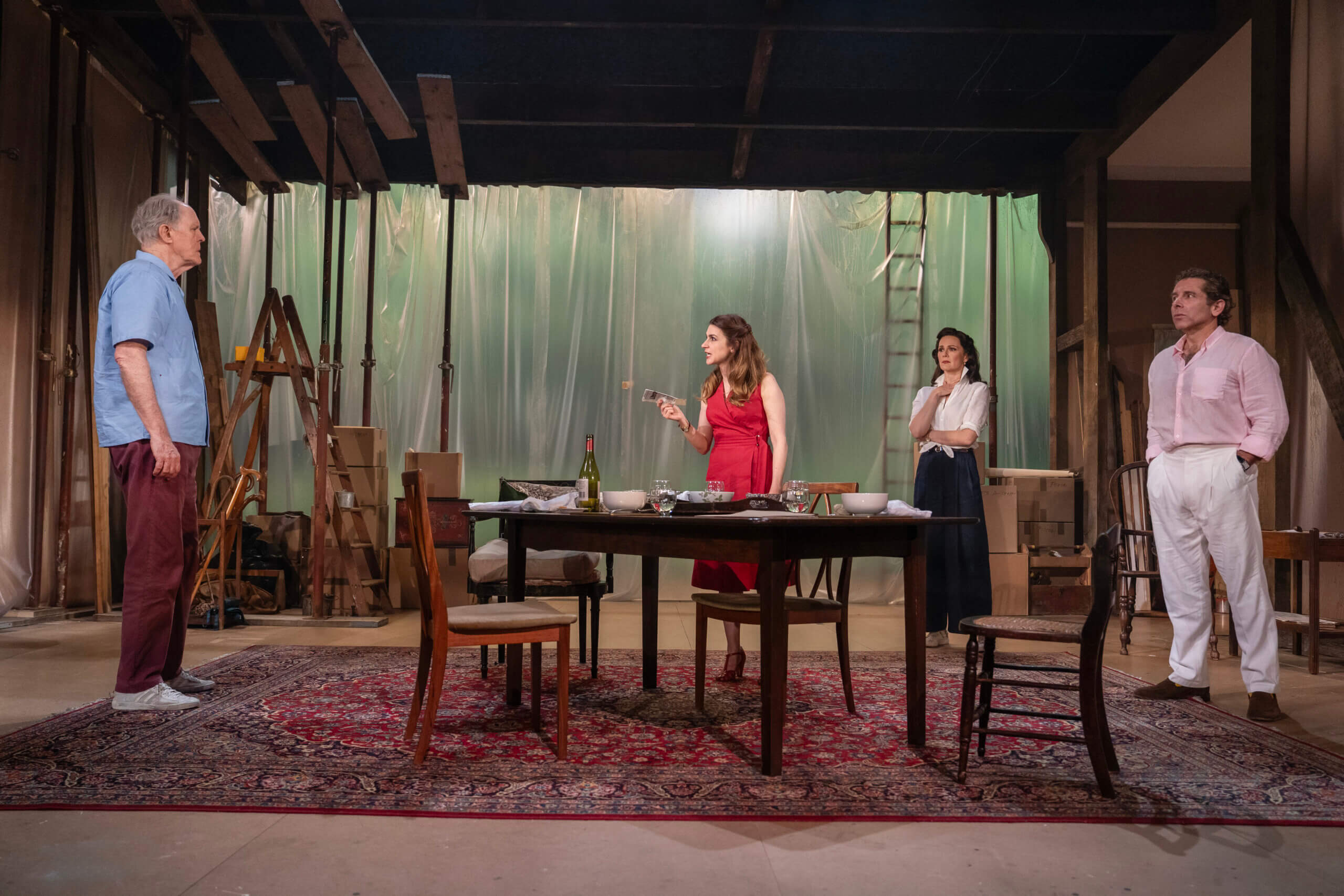
Aya Cash, John Lithgow, Stella Everett, Rachael Stirling in Mark Rosenblatt’s Giant. Photo by Joan Marcus
By PJ Grisar March 23, 2026
Roald Dahl’s house is falling down.
It’s 1983, and the children’s author’s Buckinghamshire estate is undergoing a gut renovation. Its exposed plumbing and naked beams bespeak an unseemly core behind the author’s facade of prickly charm, cracking after publication of his incendiary review of the book God Cried, about the 1982 Lebanon War. The article, which ran in the magazine Literary Review, crossed a then-clear line from legitimate critique of Israel into antisemitic tropes of the most noxious variety.
The play Giant, now on Broadway after an Olivier Award-winning run on the West End, imagines an afternoon in which Dahl’s publishers try to cajole him into an apology he’s determined not to make.
For the greater part of the first act in Mark Rosenblatt’s crackling script, the precise nature of Dahl’s comments remains obscure. We’re told that they were condemned in the press as “the most disgraceful thing to be written in the English language in a very long time.” They were so bad as to inspire a death threat credible enough to station a police constable outside Dahl’s home.
Finally, a Jewish-American sales director from Farrar, Straus and Giroux, who has arrived to do damage control, quotes Dahl’s remarks at length following a tense lunch of salad niçoise.
“Never before in the history of man has a race of people switched so rapidly from being much-pitied victims to barbarous murderers,” Dahl wrote of Israelis — or was it simply Jews? “Never before has a race of people generated so much sympathy around the world and then, in the space of a lifetime, succeeded in turning that sympathy into hatred and revulsion. It is as though a group of much-loved nuns in charge of an orphanage had suddenly turned around and started murdering all the children.”
Is it bad to say I’ve heard worse?
Were Dahl still with us, he would have an ideological home with certain members of Corbynite Labour and the Greens, to say nothing of Roger Waters. He would not run afoul of the “Zionists in Publishing” X account that tells consumers which authors are insufficiently critical of Israel; perhaps he would be marked on reading lists as an acceptable, pro-Palestinian alternative to J.K. Rowling.
Even the context of war in Lebanon that Dahl decried has currency, as Israel now trades fire with the remnants of Hezbollah and videos of demolished apartment blocks in Beirut proliferate online. More than 1,000 have died in airstrikes, more than 1 million are displaced and a possible ground invasion looms. (The play, written well before Oct. 7, and certainly before the latest offensive in Iran, suffers from a poignant prescience.)
Can a drama built around Dahl’s screed still work with the shift of the Overton window toward a strident, existential questioning of Israel and its influence? Remarkably, it does.
The credit is shared. John Lithgow, playing his whole repertoire from Churchill and avuncular alien to Dexter’s Trinity Killer, is a rangy stick of dynamite as Dahl. He pivots from boyish jokes to cruel barbs that catch on his victims like nettles.
Also in the cagey chess game are Aya Cash — as the invented American FSG envoy Jessie Stone — and Elliot Levey’s Tom Maschler, Dahl’s real-life British publisher, a child refugee from Nazi Germany.
Maschler embodies a certain Jewish-English self-effacement, angling to keep the peace and resenting Israel as an impediment to his full acceptance as an Englishman — he thinks of the country as something he’s made to defend at parties.
Stone’s more forceful, American approach — calling out Dahl for lumping all Jews together as a “single organism” — rankles her host.
Dahl waxes Goebellsian, calling her “Stein,” and has her take dictation to a Holocaust survivor bookseller in the Hudson Valley who refuses to stock his work: “The kinder of his shtetl in upstate Noo Yoik will have to make do — no, survive on a strictly kosher diet of Laura Ingalls Wilder.”
Director Nicholas Hytner has staged a boxing match for today’s discourse, without changing a line from a pre-Oct. 7 script. What makes the work sing is its refusal to resort to caricature, humanizing Dahl through his fiancée Liccy Crossland (Rachael Stirling), the tragedies of his dead daughter and disabled son and, yes, his genuine concern and justified anguish for the Lebanese and Palestinians, particularly the children.
In a quieter moment, Dahl asks Stone if she read God Cried. She tells him she was moved by an image of a legless boy with crutches. (Dahl identifies him with ease, the victim of a penetration bomb near his school, and describes in typically gruesome fashion how “his arterial blood must have sprayed everywhere like a rogue garden hose.”)
“Why is that image not enough, on its own, for you to demand a halt?” he presses Stone. “And what’s wrong with insisting Jewish people, whose country it surely is, say ‘not in my name’? Surely it’s your voice we need above all?”
This cri de coeur is common now even in Jewish circles, but the sentiment is slippery when it hints at collective blame. After his encounter with Stone, Dahl clarifies his position in a verbatim interview, infamously opining that, when it comes to Jews, “even a stinker like Hitler didn’t just pick on them for no reason.”
That draws a gasp from the audience and a gobsmacked expression from Dahl’s housekeeper, Hallie (Stella Everett).
But just how different is this claim to Ana Kasparian saying the goyim are waking up, Candace Owens claiming Satanic pedophile “Frankists” control the world, Young Republicans praising Hitler in group chats, Tucker Carlson platforming Holocaust deniers who suggest Winston Churchill was the real villain of World War II, or Joe Kent writing in his resignation letter that the U.S. is continually drawn into wars “manufactured by Israel”? At a point, the fig leaf of anti-Zionism proves flimsy. Older innuendos peek out from behind.
In the literary world of today, an audiobook narrator’s call for Zionists to kill themselves is not a cancellable offense — a Zionist moderating a book talk is. (But then, being a Palestinian critic of Israel can lead to a disinvitation to a book festival or reading series — that may be cancelled when other authors withdraw in solidarity.)
Now that we are further from the Holocaust, the carnage in Gaza was broadcast to our phones and the monoculture has atomized into internet echo chambers, Dahl’s review seems pedestrian if not quite mainstream. A cause célèbre in 1983 is now a viral retweet or a chart-topping podcast. His claim that “ancient wounds” didn’t make Jews wiser but rather gave them a “partial sight” of their own trespasses sounds a lot like the thesis of Peter Beinart’s last book.
With Giant’s move to Broadway, a local analogy may be in order.
Earlier this month, New York Mayor Zohran Mamdani’s wife, Rama Duwaji, was revealed to have contributed freelance illustrations to a book of stories by young people in Gaza compiled by the Palestinian American writer Susan Abulhawa. Abulhawa’s social media posts, which called Israelis “vampires” and “cockroaches” and refused to distinguish between Jews and Zionists, prompted Mamdani to call her words “reprehensible,” earning him grief from pro-Palestinian quarters.
What would the response be, had the first lady of New York provided artwork on a book of Dahl’s and his comments came to light? Abulhawa cuts a different figure: She is the daughter of Palestinian refugees and writes movingly of her people’s suffering. Yet I suspect, like her, Dahl, would have his defenders.
Just as Dahl doubled down when reached for comment on his review — the occasion of his “Hitler stinker” quote — Abulhawa responded to Mamdani’s censure in an interview by claiming American Jews were the “most privileged demographic in this country” and “the resentment that they are seeing now is stemming from the world watching the so-called Jewish state commit a genocide.”
In other words, the logic follows, the world isn’t picking on Jews for no reason. The sleeping giant of this rationale — a proverbial light sleeper — has been awakened. Dahl, it seems, was just too early to rouse it.
The play Giant is now playing at the Music Box Theatre on Broadway.
This is a moment of great uncertainty. Here’s what you can do about it.
We hope you appreciated this article. Before you go, we’d like to ask you to please support the Forward’s independent Jewish news. All donations are still being matched by the Forward Board - up to $100,000 until April 24.
This is a moment of great uncertainty for the news media, for the Jewish people, and for our sacred democracy. It is a time of confusion and declining trust in public institutions. An era in which we need humans to report facts, conduct investigations that hold power to account, tell stories that matter and share honest discourse on all that divides us.
With no paywall or subscriptions, the Forward is entirely supported by readers like you. Every dollar you give is invested in the future of the Forward — and telling the American Jewish story fully and fairly.
The Forward doesn’t rely on funding from institutions like governments or your local Jewish federation. There are thousands of readers like you who give us $18 or $36 or $100 each month or year.

Support our mission to tell the Jewish story fully and fairly.