Defiant After Attack, Denmark’s Jews Vow To Stay

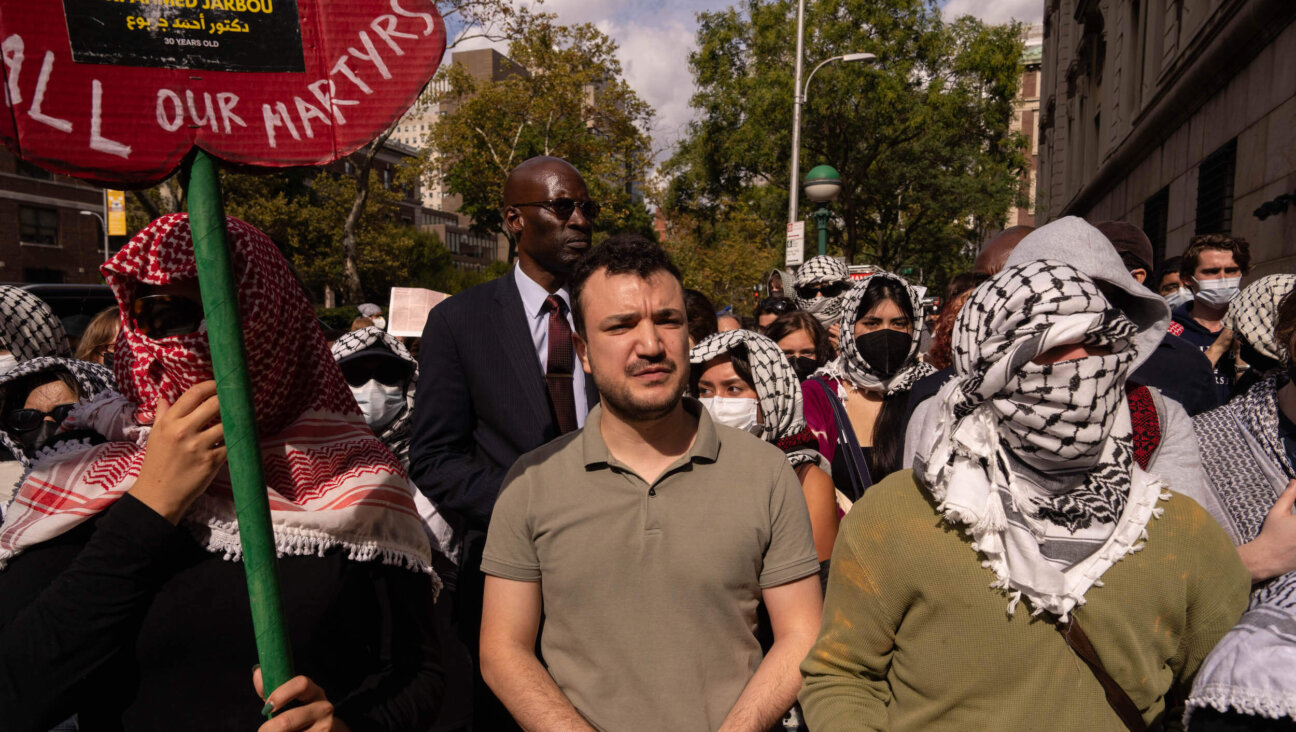
United in Grief: A protester holds a newspaper reading in Danish ‘I am Charlie. I am a police officer. I am Jewish. I am Danish’ during a demonstration. Image by Getty Images
(Reuters) — Denmark’s small but vibrant Jewish community rebuffed Israel’s call to emigrate on Sunday after an attack on Copenhagen’s main synagogue that shook the sense of security Scandinavian tolerance had long provided.
Jewish communities around Europe have been reporting rising hostility against them and an attack last month on a Paris kosher supermarket killed four Jews, prompting the United Nations to say that anti-Semitism was thriving in Europe.
That assault came two days after Islamist militants gunned down 12 people at the weekly Charlie Hebdo, which had published cartoons mocking the Prophet Mohammad.
As in the French case, Israeli Prime Minister Benjamin Netanyahu told Denmark’s 2,500 Jews they would be welcome in his country. “Israel is your home,” he said in Jerusalem.
“We appreciate the invitation, but we are Danish citizens, this is our country,” Dan Rosenberg Asmussen, chairman of the Jewish Society in Denmark, told Reuters as he offered condolences to mourners at the synagogue.
The Copenhagen shootings began with an assault on a meeting with an artist who had caricatured Mohammad, and then an attack on the city’s main synagogue where about 80 Jews celebrated a girl’s confirmation. One person was killed at each site.
Danish police have not identified the gunman, who was killed in a shootout on Sunday, but said the attacks may have been inspired by the violence in Paris.
“I feel just as safe on the streets today as I did the day before yesterday,” said Jewish community member Bent Bograd as he laid flowers at the synagogue. “We can’t do anything about it, and it’s a risk that exists.”
Denmark has welcomed Jews for centuries and most of the community survived the Holocaust, despite Nazi occupation, as Danes helped them flee to safety in neighboring Sweden.
Only a fraction of the community returned but it enjoyed a long period of tranquility. But tensions rose last year during Israel’s war with Hamas militants in Gaza. Copenhagen’s 210-year-old Jewish school was vandalized in August when its windows were broken and walls covered with anti-Semitic graffiti.
Yair Melchior, Copenhagen’s chief rabbi, flatly rejected the idea that Jews should leave Denmark.
“The terrorists must not control our lives,” Melchior told Reuters. “We need to concentrate on living our lives as normally as possible after this difficult situation. The Jewish community in Copenhagen is strong.”
This is a moment of great uncertainty. Here’s what you can do about it.
We hope you appreciated this article. Before you go, we’d like to ask you to please support the Forward’s independent Jewish news this Passover. All donations are being matched by the Forward Board - up to $100,000.
This is a moment of great uncertainty for the news media, for the Jewish people, and for our sacred democracy. It is a time of confusion and declining trust in public institutions. An era in which we need humans to report facts, conduct investigations that hold power to account, tell stories that matter and share honest discourse on all that divides us.
With no paywall or subscriptions, the Forward is entirely supported by readers like you. Every dollar you give this Passover is invested in the future of the Forward — and telling the American Jewish story fully and fairly.
The Forward doesn’t rely on funding from institutions like governments or your local Jewish federation. There are thousands of readers like you who give us $18 or $36 or $100 each month or year.

Support our mission to tell the Jewish story fully and fairly.