Jewish fans slam the trailer for Netflix’s Leonard Bernstein biopic ‘Maestro,’ which shows Bradley Cooper with an elongated nose
‘This isn’t about making a non-Jewish actor look more like Leonard Bernstein; it’s about making a non-Jewish actor look more like a Jewish stereotype,’ one critic tweeted
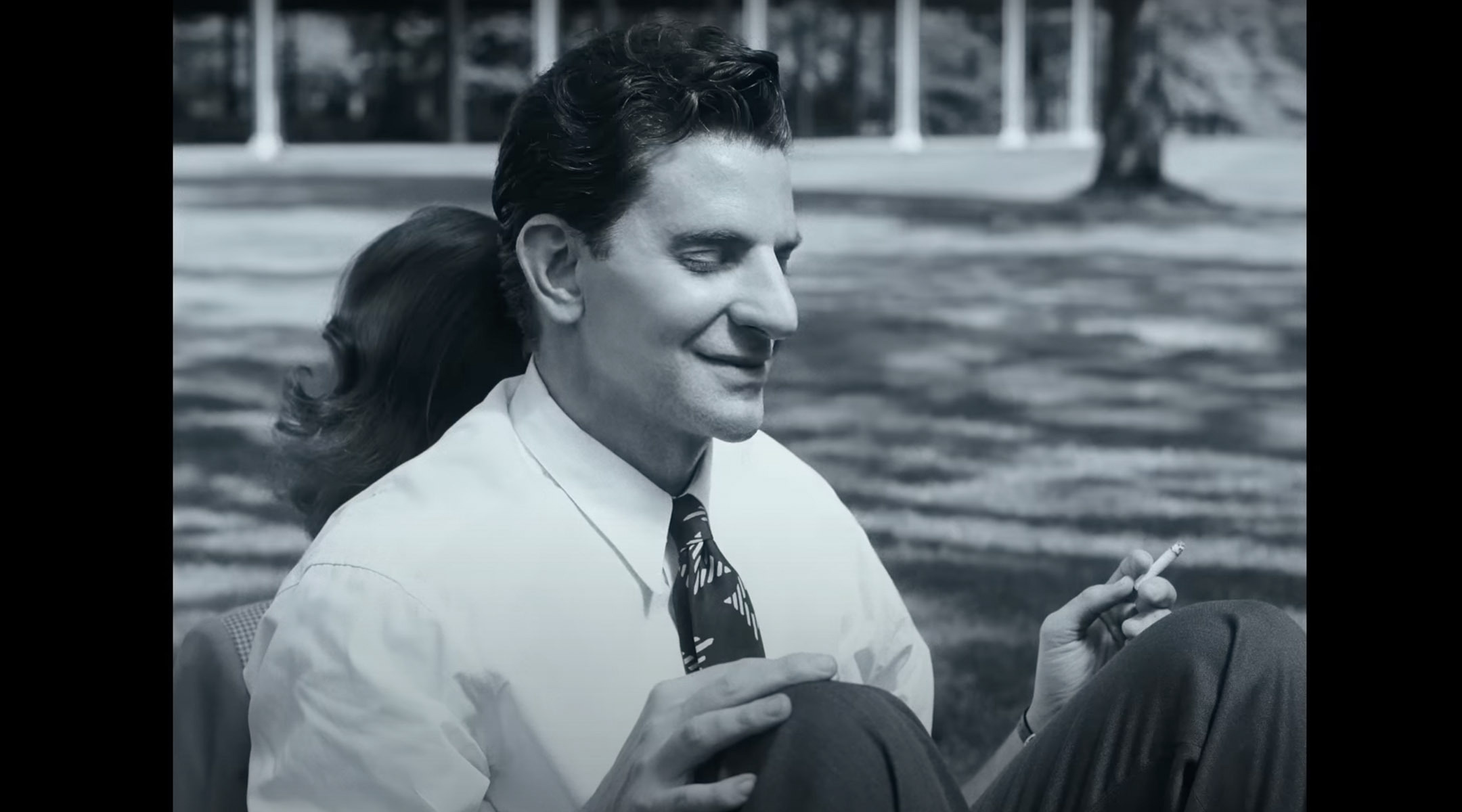
Bradley Cooper is shown as Leonard Bernstein in the trailer for Netflix’s “Maestro.” (Screenshot from YouTube)
(JTA) — Soon after Netflix dropped the first official trailer for its upcoming Leonard Bernstein biopic “Maestro” on Tuesday, one aspect of the film footage sparked a flurry of conversation online — and it wasn’t the preeminent Jewish conductor’s music, or star Bradley Cooper’s acting.
Instead, the prosthetic nose supposedly used by the Oscar-nominated Cooper, who is not Jewish — and co-wrote, directed and stars as Bernstein in the film — infuriated many Jews who argued that the appendage plays into stereotypes about Jewish facial features.
Joel Swanson, a Jewish history PhD student at the University of Chicago, shared side-by-side images of Cooper’s character and the composer, writing: “This isn’t about making a non-Jewish actor look more like Leonard Bernstein; it’s about making a non-Jewish actor look more like a Jewish stereotype.”
Left: Bradley Cooper with his prosthetic nose, playing Leonard Bernstein.
— Joel S. (@jh_swanson) August 15, 2023
Right: The actual Leonard Bernstein.
This isn't about making a non-Jewish actor look more like Leonard Bernstein; it's about making a non-Jewish actor look more like a Jewish stereotype. https://t.co/WrYWuweosW pic.twitter.com/WxspPtHktj
Some went so far as to call Cooper’s use of a prosthetic antisemitic.
just looked up a picture of the real leonard bernstein…. the big antisemitic prosthetic nose on bradley cooper was definitely not necessary…. pic.twitter.com/nrCgxi9jlL
— louisa (@stabfreeman) August 15, 2023
Daniel Sugarman, the director of public affairs for the Board of Deputies of British Jews, pointed out that Cooper had previously starred in “The Elephant Man” on Broadway, a play about a man with serious physical deformities. Cooper did not use prosthetics for that role.
As has been noted in a number of places, Bradley Cooper literally played *The Elephant Man* on stage without any prosthetics. The decision here to slap on a big nose to play a Jewish composer therefore seems…even more suspect. https://t.co/gUfrLEemKR
— Daniel Sugarman is on holiday (@Daniel_Sugarman) August 15, 2023
The controversy is the latest episode in a now years-long conversation about “Jewface,” a term used to describe non-Jewish actors playing Jewish characters on screen. Comedian Sarah Silverman popularized the term and has been a vocal critic of the trend, which angered some Jewish fans when Felicity Jones portrayed Ruth Bader Ginsburg in the 2018 film “On the Basis of Sex” and when a planned Joan Rivers project that was set to star Kathryn Hahn was scrapped.
“There’s this long tradition of non-Jews playing Jews, and not just playing people who happen to be Jewish, but people whose Jewishness is their whole being,” Silverman said on her podcast in 2021. She plays Bernstein’s sister in the film.
Silverman is not the only Jewish actor in “Maestro.” Miriam Shor, who has described herself as “half Jewish but not really religious,” plays actor Cynthia O’Neal. Alexa Swinton, who stars on HBO’s “And Just Like That…” — and who celebrated her bat mitzvah in Israel earlier this summer — plays Bernstein’s daughter Nina. And Jewish actor Gideon Glick, known for his work on Broadway and on “The Marvelous Mrs. Maisel,” plays musician Tommy Cothran.
The family of Leonard Bernstein released a statement defending Cooper’s portrayal. “Bradley chose to use makeup to amplify his resemblance, and we’re perfectly fine with that,” the family said. “We’re also certain that our dad would have been fine with it as well.”
The family of Leonard Bernstein have released a statement defending Bradley Cooper following online backlash about his appearance in ‘MAESTRO’.
— Film Updates (@FilmUpdates) August 16, 2023
“Bradley chose to use makeup to amplify his resemblance, and we’re perfectly fine with that. We’re also certain that our dad would have… pic.twitter.com/6DRlYsi20C
Following the release of the “Maestro” trailer, some also resurfaced the backstory to the film itself, which Jewish actor Jake Gyllenhaal had wanted to star in.
In a 2021 interview with Deadline, Gyllenhaal highlighted Bernstein’s Jewishness as a key factor for his interest in the project, which Steven Spielberg, who was originally to direct, eventually handed over to Cooper.
“Sticking your neck out, hoping to get to tell the stories you love and that have been in your heart for a very long time is something to be proud of,” Gyllenhaal said. “And that story, that idea of playing one of the most preeminent Jewish artists in America and his struggle with his identity was in my heart for 20 some odd years, but sometimes those things don’t work out.”
“Maestro” will premiere at the Venice Film Festival in September, followed by a limited theatrical release on Nov. 22 before it lands on Netflix on Dec. 20.
This article originally appeared on JTA.org.
This is a moment of great uncertainty. Here’s what you can do about it.
We hope you appreciated this article. Before you go, we’d like to ask you to please support the Forward’s independent Jewish news this Passover.
This is a moment of great uncertainty for the news media, for the Jewish people, and for our sacred democracy. It is a time of confusion and declining trust in public institutions. An era in which we need humans to report facts, conduct investigations that hold power to account, tell stories that matter and share honest discourse on all that divides us.
With no paywall or subscriptions, the Forward is entirely supported by readers like you. Every dollar you give this Passover is invested in the future of the Forward — and telling the American Jewish story fully and fairly.
The Forward doesn’t rely on funding from institutions like governments or your local Jewish federation. There are thousands of readers like you who give us $18 or $36 or $100 each month or year.
Support our mission to tell the Jewish story fully and fairly.