Meta’s Oversight Board urges improved distinction between hate speech and criticism of hate speech
The exhortation comes after Instagram took down a post condemning Ye’s antisemitism because it repeated his comments
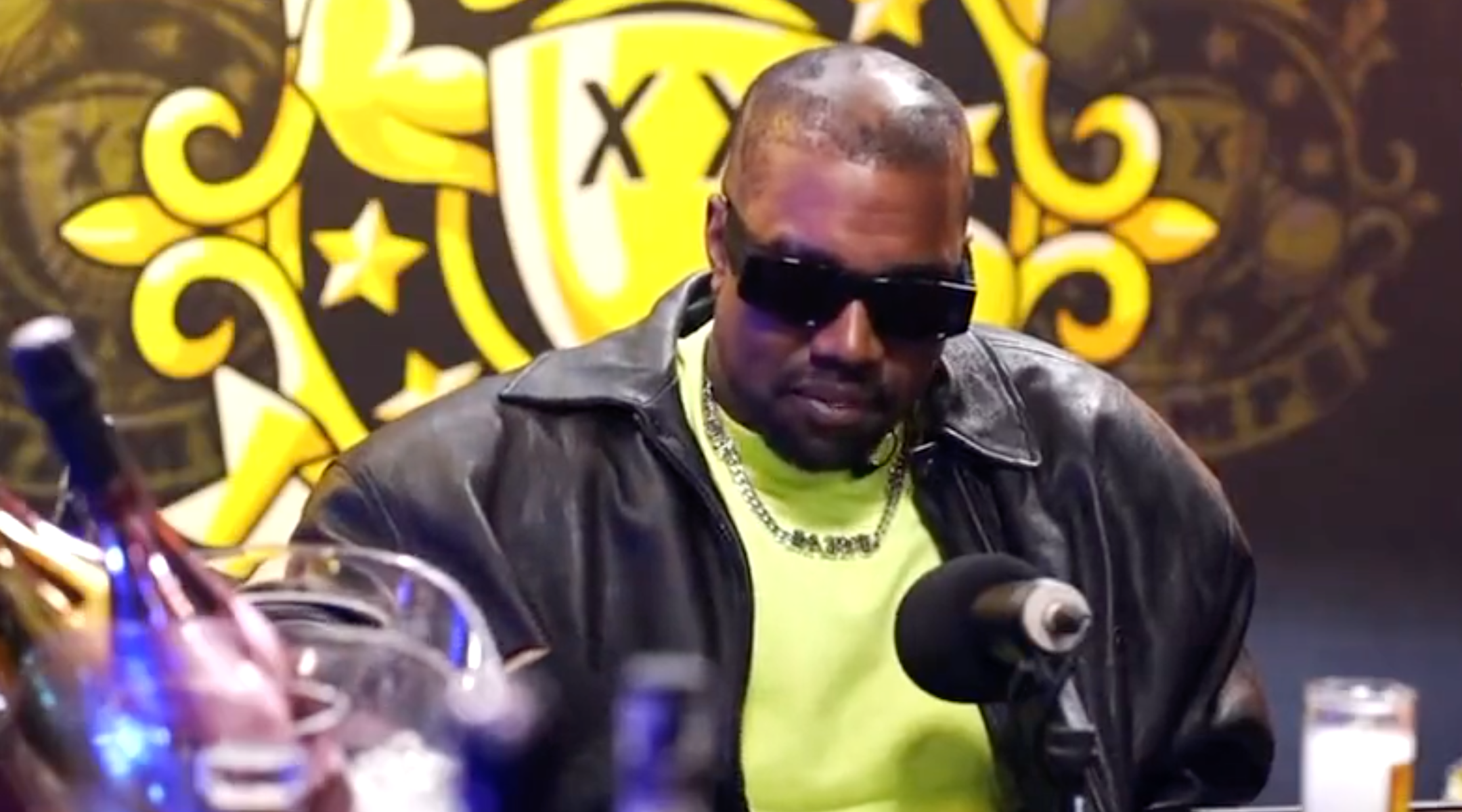
Kanye West on the “Drink Champs” podcast, Nov. 5, 2021. (Screen shot)

By Asaf Elia-Shalev September 13, 2023
(JTA) – In January, a Turkish Instagram user posted part of an interview with Ye, the artist formerly known as Kanye West, making statements in praise of Hitler and denying the Holocaust as well — and swiftly had the post removed from the social media platform.
But that wasn’t a success story for Meta’s efforts to keep hate speech off Instagram, the company’s Oversight Board has ruled. That’s because the Ye interview was accompanied by a reaction video of a reporter condemning his comments and sharing a family link to Holocaust victims.
Meta’s hate-speech detection system failed to grasp that the user was criticizing Ye, not endorsing him. So the company removed the post, accusing the user of violating its hate speech policies.
Now, the Oversight Board, an independent body tasked with reviewing Meta’s content moderation decisions, says the owner of Facebook and Instagram should improve its efforts to distinguish posts that promulgate hate from ones that aim to combat it. Too often, the board explained in a summary of its decision, human and automated moderators flag posts that are meant to educate against hate and antisemitism.
“Such mistakes can suppress speech meant to respond to hate speech, including Holocaust denial, or condemn statements of praise for dangerous individuals such as Hitler,” the summary said. “Protecting counter-speech is essential for advancing freedom of expression and a tool for combating harmful content such as misinformation and hate speech.”
Meta’s Oversight Board said Meta disregarded the context within which the user presented Ye’s comments and erroneously removed the post under policies barring Holocaust denial and praise of figures such as Hitler. The user appealed the removal to no avail, but when the Oversight Board brought the matter to Meta’s attention, the company acknowledged the error and restored the post.
The Oversight Board decided to examine the case despite the correction because it considers the underlying issue important, it said in a summary of its reasoning.
The board reiterated recommendations made in previous cases that Meta check how often its content moderators and algorithms incorrectly remove posts meant to educate about or counter hate speech. The accidental censoring of educational content has plagued the company for years, spiking, for example, when Meta banned Holocaust denial in 2020.
It is not the first time the Oversight Board, set up in 2020 amid allegations that Meta’s platforms help the spread of misinformation and extremism, has taken up a case involving antisemitism. Of the nearly 50 cases that have passed through its docket, at least four have touched upon Holocaust denial or Nazi-related content.
The most recent case came last month when the board announced it would examine Meta’s handling of a post distorting the Holocaust. In earlier cases, the board overturned Meta’s removal of a post featuring a quote incorrectly attributed to Nazi propagandist Joseph Goebbels and a post comparing the Russian military to Nazis.
This article originally appeared on JTA.org.
This is a moment of great uncertainty. Here’s what you can do about it.
We hope you appreciated this article. Before you go, we’d like to ask you to please support the Forward’s independent Jewish news this Passover. All donations are being matched by the Forward Board - up to $100,000.
This is a moment of great uncertainty for the news media, for the Jewish people, and for our sacred democracy. It is a time of confusion and declining trust in public institutions. An era in which we need humans to report facts, conduct investigations that hold power to account, tell stories that matter and share honest discourse on all that divides us.
With no paywall or subscriptions, the Forward is entirely supported by readers like you. Every dollar you give this Passover is invested in the future of the Forward — and telling the American Jewish story fully and fairly.
The Forward doesn’t rely on funding from institutions like governments or your local Jewish federation. There are thousands of readers like you who give us $18 or $36 or $100 each month or year.
Support our mission to tell the Jewish story fully and fairly.