Helen Nash, kosher cookbook author and NYC philanthropist, dies at 89
In her three cookbooks, Nash redefined modern kosher cooking by incorporating global flavors
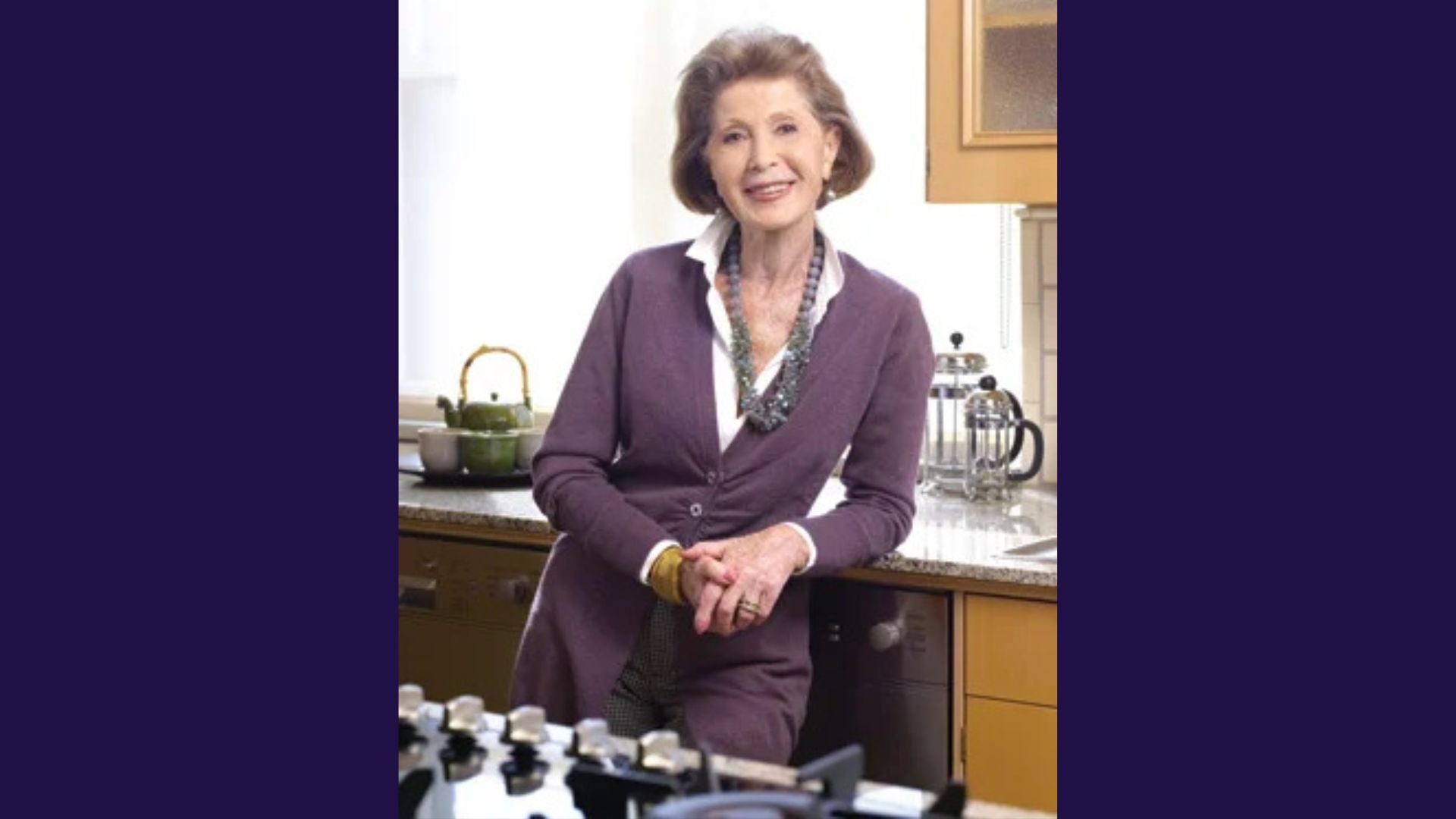
Kosher cookbook author and philanthropist Helen Nash died at 89. Courtesy of Kitchenwise by Helen Nash
(JTA) — Helen Nash, a New-York based kosher cookbook author and philanthropist who pioneered modern kosher cooking starting in the 1980s, died on Dec. 8 at the age of 89.
Her first cookbook “Kosher Cuisine,” was published in 1984 by Random House, and adapted a variety of international recipes for kosher cooks. Its publication, Nash told the Detroit Jewish News at the time, sought to prove that kosher cooking “could be as varied, elegant and exciting as one wished to make it.”
She went on to demonstrate that in two more cookbooks, demonstrating what one reviewer called “her ability to expand the kosher palate.”
“Keeping kosher is more, to me, than just a sensible way to live and to eat healthfully. The ancient Jewish dietary laws help to organize my life around family, Friday nights, and holidays,” wrote Nash in her 2012 book, “Helen Nash’s New Kosher Cuisine: Healthy, Simple, and Stylish.”
Nash was born Helen Englander in Krakow, Poland, on Dec. 24, 1935 where her family owned a textile business. With her parents and sister, Nash survived World War II with her family after they were deported to Siberia.
“There was no cooking in my childhood,” Nash told the Jewish Book Council in 2012. “When I was four and a half, my family was transported out of Krakow, and we spent the war in labor camps in Siberia. Food was nonexistent — no fruit, no vegetables. It was a ration diet of subsistence level.”
Following the war, Nash’s family reunited with her maternal grandparents in Williamsburg, Brooklyn, before settling in Crown Heights.
In 1957, she met and married her husband, Jack Nash, who was also a refugee from Berlin. Having grown up in an Orthodox family, Nash insisted that she keep a kosher kitchen.
“It was my interest,” Nash told New York Jewish Week in 2015. “Most women didn’t have careers outside the home, and I sort of carved a niche for myself, and the niche was entertaining in a certain style. Jack was very encouraging. And I met so many people I wouldn’t have met if I’d stayed in the religious mode.”
While her husband, who died in 2008, went on to serve as the chairman of the Oppenheimer & Company mutual fund business and founded the revival of The New York Sun, Nash charted her own path in the kitchen.
Following the birth of her children, Joshua and Pamela, Nash took classes with famed chefs including Michael Field and Millie Chan and worked on how to adapt their cuisines to a kosher palate.
Her second cookbook, “Helen Nash’s Kosher Kitchen,” published in 1988, also sought to break boundaries in kosher recipes. “’Kosher food is more than chopped liver and gefilte fish,” said Nash at the time.
“Helen Nash’s New Kosher Cuisine,” published following the death of her husband, also took kosher cooking to new heights, incorporating new global ingredients that had been made kosher since the publication of her earlier books.
Nash also chaired the Nash Family Foundation, which supported numerous Jewish organizations in New York City. She and her husband were also contributors to UJA-Federation of New York, Mount Sinai Medical Center, the Israel Museum, Shaare Zedek Medical Center and Yeshiva University.
Rabbi Menachem Creditor, a scholar in residence and rabbi for the UJA-Federation of New York, dedicated his Torah study on Youtube Wednesday to Nash.
“Helen Nash was many things, including a renowned author of recipe books and chef, she was a matriarch in her family,” said Creditor. “Her family foundation has changed the Jewish world for the better in countless ways, and I was blessed, privileged since the first moment I began at UJA almost eight years ago to learn Torah with Helen every single Wednesday for these last eight years.”
Nash is survived by her children and grandchildren. A funeral service for her was held on Dec. 9 at Congregation Kehilath Jeshurun, an Orthodox synagogue on the Upper East Side of Manhattan.
This is a moment of great uncertainty. Here’s what you can do about it.
We hope you appreciated this article. Before you go, we’d like to ask you to please support the Forward’s independent Jewish news. All donations are still being matched by the Forward Board - up to $100,000 until April 24.
This is a moment of great uncertainty for the news media, for the Jewish people, and for our sacred democracy. It is a time of confusion and declining trust in public institutions. An era in which we need humans to report facts, conduct investigations that hold power to account, tell stories that matter and share honest discourse on all that divides us.
With no paywall or subscriptions, the Forward is entirely supported by readers like you. Every dollar you give is invested in the future of the Forward — and telling the American Jewish story fully and fairly.
The Forward doesn’t rely on funding from institutions like governments or your local Jewish federation. There are thousands of readers like you who give us $18 or $36 or $100 each month or year.

Support our mission to tell the Jewish story fully and fairly.